Friday, 11 June 2021

Galaxies in Serpens Caput (and a Nova in Cassiopeia)

13-14 May 2021, 23:30 – 00:30 (BST)


Seeing: Average / Good
Transparency: Average

An unexpectedly clear night (for an hour at least), defying every forecast I’d looked at. Cool air, no wind (at ground level), light condensation on the telescope tube after a few minutes, but fortunately the lenses and mirrors stayed clear. Clouds low in the south, moving slowly north.

Anticipating that my observing time would be limited I stuck with just one eyepiece for the session: the 13mm Ethos at 92x.

M5, globular cluster, Serpens Caput
A beautiful sight with 5 Serpentis in the same field. Once again, V84 was at least as bright if not brighter than V42. Otherwise the cluster appeared much as it did on Tuesday night.

5 Serpentis was comfortably split at 92x. The companion star seemed a little brighter tonight; perhaps the transparency was better.

NGC 5921, galaxy, Serpens Caput
Small, faint fuzzy oval next to a y-shaped (or h-shaped, depending on your field orientation) pattern of field stars. Brighter towards the centre with averted vision.

NGC 5970, galaxy, Serpens Caput
Ghostly oval glow just south of a bright field star. Gradually brighter towards the centre with averted vision. Nice yellow-blue double star to the east (identified in NSOG as Otto Struve 300).

NGC 5962, galaxy, Serpens Caput
Round hazy glow with a bright core. Star-like nucleus with averted vision – seemed slightly offset to the east.

M13, globular cluster, Hercules
The 13mm Ethos doesn’t necessarily give the “best” view of globular clusters (in terms of resolving fine detail and pulling out the fainter stars), but it often gives the most beautiful, the Great Globular in Hercules being a prime example. When you see it in such a wide field that the field stop effectively disappears from view, it’s like being out there in space with it. And there’s always something new to see if you look carefully enough. For example, tonight I noticed two lines of stars running through M13 (parallel to the two 7th magnitude stars flanking the cluster). One running straight through the centre, and the other slightly offset to the southeast, adjacent to one of the arms of the propeller feature (adding to the contrast effect). 

By now the patchy clouds advancing from the south had covered nearly half the sky, pushing me farther north.

NGC 6015, galaxy, Draco
One of the galaxies I missed the other night. Appeared as an extended lenticular haze east of a field star. Brighter towards the centre with averted vision.

With the clouds pushing me still farther north, there was just time for a quick look at Nova Cassiopeiae 2021 (aka V1405 Cas), which has brightened dramatically in recent days. (See: https://skyandtelescope.org/astronomy-news/observing-news/nova-in-cassiopeia-brightens-suddenly/ )

I didn’t have a finder chart to hand so I had to identify it by comparing the field stars on my atlas to the ones visible in the finderscope. Fortunately it stood out really well at around magnitude 5.5. The Ethos showed it in the same field as rich open cluster M52. A very nice appetiser as I wait for my elusive first supernova.

At this point it seemed like the patchy clouds might leave some clear sky behind them, but then the wind abruptly reversed direction and an even thicker bank of cloud rolled across from the north, putting an end to the session.

Wednesday, 2 June 2021

Globular Clusters in Hercules and Galaxies in Draco

11-12 May 2021, 22:45 – 01:15 (BST)


Seeing: Average
Transparency: Average

A breezy night with occasional gusts. Some high cirrus cloud early on; this blew away and the sky remained clear until about 1 AM. It had been a warm day, so the temperature was relatively mild at the start of the session, but it soon fell away and became quite chilly by the end. No condensation though.

Satellites and space junk everywhere I looked (including through the eyepiece). More planes than last year too.

At this time of year I always find myself drawn irresistibly towards globular clusters (no matter how many times I’ve seen them before) so I began the session with a tour of some of the season’s best.

M5, globular cluster, Serpens Caput
133x and 171x. As per previous observations: lovely, well resolved cluster with a bright, condensed core. Its stars seemed to have a considerable spread of magnitudes, with the most prominent member lying just southeast of the core. Another slightly less bright star is offset to the SW, forming a tight triangle with two other fainter stars. Reading up on M5 the next day I learned that both of these bright stars are variables: V84 (an RV Tauri star) and V42 (a Cepheid) respectively.

Another distinctive feature was a chain of stars curling around the NE side of the cluster, like a spiral arm. Not a great deal of difference between the two magnifications, but the stars did seem to “pop out” more at 171x. No colour to the cluster (or its individual stars) that I could perceive on this occasion.

While at 171x I also had a look at the nearby double star 5 Serpentis, comprised of a bright white primary and a dim secondary roughly NE. The secondary seemed to have a pale violet/indigo(?) hue, but it was very subtle and mostly likely caused by a contrast effect with the primary.

M13, globular cluster, Hercules
171x. Tonight M13 looked like a sprawling sea monster compared to M5. No individual stars stood out from the crowd, but there was good resolution across the face of the cluster. It took me a few minutes to “get my eye in” before I could spot the Y-shaped propeller feature, but once I did it was quite obvious. Nearby galaxy NGC 6207 (with its false nucleus) also showed well at 171x.

NGC 6229, globular cluster, Hercules
171x. Small and ghostly compared to M13. With averted vision the cluster swelled in size, and the core glowed with a soft intensity. After a few minutes of observing the cluster started to look a little mottled around the centre and grainy on its outskirts, but no stars were resolved other than a very faint star trailing to the east, of which I had only fleeting glimpses. (Most likely a foreground Milky Way star.)

M92, globular cluster, Hercules
171x. A bright, underrated globular with a very condensed core. Lots of stars resolved at 171x, but the oval shape noted previously starts to break up, although the area around the core still appears somewhat elongated. Other distinctive features include two straggly arms of stars roughly trailing to the north and south, and another tighter one folding back on itself east of the core.

NGC 6543, Cat’s Eye Nebula, Draco
171x and 133x. Another late spring/summer favourite. Impression much the same as last year: vivid, pale green ellipse – slightly misshapen. The central 11th magnitude star wavered in and out of view using direct vision, sometimes holding steady for several seconds at a time depending on the seeing. The view at 133x was similar, but the green colour was more intense.

NGC 6503, galaxy, Draco
133x. (The one that Herschel missed.) As per previous observations. Extended ellipse; not much brightening towards the centre, other than a vague impression of mottling/clumpiness.

NGC 6340, galaxy, Draco
133x. Round fuzz (fainter than 6503), roughly east of a double star. Star-like nucleus with averted vision.

NGC 6643, galaxy, Draco
133x. Faint streak of light east of and parallel to two field stars. A little brighter towards the centre with averted vision. This one looked like a ghost of NGC 6503.

While in the area I noticed a very distinctive W-shaped asterism in the finder, near 44 Draconis and later identified as Kemble 2. The eyepiece view revealed a few more stars in addition to the core five, but the best view was through the 9x50 finder.

Psi Draconis, double star, Draco
133x. One I’ve been meaning to revisit for a while (I always get distracted by the Cat’s Eye Nebula). A really lovely, bright double – at 30 arcseconds, wide enough to split (barely) in the 9x50 finder. In the main scope it appeared as a pale yellow-white primary with a pale blue-white secondary.

I couldn’t find galaxies NGC 6412 or NGC 6140 for some reason, though I suspect some high hazy cloud was starting to interfere with the transparency. With more clouds gathering low in the southwest (and a fox barking very loudly from the same direction), I decided to round off the session with another old favourite at a very high magnification.

M57, Ring Nebula, Lyra
428x (7mm DeLite + 2.5x Powermate). At this magnification the target crosses the field of view so quickly you need to get the scope ahead of it to give yourself time to have a decent look. The inner part of the ring looked a little ragged at this power, but unsurprisingly there was no sign of the central star, not even a hint of a glint. I think I’d need an equatorial platform (and near-perfect conditions) to stand even a chance of picking it out from the gauzy central region.

As the bright clouds pushed across the sky there was just time for a quick return visit to M13 at the same power. The sheer volume of stars was a little too much to take in during the short time available; at this magnification it looked less like a sea monster and more like a hanging basket brimming over with bright and unruly flowers; the entire field of view clotted with ancient starlight.

Sunday, 30 May 2021

Moonshots

22 April 2021, 19:30 – 21:10 (BST)


This evening the sky was dominated by a bright gibbous moon high up in Leo. The phase was very similar to that described on 23 March, but this time the seeing was even better. I took the opportunity to capture some images, followed by some observing.

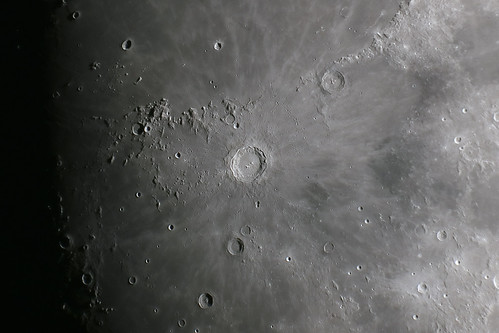
Magnifications used: 171x (DeLite 7mm) and 240x (Nagler 5mm). As the Powermate was still attached to my camera, I used the Orion 2x Shorty Barlow with the 5mm Nagler to also reach a magnification of 480x. Copernicus at that power has to be seen to be believed.

Copernicus

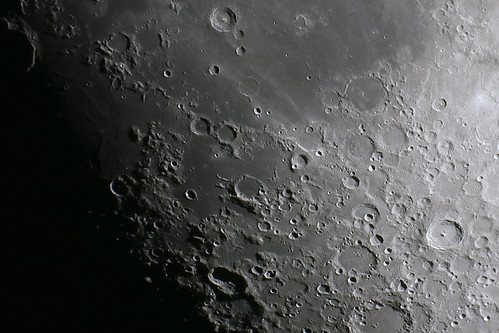
Highlights: In addition to all the incredible detail in and around Copernicus, I also resolved four craterlets in Plato. The northern pair are very close together, which I probably why I didn’t split them last time around. I had fleeting glimpses of the Alpine Valley Rille; it appears to be at its widest in (ironically) the narrowest part of the valley, and so can easily be lost in shadow if the illumination isn’t optimal. Hesiodius A was showing well again, as was another concentric crater, the tiny Marth, in nearby Palus Epidemiarum (below). This was a tough one; the interior of the crater was partly shadowed, and I could only see the inner ring intermittently at the highest magnification when the seeing was perfect.

Palus Epidemiarum

Nature note:
First swift of the year spotted some distance away to the south. (I needed binoculars to confirm it.)

Thursday, 20 May 2021

Galaxies in Leo Minor and Coma Berenices

​16 April 2021, 22:00 – 00:30 (BST)


Seeing: Good
Transparency: Average

Conditions: Chilly, but not quite as bitter as recent nights. Breezy again, but frequency of gusts declined over the course of the session. A few small patchy clouds passing over.

With a new lunar cycle already underway this is likely to be the last deep-sky session for a while. The eyepiece of choice was the 13mm Ethos at 92x.

NGC 3344, galaxy, Leo Minor
Revisiting an object I first saw in subpar conditions in March 2020. Large amorphous round haze; condensed core with averted vision. Two bright field stars superposed on the face of the galaxy in a line east of the core. This is probably the best of the galaxies in Leo Minor.

NGC 3414, galaxy, Leo Minor
Mottled round haze in a busy star-field (the galaxy is surrounded by several moderately bright stars). Bright core, but not star-like.

NGC 3486, galaxy, Leo Minor
Large round haze, gradually brighter towards the centre. The inner region seemed slightly clumpy with averted vision.

NGC 3504, galaxy, Leo Minor
Small oval galaxy, aligned NW-SE; seemed quite bright. Star-like nucleus with averted vision.

NGC 3245, galaxy, Leo Minor
Extended ellipse, aligned roughly N-S. Bright core with averted vision.

NGC 3277, galaxy, Leo Minor
Small, very faint haze east of NGC 3245 (there’s a bright double star about halfway between the two galaxies). Tough to spot; I saw the core (which shows a star-like nucleus with averted vision) before I saw the rest of the galaxy. 

NGC 4203, galaxy, Coma Berenices
Revisiting one from last year. Small round haze south of a bright 8th magnitude field star. Almost on the border with Canes Venatici. Bright core, stellar nucleus with averted vision.

NGC 3995, galaxy, Ursa Major
(Plotted in SA2000, not the PSA.) Very faint round haze, not helped by a bright 6th magnitude field star to the east hindering its visibility. Brighter towards the centre with averted vision.

At 23:10 I was distracted by some birds calling overhead and looked up to see a v-formation of what I assume were ducks or geese flying in an ENE direction, showing up quite pale against the night sky. The calls sounded higher in pitch than the honking I associate with species like greylags; white-fronted geese perhaps?

NGC 4062, galaxy, Ursa Major
Faint elliptical haze, aligned east-west, near the border with Coma Berenices. Not much in the way of detail other than a slight, very gradual brightening towards the centre.

NGC 4150, galaxy, Coma Berenices
Small oval haze; stellar core with averted vision. Faint field star SW, and a brighter one farther west. Another galaxy (NGC 4136) is plotted to the SW, but I couldn’t see it on this occasion.

NGC 4245, galaxy, Coma Berenices
Another round haze with a condensed core. Distinctive curved line of four 11th magnitude stars to the west.

NGC 4274, galaxy, Coma Berenices
Extended elliptical haze, east of NGC 4245. Aligned east-west. Brighter towards centre with averted vision.

NGC 4274 area in Coma Berenices (Stellarium)


NGC 4278 and NGC 4283, galaxies, Coma Berenices
Small pair of hazy elliptical galaxies separated by 3 or 4 arcminutes; south of NGC 4274 and in the same field (though only NGC 4278 is plotted in the PSA.) Both show star-like cores with averted vision, but the western member of the pair (NGC 4278) is clearly bigger, brighter and more intense than the other.

NGC 4314, galaxy, Coma Berenices
Faint streak of light NE of NGC 4274 (this is a busy part of the sky for galaxies!). Bright core with averted vision and a faint, approximately 13th magnitude star on the NW tip. (I had my hopes up for a supernova, but it is a foreground object.)

NGC 4251, galaxy, Coma Berenices
Bright little lens-shaped galaxy, aligned east-west. Star-like core with averted vision. 13th magnitude field star to east.

NGC 4448, galaxy, Coma Berenices
Oval haze half a degree NE of bright 4th magnitude Gamma Comae Berenices (occupies the same field in the 13mm Ethos). Brighter towards centre with averted vision.

At 00:10, while taking a break from the eyepiece, I saw a slow meteor pass between the bright stars of Lyra and Draco, heading towards the northern horizon.

With fatigue starting to set in I opted for one more galaxy in an under-explored (for me) part of the sky to round off the session.

NGC 6217, galaxy, Ursa Minor
Amorphous round haze, near a loose band of bright stars. Brightens smoothly towards the centre; has the “feel” of a spiral galaxy even if I can’t see the spiral.

Nature note:
As well as the flock of birds noted earlier, I heard a fox barking very loudly on the street and another flurry of late-night singing from the resident dunnock.

Friday, 14 May 2021

Return to the Coma Galaxy Cluster

​14 April 2021, 21:45 – 23:30 (BST)


Seeing: Average / Good
Transparency: Average

Chilly and windy (again). A few scattered clouds blowing south. The previous night’s attempt at astrophotography was blighted by polar alignment issues and a loose power cable. I did however manage to get a 120-second test shot of the Coma Galaxy Cluster, which showed a surprising amount of galaxies for a single unstacked image (see edited crop below). Bodes well for future imaging runs (if the wind ever drops again).

The galaxies near the centre of this image are over 300 million light years away.


Before diving into the galaxies I warmed up with a look at some double stars and a carbon star:

Izar (Epsilon Bootis)
Tight split at 171x. Pale yellow primary; blue-ish secondary NW. I say “blue-ish” because at times it looked vaguely purple (an impossible colour for a star).

Cor Caroli, Canes Venatici
171x. Brilliant bright double; wide separation. Icy white primary; pale yellow secondary.

Y Canum Venaticorum (La Superba), Canes Venatici
171x: Rusty red-hued star, though the colour is due to carbon, not iron.

NGC 3640, galaxy, Leo
171x. Follow up from previous session. As suspected, higher magnification made the difference. I could see a faint field star north of the galaxy, and a very faint, small fuzzy patch (NGC 3641) a similar distance to the south, only just visible with averted vision.

NGC 3705, galaxy, Leo
171x. Large oval haze. Star-like nucleus with averted vision, which also suggested mottling in the surrounding haze (possible s-spiral?). I missed this galaxy on Monday night and I’m not sure why, because it’s quite impressive – certainly not faint or inconspicuous.
 
NGC 4449 (Caldwell 21), galaxy, Canes Venatici
171x. Revisiting a favourite from the Caldwell list. Fascinating irregular galaxy, showing a lot of detail for a non-Messier object. Oblong haze with a bright bar running through it on a diagonal north-south axis. Averted vision showed a bright central spot on this bar flanked by two fainter ones. Averted vision also showed another spot or clump on the eastern corner (as noted in previous observations).

NGC 4889 (Caldwell 35), galaxy, Coma Berenices
171x. The powerhouse at the centre of the Coma Galaxy Cluster (see above). Faint but obvious, as was its slightly dimmer neighbour NGC 4874. Both galaxies appeared to swell in size with averted vision. As both the seeing and the transparency were relatively good I wanted to see if I could pick out any of NGC 4889’s companions (which I’m sure I’ve glimpsed on previous occasions). Once I got my eye in I could see a faint fuzzy spot (NGC 4886) just west of 4889, in line with the 7th magnitude “finder” star HD 112887. On the other side of 4889 and slightly south was a faint foreground star (no fuzziness), and then, a little farther east, another even fainter fuzzy spot (NGC 4898), forming a near right-angle triangle with two field stars to the south. All these galaxies were still visible when I dropped down to 133x, although it was a little more challenging with the comparatively bright HD 112887 in the field of view.

By now the clouds were getting larger, and reflecting a lot of light from the ground as they drifted southwest. With most of Coma Berenices obscured, I relocated to the constellation of Boötes.

NGC 5557, galaxy, Boötes
133x. Round blur; swelled with averted vision. Averted vision also showed a condensed, bright core with a star-like nucleus. Field star west, fainter one east.

SA 2000 plots a handful of other galaxies here, in addition to NGC 5557. I couldn’t see NGC 5529, but I did catch another one before the clouds got in the way.

NGC 5533, galaxy, Boötes
133x. Inconspicuous oval haze, fainter than NGC 5557. Gradually brighter towards the centre; star-like nucleus with averted vision.

The red light on my torch had been getting steadily dimmer throughout the session and now it was so dim I couldn’t see the star-charts or my notes, so it seemed like an appropriate point to call it a night. Though on the plus side, that dimness may well have helped me to see those faint galaxies in the Coma Cluster.