Showing posts with label nagler. Show all posts

Sunday, 30 May 2021

Moonshots

22 April 2021, 19:30 – 21:10 (BST)


This evening the sky was dominated by a bright gibbous moon high up in Leo. The phase was very similar to that described on 23 March, but this time the seeing was even better. I took the opportunity to capture some images, followed by some observing.

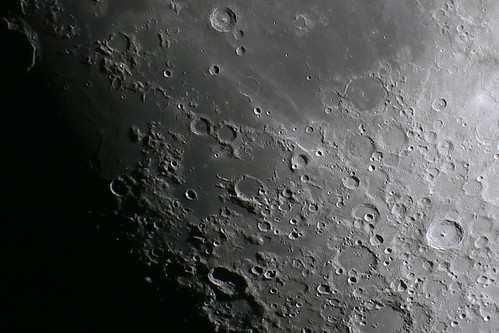
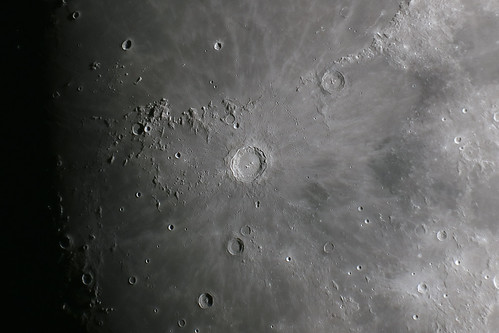
Magnifications used: 171x (DeLite 7mm) and 240x (Nagler 5mm). As the Powermate was still attached to my camera, I used the Orion 2x Shorty Barlow with the 5mm Nagler to also reach a magnification of 480x. Copernicus at that power has to be seen to be believed.

Copernicus

Highlights: In addition to all the incredible detail in and around Copernicus, I also resolved four craterlets in Plato. The northern pair are very close together, which I probably why I didn’t split them last time around. I had fleeting glimpses of the Alpine Valley Rille; it appears to be at its widest in (ironically) the narrowest part of the valley, and so can easily be lost in shadow if the illumination isn’t optimal. Hesiodius A was showing well again, as was another concentric crater, the tiny Marth, in nearby Palus Epidemiarum (below). This was a tough one; the interior of the crater was partly shadowed, and I could only see the inner ring intermittently at the highest magnification when the seeing was perfect.

Palus Epidemiarum

Nature note:
First swift of the year spotted some distance away to the south. (I needed binoculars to confirm it.)

Monday, 7 December 2020

Open Clusters in Cassiopeia

21 – 22 September 2020, 21:45 – 01:00


Conditions: Mild to begin with, but soon turning chilly. No wind. Condensation increasing over the course of the session.

Seeing: Average
Transparency: Poor

Again, with a couple of hours to spare before Mars reached a usable altitude, and the transparency no better than the previous night, I filled the time by touring some of Cassiopeia’s many open clusters.


M52, open cluster, Cassiopeia
133x. Rich, vaguely delta-shaped cluster with a bright star on the eastern corner.

Also of note: between 21:50 and 21:55 BST, while looking at this cluster I spotted an unusually slow-moving satellite of about 8th or 9th magnitude, winking into view every three seconds. It was travelling west to east, and passed just south of M52, taking about a minute to cross the field of view. Later, when I was back indoors, I used a quick back-of-the-envelope calculation to estimate it was on a 12-hour orbit. This puts it squarely in the Medium Earth Orbit (MEO) range; the first time (as far as I can remember) that I’ve observed one of these satellites.

NGC 7790, open cluster, Cassiopeia
133x. Compact cluster of about 20 faint stars with an underlying unresolved haze. Quite a nice view. In the same field of view to the NW was an even smaller triangular cluster of about 6 stars plus an unresolved haze – what I assume to be NGC 7788.

I looked (rather optimistically, it has to be said) for the galaxy IC 10, but couldn’t see it. However I did spot a very close double star nearby, just to the north.

NGC 129, open cluster, Cassiopeia
133x. Large, loose cluster with a mixture of bright and faint stars. No underlying haze that I could see.

NGC 225, open cluster, Cassiopeia
133x. Large cluster of about 20 to 30 similarly bright stars.

King 14, open cluster, Cassiopeia
133x. Faint stars plus haze in a rich star field, just NW of 15 (Kappa) Cas. It's a nice field in the Nagler, but the cluster doesn’t really jump out.

NGC 7789, open cluster, Cassiopeia
133x. Not so well resolved tonight as on previous occasions, but still wonderfully rich. Looked like a hazy “swarm” of stars.

NGC 559 (Caldwell 8), open cluster, Cassiopeia
133x. Small, hazy, rectangular cluster with bright stars on each corner; the brightest stars on the eastern side formed a triangle. More stars popped out with averted vision.

NGC 663 (Caldwell 10), open cluster, Cassiopeia
133x. Rich, large, lots of bright stars, plus that distinctive horseshoe shape. Always impressive.

NGC 659, open cluster, Cassiopeia
133x. Small, arrowhead-shaped cluster near NGC 663. Fainter stars of similar brightness plus two bright ones (are these foreground stars?).

IC 1747, planetary nebula, Cassiopeia
I added the 2.5x Powermate to boost the magnification to 333x, but before heading to Mars, I paid a return visit to this little planetary nebula. There wasn’t much to see other than a faint little disc – but at least it was an obvious disc as opposed to a bloated star. With averted vision it seemed slightly brighter on the western side, but this feature (if real) was very subtle.

Mars: 333x. The seeing wasn’t quite as good tonight as it had been over the weekend, but the Sinus Sabaeus region was still showing well, with just a hint of Syrtis Major on the evening limb.

Friday, 14 August 2020

Exploring Sagittarius

17 - 18 July 2020, 23:30 – 1:45


Conditions: Muggy, mild, breezy. Patchy cloud. Light condensation increasing over the duration of the session.

Seeing: Poor
Transparency: Average / poor

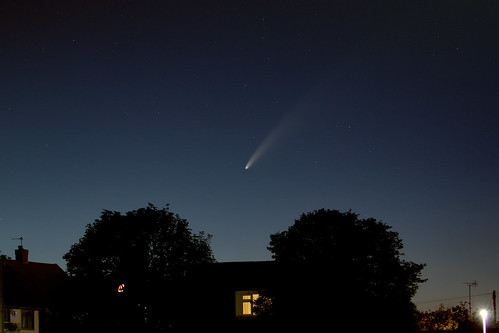
Comet C/2020 F3 NEOWISE has moved further into the evening sky, appearing a little faded since the previous weekend but still a relatively easy naked-eye object. Binocular view still good: the tail seemed longer, perhaps because I was seeing it against a darker sky.

Eyepieces used tonight were the 9mm Nagler (133x) and the 7mm DeLite (171x). The XT10 was balanced on the improvised “Observing table + bricks” platform again.

NGC 6522, globular cluster, Sagittarius
133x. Small, condensed fuzz with star-like core. Near Gamma Sgr. The low altitude and poor seeing made it hard to be certain but the core seemed to double with averted vision, possibly due to a foreground star nearby. Couldn’t confirm neighbouring globular NGC 6528.

M69, globular cluster, Sagittarius
133x. Definitely saw it tonight – visible as a soft round blur just south of an 8th magnitude star (which helps a lot when tracking it down). A little condensed with averted vision. In the brief window of time I had to look at it I was able to make out 2 or 3 speckles of individual starlight – possibly foreground stars, but overall this globular remained very faint.

M70 is harder to locate because there is no comparative star nearby. Again, I’m not confident I saw it this time – confirmation will have to wait for a better night. Likewise, M55 was right on the threshold of visibility; I think I glimpsed it with averted vision along with a few speckles of starlight, but I want to see it again to be sure.

I moved the XT10 to a less precarious spot and looked at Jupiter and Saturn at 171x. Both planets were visibly “rippling” with the seeing, so I abandoned my plan to do some imaging and returned to a couple of deep-sky objects.

M75, globular cluster, Sagittarius
Currently not far away from Saturn in the sky and quite obvious at 171x (though I suppose most DSOs would seem obvious after struggling with the previous three). Small, bright, condensed – swells in size with averted vision. Hint of graininess, but no stars popping out. Suggestion of dark area on the eastern side.

NGC 6818, “Little Gem Nebula”, planetary nebula, Sagittarius
171x. Small, fairly bright green-grey disc, slightly oval. Shows well at this magnification. Suggestion of darker centre. Oddly, with averted vision it seemed more blue-grey than green-grey.

Friday, 7 August 2020

Of Comets and Globular Clusters

12 July 2020, 00:00 – 2:00


Conditions: Mild with a very light wind. Some condensation (not forecast on clearoutside.com)

Seeing: Average
Transparency: Poor / average

Astronomy is not known for being a hectic pursuit, but this month it’s all been happening: the crowded star-fields of Sagittarius at their best (including my last three elusive Messier targets), Jupiter and Saturn at opposition, and – as if that wasn’t enough – a naked-eye comet that actually lived up to the hype. This was the second of three consecutive clear nights. Nights one and three were devoted exclusively to early-morning comet-chasing; on this night (11-12 July) I popped round to my local park to take some photos before returning home to catch up on some deep-sky observing.

Comet C/2020 F3 NEOWISE itself was too low and in the wrong part of the sky to get my telescope on, but 7x50 binoculars gave a really good view, clearly showing the bright star-like pseudo-nucleus and the long dust tail extending several degrees, gently curving up and away from the horizon. I wouldn’t rank it as a Great Comet like Hyakutake and Hale-Bopp, but it’s certainly the best one I’ve seen for many years.

Comet C/2020 F3 (NEOWISE)

In a new strategy, I put bricks beneath the observing table to give the XT10 the little extra clearance it needed to reach below -32 degrees declination. The arrangement was more stable than it looked, but it’s not something I want to repeat too many times. All observations at 133x (9mm Nagler).

NGC 6624, globular cluster, Sagittarius
Fairly large condensed blur. Bright core with averted vision. Near Delta Sgr.

Given that I could clearly see NGC 6624 (at -30.3 degrees) you’d think I would have been able to see M69 and M70, but once again those two extra degrees of declination made all the difference. I may have glimpsed M69 as an extremely faint blur, but I need a follow-up observation to be sure.

M54, globular cluster, Sagittarius
Back up to -30 degrees again and this globular was no problem at all. Small, bright, condensed; as noted previously.

Bright ISS pass at 12:50.

M22, globular cluster, Sagittarius
Rich, large mass of stars – a little hazy tonight (its more typical appearance in UK skies, I think). Prominent rift on leading side, west of the core. Seemed quite loose at 133x.

I also tried (somewhat optimistically) for M55, but any chance of seeing it was hindered by the light from the rising last quarter moon. I spent the remainder of the session looking at Jupiter and Saturn, but poor seeing meant I only got fleeting glimpses of fine detail.

Wednesday, 5 August 2020

Stormy Skies

25 – 26 June 2020, 23:45 – 2:00


Conditions: Very warm and muggy. Distant thunderstorm on southern horizon. Clouding over towards end of session.

Seeing: Atrocious
Transparency: Poor

The universe clearly doesn’t want me to see those last few Messier globular clusters – at least not just yet. As soon as I went out I could see flashes of red-hued light sporadically illuminating a bank of clouds hugging the southern horizon, possibly as far away as France judging by the lack of thunder. A look through the binoculars confirmed my fears: no stars at all visible below about -30 degrees declination, so M69 and M70 would have to wait for another night.

As it turned out, the seeing was the worst it’s been since I got the XT10 – even worse than the previous night. Despite giving the scope ample time to cool down, Antares looked like a bulbous sky lantern no matter how much I tweaked the fine focuser. Objects higher in the sky like M11 looked a little better, but the pin-sharp detail I’ve become accustomed to was only fleetingly visible; most of the time it looked like a rippling, smeared-out mess.

Nevertheless, the scope was outside and the sky was clear (sort of), so I carried on as best I could. All observations at 133x with the 9mm Nagler.

NGC 6712, globular cluster, Scutum
A fuzzy round blob – which, to be fair, is kind of how it looks at the best of times. Still, it showed up fairly well.

NGC 6751, planetary nebula, Aquila
Small, pale disc – brightens with averted vision. Quite prominent despite the poor conditions. While sweeping towards this object I noticed a very distinctive red star which turned out to be the carbon star V Aquilae.

NGC 6638, globular cluster, Sagittarius
Condensed blur just east of Lambda Sagittarii, fainter than M28.

NGC 6642, globular cluster, Sagittarius
Small round blur, west and a little north of M22 (which was pretty washed out again tonight). Condensed core with averted vision.

M71, globular cluster, Sagitta
Rich arrowhead-shaped mass of stars (quite apt considering the constellation it resides in). More condensed than any open cluster, but quite loose for a globular.

From about 1:45 I noticed the first clouds passing overhead, travelling south to north. By 02:00 over half the sky was covered, so I called it quits for the night. The storm itself eventually arrived (with a vengeance) just before 6 AM, waking me up after less than three hours’ sleep.

Nature note:
Stoker, the neighbours’ black cat, silently appearing as if out of nowhere beside my scope in the way that only cats do. And later, after the cat had gone, several frogs noisily roaming the garden in the way that only frogs do.

Sunday, 19 July 2020

The Southernmost Messier Object

14 June 2020, 00:30 – 03:30


Conditions: Mild, still (no wind), hazy and humid – heavy condensation. Cloud increasing over the course of the session.

Seeing: Average / poor
Transparency: Poor

I don’t normally observe in the two weeks either side of the summer solstice because the sky doesn’t get reasonably dark until gone midnight – and it doesn’t stay dark for very long. However, if I’m to do justice to the Scorpius/Sagittarius region I figured I should at least try to observe some of the brighter objects this month rather than tackle them all in a mad scramble in July or August. (And of course there’s no guarantee the skies will be clear then anyway.)

Also, encouraged by my glimpse of M7 last time out, I had the TV60 set up on the Super Polaris mount. However I hadn’t taken into consideration just how much the trees and plants can grow in barely a month, so I was contending with foliage as well as the neighbour’s fence. Fortunately, the TV60 is easier to move from side to side than the XT10.

After warming up with a look at M13 in both scopes (it appeared hazy and a little washed-out tonight, despite being nearly overhead), I switched to the main target for the evening.

M7, open cluster, Scorpius, 40x (TV60 + 9mm Nagler)
The scope was almost horizontal, but I was able to get just enough clearance over the neighbour’s fence to centre M7 in the field of view. The object itself appeared faint and washed out, but enough stars were visible to at least give a sense of a very large, splashy open cluster. The brightest stars seemed to form a distorted x-shape with a double star at the centre (although the atmospheric distortion and low magnification made it hard to split). There was also a haze of unresolved stars, plus an incomplete ring of brighter stars surrounding the central cluster. Even if M7 were high enough to be visible in the XT10, the TV60 would still be a better choice of scope to view it simply because of the larger field of view (2 degrees in the 9mm Nagler). By comparison, M6 – which is itself a fairly large cluster – appeared more traditionally condensed at the same magnification.

I also had the XT10 set up in the garden, but another thing I hadn’t taken into consideration was how bad the condensation would be tonight. I had planned to use the 13mm Ethos, but unfortunately the eye-lens misted over while I was looking at M7, so I swapped it out for the 9mm Nagler. The sky was getting hazier too, so I stuck to only the brightest objects. (The fainter stuff could wait for a better night.)

M21, open cluster, Sagittarius
133x. Loose, bright cluster, a little north of M20. Star pattern at centre in the shape of a teacup, or a backwards “3”.

M23, open cluster, Sagittarius
133x. Rich, large cluster. Uniformly bright stars filling the fov. Bright star to north. Concentration of fainter stars at western end of cluster.

M25, open cluster, Sagittarius
133x. Bright, large cluster, with a distinctive “D” shaped pattern of stars at the centre. Unlike M23, the stars come in a mixture of brightnesses.

With the condensation worsening and the sky already starting to brighten, it was almost time to pack up. However while taking the TV60 indoors I noticed that Jupiter and Saturn were starting to emerge from behind the tree, so I (carefully) moved the XT10 and changed the 9mm Nagler for the 7mm DeLite.

Jupiter, 171x: the seeing was variable but in the fleeting moments that it steadied, the DeLite gave a very sharp, comfortable view. All four Galilean moons were on view and I could see the Great Red Spot moving onto the disc, showing its familiar brick-red colour when the seeing allowed.

Saturn, 171x: Titan and three faint moons were visible, despite the brightening sky. Saturn was its usual exquisite self with the Cassini Division showing well in moments of good seeing, as well as the shadow of the planet on the rings, and the dusky equatorial band.

Friday, 10 July 2020

Summer Clusters and Nebulae

18-19 May 2020, 23:45 – 2:30


Conditions: Breezy, relatively mild (first night I haven’t needed my winter coat). After a day dominated by high cirrus, the sky cleared suddenly, with just a few lingering vapour trails crossing the sky. Cloudy later on.

Seeing: Average - poor
Transparency: Poor - average

The nights are so short now that it doesn’t get reasonably dark until after 11pm, which makes for a lot of hanging around in the evening when (like tonight) the clear-sky forecast is ambiguous. With the sky near the northern horizon staying noticeably light, and vapour trails drifting overhead, the seeing and transparency varied considerably from minute to minute and from one part of the sky to another.

After warming up with M12 and M10 (both clusters looked a little hazy tonight), I tracked down another lesser-known globular in Ophiuchus:

NGC 6426, globular cluster, Ophiuchus
133x. Very faint hazy patch; a little condensed with averted vision. Unimpressive.

NGC 6572, planetary nebula, Ophiuchus
133x and 171x. Small, very bright oval disc; almost stellar at 133x. Stands out largely because of its strong green-blue colour. At 171x, the central star or core region (it was hard to tell exactly what I was seeing) overwhelms the surrounding nebulosity in direct vision. In averted vision the opposite is true: the outer nebulosity becomes the dominant feature.

NGC 6633, open cluster, Ophiuchus
133x. Follow-up from previous observation. Loose cluster of bright stars elongated roughly N-S. As noted previously, shows well in finder. Small “arrowhead” asterism of about 8 stars separated from main cluster on western (leading) side. Quite large, but a bit more “telescope-friendly” than the nearby IC clusters 4665 and 4756.

IC 4756, open cluster, Serpens
133x. Not as bright as IC 4665 and NGC 6633, but a very rich, very large cluster – best suited for smaller wide-field scopes.

NGC 6791, open cluster, Lyra
133x. Faint, extended haze. Starts to resolve with averted vision, giving at least a sense of its richness. Not much, if any, improvement on my previous observation, but I am slowly warming to this cluster.

M56, globular cluster, Lyra
133x. A little washed-out compared to previous observation. The triangular core was less apparent tonight, but I did notice a bright star leading the cluster and a long “x” shape of stellar arms.

M57, The Ring Nebula, Lyra
171x. Additional prep work for sketch (first draft below). The transparency must have been good in this part of the sky because I could just about detect a faint 14th magnitude star east of the ring (just beyond the brighter 13th magnitude star).


At 1:20 I was distracted by the unmistakable sight of the ISS passing high overhead.

After quick looks at M27, M4 and M80 I was irresistibly drawn to an old favourite:

M11, the Wild Duck Cluster, Scutum
133x. After all these years it still boggles me that I don’t have to travel any further than my back garden to see something as breathtakingly beautiful as this cluster. I have mixed feelings about the bucket list approach to life, but if you insist on such a checklist, seeing M11 through a telescope should probably be on it.

At around 2 AM the clouds returned with reinforcements, but after I’d taken the scope indoors – wouldn’t you know it – the sky suddenly cleared again from the south, and now it was remarkably free of haze. With only about half an hour of usable dark left, it wasn’t worth carrying it back out again, so all remaining observations were carried out with 7x50 binoculars and the naked eye (the most important instrument of all!).

M24, star-cloud, Sagittarius
I don’t recall ever seeing M24 with the naked eye before (the Milky Way in Sagittarius is always a little washed out from my location), but tonight it was visible as a hazy patch, a little smaller than the Scutum star-cloud further to the north. The binoculars revealed it to be sprinkled with stars, the brightest ones forming a distinctive almond shape.

This part of the sky (the steam rising from the spout of the Sagittarius teapot) is rich in bright clusters and nebulae, many of which showed up well in the binoculars (particularly M8, the Lagoon Nebula). Also visible in the binoculars were M12, M10, M11 and M27.

The binoculars resolved several more stars in M6 tonight, giving a much better view than 17 May. I also got my first glimpse of M7, which was just visible as a faint hazy patch very low in the south. I propped my elbow against a door-frame to steady the view and over time a few faint stars began to pop out. Averted vision also showed the cluster to be larger than was first apparent. From the same vantage point I could also see the bright stars Lambda Scorpii (Shaula), Upsilon Scorpii (Lesath) and G Scorpii through the binoculars (but not with the naked eye), all three of which culminate at less than 2 degrees above the horizon from my location. I don’t think I’ll be able to get the XT10 on M7, but it might be possible in the TV60.

Saturday, 20 June 2020

The Cat's Eye Nebula and other Highlights

14-15 May 2020, 22:30 – 3:15


Conditions: Chilly, breezy; sky noticeably lighter along the northern horizon.

Seeing: Good
Transparency: Good overhead, average to poor everywhere else

M61, galaxy, Virgo
With the Virgo cluster already sliding past the meridian by the time it gets dark I wasn’t expecting to look at M61 again this year, but I’ve never seen a supernova before so I had to at least try to spot SN 2020jfo. After several minutes of careful observing (at 171x), using averted vision and enhanced breathing and all the usual tricks, I could intermittently see one or two faint stars west of the nucleus. So did I see it or was my mind filling in the gaps? Difficult to say, so I’ll leave that as a “maybe” rather than a definite “yes”. Had it exploded a month or so earlier (away from the Thanet light-dome) I think I would have caught it. (And yes, I know there was a brighter supernova in neighbouring Leo, but I’d like to be able to see the host galaxy as well. There will be other, better opportunities.)

M51, Whirlpool Galaxy, Canes Venatici
Having the galaxy almost directly overhead made for awkward tracking with the dob, but structure was clearly visible at 133x and 171x. The core of NGC 5195 appeared more condensed and stellar than that of M51, with a dark cut-off on the eastern side. The bright area noted last time was more apparent tonight, with a definite clumpiness to the spiral arm east of M51’s core.

M106, galaxy, Canes Venatici
171x. As per previous sightings. Northern spiral arm brighter as usual; appeared to be a dark lane on the western side of the galaxy, slanting diagonally south. At this higher magnification the core itself seemed slightly elongated in a NW-SE direction.

Using Sky Atlas 2000 I found three of the neighbouring galaxies (two of which I’ve seen previously):

NGC 4346, galaxy, Canes Venatici
171x. Small spindle galaxy with a bright stellar core aligned E-W. Located east (and a little south) of M106.

NGC 4220, galaxy, Canes Venatici
171x. Faint elongated galaxy N and W of M106, aligned NW-SE. Brighter towards centre with averted vision.

NGC 4217, galaxy, Canes Venatici
171x and 133x. Faint streak of light west of M106, aligned NE-SW. I missed this one last time, mostly because its visibility is hampered by a bright 9th magnitude star to the north and another fainter one west, lying almost on top of the core. Easy to overlook if you’re not paying attention.

NGC 4144, galaxy, Ursa Major
133x. Large, faint smudge of light. Brighter towards centre with averted vision. Close double star to north.

After quick looks at M5 and M13 I then turned my attention to a selection of the summer objects rising into view:

Epsilon Lyrae, “the Double Double”, Lyra
My previous views of this famous multiple system in the XT10 have been hampered by poor seeing, but tonight the stars were clearly split at 133x and 171x. Obviously the better view came at the higher magnification, with lovely contrast and clean space between the respective pairs.

M57, Ring Nebula, Lyra
171x. I was mostly plotting field stars in preparation for a sketch, but I also took a moment to jot down the key features of this famous nebula: bright oval ring of light, elongated NE-SW. Faint 12th or 13th magnitude star just off the NE edge. The NW and SE edges (on the minor axis) are noticeably brighter than the rest of the ring. The central portion of the ring is not completely dark, but has a slightly glazed appearance.

I took a break at 1:20 to watch a bright pass of the ISS, also noticing a few small clouds scudding across the sky. Then I returned to another planetary nebula:


NGC 6543, “Cat’s Eye Nebula”, Draco
Viewed at 133x and 428x (7mm DeLite + 2.5x Powermate) in preparation for a sketch (above). The seeing perhaps wasn’t quite good enough to justify such a high magnification, but the view occasionally came close to the one I got on 20 April. I notice that getting the correct eye placement is a lot more critical at 428x. Key features: pale green oval disc (at 428x); bright and sharp-edged. Seemed to be a hint of a yellow tinge to the central star, but this might be a contrast effect. When the seeing steadied there was also the suggestion of a tiny dark gap between the central star and the nebula, but oddly this seemed more apparent at the lower magnification. The “arm” features weren’t quite so apparent tonight, showing fleetingly as bright fringes, but the western (long) edge of the nebula did seem slightly misshapen, appearing to extend beyond the main disc.

NGC 6826, “The Blinking Planetary”, Cygnus
A beautiful sight at 171x, much improved on the last time I saw it. Bright central star, dominating the view in direct vision. The nebula was very bright in averted vision; rounder and softer-edged compared to 6543. Colour was less intense too, appearing as a pale green-grey.

At 1:50 a lovely meteor flashed through Cygnus, heading towards the eastern horizon.

M4, globular cluster, Scorpius
133x. A little washed out (as usual), but still plenty of stars resolved. The central N-S “bar” was very prominent tonight.

M11, the Wild Duck Cluster, Scutum
133x. A wonderfully rich cluster, one of the very best in the sky (or at least, the part of it that I can see). Bright lucida surrounded by a somewhat squared-off dense mass of stars. The overall impression is that of a fractured globular cluster.

The cloud cover was increasing at this point – and in a haphazard fashion, effectively pushing me from one clear part of the sky to the next.

M26, open cluster, Scutum
133x. Small cluster somewhat overshadowed by M11 to the north. The brightest 4 stars make a kite shape, surrounded by a swarm of fainter stars, although the central part of the cluster seems strangely vacant. I also noticed a curved tail of stars on one side before the clouds got in the way.

M107, globular cluster, Ophiuchus
133x. Follow-up observation. Faint (for a globular) – washed-out appearance. Grainy in averted vision with a brighter, mottled core.

M14, globular cluster, Ophiuchus
133x. Large, reasonably bright globular. A few stars on the outskirts resolved with averted vision, but otherwise unimpressive.

M80, globular cluster, Scorpius
133x. As noted previously: small, bright, condensed and grainy – but not resolved.

The ISS made another dazzling pass at 3 AM, travelling almost directly overhead. With the sky starting to brighten, there was just time for a quick look at a couple of prominent open clusters.

IC 4756, open cluster, Serpens
133x. Large, loose cluster comprised of bright stars. Not really suited for the XT10.

NGC 6633, open cluster, Ophiuchus
133x. Bright, wedge-shaped cluster. Comprised of bright stars, loosely arranged. Shows up very well in finder and binoculars.

I also used the binoculars to look for M7 and Comet C/2020 F8 (SWAN), but the sky was too bright to see either. Realistically I think my only chance of seeing the latter is by making a trip to the North Foreland lighthouse (from where I saw Comet C/2006 P1 McNaught), but the latest reports suggest it isn’t bright enough to justify the effort.

Nature note:
The usual pale frog in the pond (surrounded by the ever-growing tadpoles). The local herring gulls were restless tonight, frequently taking off and occasionally calling for no apparent reason. Perhaps their eggs are close to hatching…

Wednesday, 3 June 2020

Galactic Multi-tasking

25 April 2020, 22:15 – 00:30


Conditions: Cold, with a light breeze

Seeing: Good
Transparency: Average

Lately I’ve been using one telescope at a time (i.e. observing or imaging, but not both). On the evening of 24 April, with clear skies forecast for the entire night, I hauled both rigs into the garden and began the careful process of assembling, balancing and polar-aligning my astrophotography set-up. An hour later I was ready to begin imaging … at which point clouds rolled in from the north and completely covered the sky. This isn’t the first time this has happened to me, and it probably won’t be the last, but that’s English weather for you.

Undaunted, I repeated the process the following evening and this time the skies stayed clear. My imaging target was M101 (more on that in the next post), and while that was in progress I used the XT10 to track down some more galaxies around the Virgo/Coma border. (As I’ve discovered this spring, there are always more galaxies…)

All observations carried out at 133x (Nagler 9mm) unless otherwise stated.

NGC 4212, galaxy, Coma Berenices
Smooth oval glow, gradually brighter towards the centre. Possible extended bar-like core. (Photographs show no such feature, although there does appear to be a brightening along the long axis, which is possibly what I saw.)

NGC 4216, galaxy, Virgo
Pretty impressive edge-on (or close to edge-on) galaxy with very bright core. Suggestion of dark cut-off on eastern side.

NGC 4267, galaxy, Virgo
Round haze with bright core. Averted vision revealed stellar nucleus and several faint field stars.

NGC 4168, galaxy, Virgo
Faint round haze west of NGC 4216. Brighter towards centre with averted vision.

NGC 4178, galaxy, Virgo
Very faint extended haze west of bright star. Low surface brightness object; easier to see when the star is out of the field.

NGC 4124, galaxy, Virgo
Another very faint oval haze, aligned roughly east-west. Brighter core and stellar nucleus with averted vision.

NGC 4293, galaxy, Coma Berenices
As per previous observation of this object. Extended lens-shaped galaxy. A little brighter towards the centre with averted vision.

NGC 4147, globular cluster, Coma Berenices
I’ve seen this cluster before, but it makes a refreshing change from all the galaxies nearby. That said, it’s a typical NGC globular: round, condensed, grainy with averted vision, but not resolved.

24 Comae Berenices, double star
Attractive pairing. Yellow primary and a pale blue secondary (some 20 arcseconds west).

NGC 4651, “The Umbrella Galaxy”, Coma Berenices
Large oval haze, aligned east-west. Brighter towards centre, mottled envelope.

NGC 4710, galaxy, Coma Berenices
Edge-on “spindle” galaxy, quite bright, aligned SW-NE. Field star east of nucleus. Seemed mottled with averted vision, particularly north of the core.

NGC 4689, galaxy, Coma Berenices
Large round haze, low surface brightness. A little brighter towards the centre with averted vision, but otherwise featureless. Two field stars to north.

I took a break from galaxies to look at M5 again, before revisiting one of the galaxies I saw on Monday.

NGC 5846, galaxy, Virgo
Appeared as before, but this time I could just about see the bright spot (corresponding with NGC 5846A) south of the nucleus with averted vision. It almost looks like the core of NGC 5846 has split into two unequal parts.

With the imaging run nearing the end of its sequence, I changed the Nagler 9mm for the DeLite 7mm (171x) and rounded off the session with a look at two planetary nebulae in Hercules.

NGC 6210, planetary nebula, Hercules
Very bright blue-green ellipse. Seemed brighter on the western (leading) side.

IC 4593, planetary nebula, Hercules
Very small, almost stellar disc of blue-grey light, east of bright star. Best seen using averted vision (because the 11th magnitude central star overwhelms the nebulosity in direct vision). Nice close double star to the east.


Thursday, 28 May 2020

Spring Galaxies

22 – 23 April 2020, 21:45 – 01:30


Conditions: Breezy, cool. Light condensation (mostly on the star-charts)

Seeing: Initially good, but deteriorated considerably after midnight
Transparency: Average

The previous night/morning I went out sans telescopes to observe the Lyrid meteor shower. After about an hour all I had for my trouble were cold feet and a stiff neck. But hey, that’s meteors for you.

Tonight I returned to deep-sky observing, but before I went out I watched live on YouTube as SpaceX launched another sixty Starlink satellites into orbit, raising the total to 420 (of a planned 12,000!).

I began with some galaxies in northern region of Ursa Major. All observations carried out at 133x (Nagler 9mm) unless otherwise stated.


NGC 4036, galaxy, Ursa Major
Oval galaxy with a bright core – possibly bar-shaped. Mottled outer envelope.

NGC 4041, galaxy, Ursa Major
In same fov as 4036, albeit a little larger and fainter. Brighter towards the centre.

NGC 3945, galaxy, Ursa Major
Small, round and condensed. Stellar nucleus with averted vision. Field star to south.

NGC 4125, galaxy, Draco
Bright, elongated galaxy with bright field star to east. Very bright extended core.

I then pushed further north to look for NGC 4236 (Caldwell 3), but after initially thinking I’d seen something, it stubbornly remained invisible. This galaxy is notoriously faint apparently, so my failure to spot it didn’t come as a complete surprise. (I’ll try again with the Ethos on a better night.) Next stop: Virgo.

NGC 4753, galaxy, Virgo
Large oval haze, east of Porrima. Fairly dim overall but brighter towards the centre. Mottled outer envelope with a suggestion of a dark cut-off on the NW side.

NGC 4699, galaxy, Virgo
Round haze, very bright star-like nucleus with averted vision. Mottled envelope. Near Psi Virginis.

NGC 4293, galaxy, Coma Berenices
Faint elongated ellipse, quite large. Two field stars at either end of the long axis and two more on the northeast side, but no detail other than a vague mottling. North of 11 Com and not far from M85.

NGC 5746, galaxy, Virgo
Edge-on “needle” galaxy hidden away in eastern Virgo. Looked quite impressive with averted vision (especially considering it’s 95 million light years away), but dimmed as soon as 4th magnitude 109 Virginis crept into the field from the east. Brighter towards centre; maybe a dark lane slightly offset from core on eastern side.

NGC 5363, galaxy, Virgo
Round galaxy south of bright star. Bright core and stellar nucleus with averted vision. Couldn’t see nearby NGC 5364.

NGC 5653, galaxy, Bootes
Very faint round galaxy near Rho Boo (plotted in Sky Atlas 2000, not PSA). Brighter towards centre with averted vision. Possible barred core.

NGC 5466, globular cluster, Bootes
Follow-up observation at 133x. Seemed fainter tonight. Large, low surface brightness. This object requires patience: after a while some stars gradually popped out with averted vision.

At this point I had a quick break to eat a banana (well, if it works for tennis players…). When I returned outside I found a snail crawling across my sky atlas (just as well it’s laminated). I intercepted it before it reached M101 and picked up the session with an old favourite:

NGC 4565, Needle Galaxy, Coma Berenices
Bright and beautiful. Still the best edge-on galaxy. Twice the apparent size of NGC 5746.

NGC 4559, galaxy, Coma Berenices
As previous observation last year. Seemed a little faint tonight.

NGC 4414, galaxy, Coma Berenices
Elliptical shape, brighter towards centre. Stellar nucleus with averted vision. Hint of dark cut-off on western side.

NGC 4631 (“Whale”) & 4656 (“Hockey Stick”), interacting galaxies, Canes Venatici
Already past the meridian and starting to descend into the murky part of the sky when I caught up with them, so neither galaxy at its best. Still impressed though by how large they are, particularly 4631. NGC 4657 (the “hook”) was very faint – just visible with averted vision as an extension on the eastern edge of 4656.

NGC 4203, galaxy, Coma Berenices
Small round galaxy near a bright 8th magnitude star. Bright core with averted vision. Nice double star (Struve 1615) close by to the southwest: pale yellow primary and a pale blue secondary (due east).

NGC 4214, galaxy, Canes Venatici
Extended misty patch; brighter towards centre with averted vision and a suggestion of mottling. (I had a better view of this galaxy in 2019; think I need to revisit it on a really good night). In photos it looks similar to NGC 4449.

NGC 4244 (Caldwell 26), galaxy, Canes Venatici
Large, faint edge-on galaxy. Fairly easy to spot, but tough to make out any detail other than a subtle brightening towards the centre.

NGC 5982, galaxy, Draco
Brightest member of the Draco triplet (although I could only see two of them). Appeared as a small round galaxy with a bright core.

NGC 5985, galaxy, Draco
Large round galaxy in same fov as 5982. Low surface brightness. The third member of the trio (5981) is probably too faint to see from my home location.

At this point I upped the magnification to 171x (DeLite 7mm) and had a quick look at some old favourites: M13 and M57. And then it was on to Cygnus for a planetary nebula I haven’t seen for sixteen years.

NGC 6826, “The Blinking Planetary”, Cygnus
171x. Pale green disc near the bright double star 16 Cyg. The nebula brightens with averted vision, causing the blinking effect (although this is by no means unique to NGC 6826). The central star was flitting in and out of view, its visibility affected by the deteriorating seeing.

I also had another look at NGC 6543 (which looked so good the other night). This time the central star wasn’t visible at all, so I dropped back down to 133x for the remainder of the session.

NGC 6939, open cluster, Cepheus
Rich little cluster with two lines of stars forming a distinctive right-angle.

NGC 6946, “The Fireworks Galaxy”, Cygnus/Cepheus
Amorphous round glow near a distinctive triangle-shaped pattern of stars. It’s unusual to see a galaxy in such a rich star-field, but it needs to be much higher in the sky for me to have any chance of spotting the spiral structure. (I did see this one with the SP-102 back in 2004, but it was extremely faint in that scope.)

Nature note:
The tadpoles are getting noticeably bigger. The resident pale adult frog was also present, as well as one of last year’s froglets, sitting on the access log.

Tuesday, 19 May 2020

Dusk till Dawn

19 – 20 April 2020, 22:15 – 04:15


Conditions: Windy, cold (for time of year).

Seeing: Average
Transparency: Average

The evening got off to an inauspicious start when I was “treated” to a display of the infamous Starlink satellites. They were already crossing the sky when I took the scope out at 21:30 and the grim spectacle carried on in a continuous procession for another fifteen minutes. The occasional straggler was still passing overhead at 22:00, following the same path as the others. Each satellite reached a peak brightness of about 2nd magnitude, rivalling the primary stars in Ursa Major. I suppose I’m fortunate in that I’m primarily an old-school observer who dabbles in astrophotography, so I have less at stake than those who’ve spent vast sums of money on dedicated astro-cameras, high-end mounts etc., but I am worried about the impact these mega-constellations will have on professional astronomy – particularly the various wide-field survey programmes.

Anyway, satellite trains aside, as the previous session had gone so well I wanted to try something longer, perhaps even an all-nighter (clouds and energy levels permitting). I had no specific plan, other than revisiting a few old favourites, as well as picking up a few objects I’d missed along the way.

All observations carried out at either 133x (Nagler 9mm) or 171x (DeLite 7mm).

M53, globular cluster, Coma Berenices
Viewed at 133x and 171x. As per previous observations. Dark lane on the north side separating a moderately bright star (noted previously) from the core of the cluster.

NGC 5053, globular cluster, Coma Berenices
Finally tracked it down (at 133x) after who knows how many attempts. Visible as a large, hazy patch of very low surface brightness. A little speckly with averted vision, and a field star to the east. Not impressive. Definitely my least-favourite globular cluster.

M51, Whirlpool Galaxy, Canes Venatici
133x. Best view of M51 this season. Ghostly spiral arms visible. With time and careful use of averted vision, there were even hints of brighter spots within the arms, most prominently on the arm immediately east of the core.

M101, Pinwheel Galaxy, Ursa Major
133x. Tantalising hints of structure with averted vision but, as usual, little more than that. Now I’ve seen it a few times I’m more confident of the nebulous spot east of the core (most likely NGC 5461 or 5462). There also seemed to be a tiny faint spot (possibly a star) west of the core.

Porrima (Gamma Virginis), double star, Virgo
133x. Close “headlight” double. Identical white stars 38 light-years away on a 169-year orbit.

NGC 4684, galaxy, Virgo
133x. Small, faint streak of light, aligned NE-SW. Brighter towards centre with averted vision.

NGC 4691, galaxy, Virgo
133x. Another small faint ellipse, aligned E-W. Bright core with averted vision.

NGC 4697 (Caldwell 52), galaxy, Virgo
133x. Bright oval galaxy. Stellar core with averted vision, surrounded by a large extended envelope. Faint star to north; brighter one east.

While I was in this part of the sky I ventured south to Corvus to look for the Antennae galaxies again, but couldn’t detect anything with any degree of confidence.

M99, galaxy, Coma Berenices
133x. Ghostly round galaxy. Dark patch west of nucleus. Suggestion of reverse-s spiral.

M98, galaxy, Coma Berenices
133x. Large faint streak of light, aligned NW-SE. Brighter towards centre with averted vision.

NGC 4262, galaxy, Coma Berenices
133x. Small round fuzz. Bright stellar nucleus with averted vision. (Plotted on Sky Atlas 2000, not PSA.)

M100, galaxy, Coma Berenices
133x. Large round galaxy with bright fuzzy core. Possible bright spot east of core but tough to discern detail in this one.

NGC 4340 & 4350, galaxy pair, Coma Berenices
133x. Pair of similar sized galaxies in same field of view; both with stellar nuclei. The eastern one (4350) clearly brighter and more elongated.

NGC 4450, galaxy, Coma Berenices
133x. Large round haze, brighter towards the centre with averted vision. Stellar nucleus. Another reverse-s spiral?

M85, galaxy, Coma Berenices
133x. Bright, round, with very bright core. Star north of nucleus. NGC 4394 in same field to east-northeast. Similar size, but fainter than M85. Brighter towards centre with averted vision.

I then pushed the scope south again to confirm my previous observation of M83. It was still visible, albeit not as clearly as on 15 April, with only the core region standing out from the background.

As I don’t normally observe for much longer than three hours, this seemed like a good point to stop for a coffee break and a cereal bar. Q1: How do you make a hot drink with only a dim red light for illumination? Answer: very carefully. Q2: How do you get the milk in and out of the fridge without ruining your night vision? Answer: close (and cover) your eyes and do it quickly (practice in daylight if you have to). Who needs a thermos?

I resumed the session with one of my favourite globular clusters:

M5, globular cluster, Serpens Caput
133x and 171x. See previous observation for superlatives. This time I remembered to check the cluster for colour; it was subtle: a pale aquamarine tinge. The bright star (SE of the core) I noticed last time out didn’t seem as bright tonight. At 171x the cluster was spectacular; the greater contrast allowing me see even more faint stars. The core wasn’t fully resolved, but definitely speckled.

NGC 5838, galaxy, Virgo
133x. Small round galaxy with bright core. One of a group of several galaxies (I picked up 8 tonight) clustered around 110 Virginis, a few degrees west of M5.

NGC 5854, galaxy, Virgo
133x. Faint ellipse, a little brighter towards the centre. (Sky Atlas 2000)

NGC 5846, galaxy, Virgo
133x. Round fuzzball, somewhat brighter towards the centre. Visually, this appears to be the dominant galaxy of this cluster.

NGC 5850, galaxy, Virgo
133x. Large hazy patch east of 5846 in same field. Very low surface brightness.

NGC 5831, galaxy, Virgo
133x. Small ellipse; sharp stellar nucleus with averted vision. (Sky Atlas 2000)

NGC 5813, galaxy, Virgo
133x. Small, fuzzy oval at the centre of a square formed by four stars. Brighter core with averted vision.

NGC 5806, galaxy, Virgo
133x. Very faint oval galaxy, brighter towards the centre with averted vision. (Sky Atlas 2000)

NGC 5864, galaxy, Virgo
133x. Very faint streak of light. Brighter along central axis with averted vision. (Sky Atlas 2000)

NGC 6309, “Box Nebula”, planetary nebula, Ophiuchus
133x. Small disc of light with a very close star off the western edge. Suggestion of asymmetry – northern half brighter?

NGC 6503, “Lost in Space Galaxy", Draco
133x. Large, bright lens-shaped galaxy. Unusually, no brightening towards the centre that I could see. Some nostalgia attached to this galaxy as it’s one of the select non-Messier/Caldwell galaxies that I tracked down with the SP-102 years ago. It's also one of the rare bright DSOs that wasn't discovered by a member of the Herschel family.

NGC 6543, “Cat’s Eye Nebula”, Draco
Viewed at 133x and 171x. Very bright blue-green ellipse near a bright star. 171x showed the central star embedded in the nebula and – in moments of fine seeing – a suggestion of structure in the form of two curved arms extending through and just beyond the nebula. The colour also seemed more intense at the higher magnification. On this evidence, the Cat’s Eye ranks high on the list of beautiful planetary nebulae.

M4, globular cluster, Scorpius
133x. Large, grainy globular; a little washed out, but still impressive. Amazingly, given its low altitude, I counted at least two dozen stars resolved. It may be an illusion due to the way the brightest stars are arranged, but the core region seemed more bar-shaped (on a north-south axis) than round. This must be a superb sight from more southerly latitudes.

M80, globular cluster, Scorpius
133x. Small, bright, condensed globular. Grainy, but no stars resolved.

While I was in Scorpius I took the opportunity to look at the red supergiant star Antares. It was a remarkable sight in the XT10, with the thick atmospheric turbulence at that altitude making it appear to seethe and boil, as well as cycling through a range of vivid colours from blood red to apple green.

M19, globular cluster, Ophiuchus
133x. Large, grainy – and faint – globular. A few stars resolved with averted vision. Pretty good considering its low altitude.

I had to balance the XT10 on my restored observing table to see two of the remaining three objects, such was their low altitude. The rubber feet were a little too near the edge for my liking, but otherwise it was fine.

M62, globular cluster, Ophiuchus
133x. Small condensed globular. Quite bright, but no resolution.

M9, globular cluster, Ophiuchus
133x. Grainy globular; not particularly bright. Starts to resolve with averted vision. Apparent dark patches give it a misshapen appearance.

It was 4:15 at this point, and the morning twilight was becoming ever more apparent, but there was just time for one last object.

M6, “Butterfly Cluster”, open cluster, Scorpius
133x. Glimpsed through a convenient gap in the neighbour’s tree, and still only just clearing the fence. But even then the distinctive pattern of bright stars which gives it its name was visible. Will try and revisit this one with the Ethos. Also worth noting there are only three Messier objects more southerly than this one…

Nature note:
A robin started singing from about 3:20 onwards (the beginning of astronomical twilight, but still well before dawn).

Thursday, 14 May 2020

Night of the Globular Clusters

14 -15 April 2020, 23:30 – 02:45


Conditions: Slight breeze, hazy bands of cloud receding low in the southeast.

Seeing: Poor
Transparency: Average

I was in the mood for something different after all those faint galaxies, so I started a bit later than usual with a session devoted (mostly) to globular clusters. All observations carried out at 133x with the 9mm Nagler. In the XT10 this eyepiece seems to hit the sweet spot for framing and resolving globulars; also, sticking to one magnification for the entire session makes it easier to compare one cluster to another.

M13, globular cluster, Hercules
What better place to start? (I returned to this cluster several times during the session as it rose higher in the sky.) Stunning as always, and for the first time I clearly saw the dark Y-shaped “propeller feature” adjacent to the core. Like the nearby galaxy NGC 6207, I suspect it’s one of those things that becomes fairly obvious after you’ve seen it once. No overall colour to the cluster that I could see – at least not on this occasion.

M92, globular cluster, Hercules
Smaller than M13, but an impressive globular in its own right. Well resolved. Oval shape. Slight blue tinge.

NGC 6229, globular cluster, Hercules
The “baby bear” of the three Hercules globulars. Small, condensed, quite bright. Grainy, but no stars resolved.

M104, Sombrero Galaxy, Virgo
A “stop-off” on the way to M68. Long, saucer-shaped galaxy with central bulge and bright stellar core. Dark lane clearly seen offset to the south.

M68, globular cluster, Hydra
Large, faint misty patch of light, all but washed out by its low altitude and atmospheric haze. With averted vision it seemed a little mottled, but that was all I could make out. A tough object – I lost it a couple of times and had trouble relocating it.

NGC 4565, Needle Galaxy, Coma Berenices
Very long and thin compared to M104, extending almost halfway across the field of view. Star-like nucleus embedded in slightly bulging core. Dark lane cutting across core; with averted vision it can be seen extending further out across the galaxy.

NGC 5634, globular cluster, Virgo
Small, round unresolved fuzzball, not very condensed. Faint star to west, bright one to east.

M5, globular cluster, Serpens Caput
A lovely, rich condensed cluster, rivalling M13. Well resolved most of the way to the core. (It’s such a stunning cluster I completely forgot to check for colour.) Stars appear “swept back” to the east. Particularly prominent star just southeast of the core. Further away, just out of the field to the southeast, lies a bright and closely paired double star (5 Serpentis).

M83, Southern Pinwheel Galaxy, Hydra
Took a while to track down, and when I did it was literally grazing the neighbour’s fence (culminating at less than 9 degrees above the horizon!). The galaxy itself was just visible as a condensed fuzzy core, with a distinctive line of 3 stars to the south and east. Averted vision revealed a very faint surrounding haze. A minor miracle that I’m able to see a galaxy this far south (I only searched for it on a whim because the haze had cleared and all the neighbours’ lights were off). That I was able to see it all illustrates that it must be a spectacular object when viewed from more southerly latitudes.

M12, globular cluster, Ophiuchus
Unusual, spidery cluster with a pear-shaped core and two long straight “arms” of stars forming a flattened “X” shape. Also a seemingly detached clump of stars to the west and a bright (foreground?) star southeast of the core, reminiscent of the one in M5. A straggly cluster, quite well resolved, with lots of intriguing detail.

M10, globular cluster, Ophiuchus
A more “conventional” globular than M12, appearing as a rich, condensed ball of stars. Most distinctive features are a wavy arm of stars to the north and an opposing one extending south (like the integral sign or the f-hole on a violin). Well resolved.

M56, globular cluster, Lyra
Small, condensed globular residing in a rich Milky Way field. Bright star to west. Distinctive triangular core. Resolved fairly well with averted vision.

M14, globular cluster, Ophiuchus
Large, grainy, condensed cluster. Very few stars resolved – not sure if this was due to haze, interstellar dust extinction, or tiredness creeping in.

M107, globular cluster, Ophiuchus
A relatively faint, condensed cluster, smaller than M14. Grainy with averted vision. Again, possible haze/dust/tiredness affecting the view.

IC 4665, open cluster, Ophiuchus
Loose, boxy cluster of bright, blue-white stars of similar magnitude. Too large to fully appreciate at 133x, but looked very good in the finderscope and in 7x50 binoculars.

As tempting as it was to wait around for Scorpius (another constellation typically lost to the midsummer continuous twilight) to clear the neighbour’s tree, I’d been outside for over three hours, so I called it a night.

Saturday, 9 May 2020

Hickson 68

12 April 2020, 21:30 – 22:45


Conditions: getting chilly, breeze picking up. Cloud cover increasing gradually. Sporadic flashes of lightning way off in the northeast.

Seeing: Poor to average
Transparency: Poor

The original plan was to photograph a galaxy or two, but as the sun set and patches of haze and cloud began to advance across the sky I abandoned that idea and hauled out the XT10 for an impromptu observing session. It was also an opportunity to put my newly restored wooden garden table to the test. (As I found out on 22 March, balancing Sky Atlas 2000 on a chair is not a practical way of going about things.)

I started with some double stars again, looking at Polaris, Cor Caroli and Izar (Epsilon Bootis). The latter was more challenging than it should have been due to the indifferent seeing, but still an impressive sight with a distinctive orange primary and a very close secondary lurking within the diffraction rings.

M94, galaxy, Canes Venatici
171x. Bright fat oval, like an unresolved globular (as noted previously). Very bright towards the centre.

I then moved over to the eastern part of Canes Venatici to investigate HCG 68, one of the few Hickson Compact Groups within range of my scope. According to sources online, these galaxies are 100 million light years away.

NGC 5353 & 5354, interacting galaxies, Canes Venatici
133x and 171x. A pair of small, very close galaxies, resembling eyes in a mask. Their long axes were angled towards each other, not unlike the 4485/4490 pair (also in CVn), although this pair were more closely matched. The southernmost galaxy (5353) was a little brighter and more condensed than 5354.

NGC 5350, galaxy, Canes Venatici
133x and 171x. Very faint round haze close to bright orange-hued star. In same field as 5353/5354 pair.

NGC 5371, galaxy, Canes Venatici
133x and 171x. Very faint amorphous haze; quite large. A little brighter towards the centre with averted vision.

The observations at 171x were mirrored at 133x: the lower magnification had less contrast, but this was balanced by the surface brightness being concentrated in a smaller area. Either way, these galaxies were a lot easier to see than Stephan’s Quintet (arguably the most famous Hickson group).

The clouds were starting to gather overhead at this point, so I called it a night.

Nature note
Two large frogs in the pond and 1000+ tadpoles!

Monday, 20 April 2020

Galaxies, Globulars and a Comet

23 March 2020, 20:30 – 23:30


Conditions: Another cold, breezy night. The wind wasn’t as excessive as it was on Sunday, but still too severe for astrophotography. After the rigours of the Virgo Cluster this session was somewhat unstructured, and it took me a long time to properly get going. Though with hindsight I think my eyes hadn’t fully recovered from the previous night. Peering at faint galaxies can be surprisingly tiring.

Seeing: Good
Transparency: Average

Comet C/2019 Y4 (Atlas)
Viewed at 133x (Nagler 9mm) and 171x (DeLite 7mm). Other than having moved near a different star it appeared much the same as it did the previous night. Though without the glare of Rho UMa affecting it, there did seem to be a hint of a stubby tail to the southeast.

While I was in the area I took another look at M81, M82 and NGC 3077 at 133x and 171x. Nothing to add to previous notes. I think I’ve reached the point with these galaxies (particularly M81 and M82) where I’d need one of those rare nights of excellent transparency to eke out any more detail.

M94, galaxy, Canes Venatici
171x. Bright core; mottled outer envelope. Again, not much to add to previous notes.


Leo Galaxy Triplet (plus an asteroid)
The Leo Triplet, as imaged on the following night (24 March)


M65, galaxy, Leo
133x. Large, extended galaxy with bright core. Suggestion of dark and light bands on eastern side (dust lane and spiral arm).

M66, galaxy, Leo
133x. Initially appears smaller than M65, but with time the fainter outer regions became more apparent and the overall shape seemed more irregular than M65. Stellar nucleus, but the surrounding core region seemed larger than the one in M65.

NGC 3628, galaxy, Leo
133x. Third member of the Leo Triplet. A large, faint, boxy galaxy. The dust lane was just about visible with averted vision, but this galaxy really needs a night of excellent transparency to get the best out of it.

NGC 3521, galaxy, Leo
133x. Large oval galaxy, aligned north-south. Bright stellar nucleus. With averted vision it seemed more elongated and elliptical, with a suggestion of a dark lane on the western side. Quite an impressive galaxy tucked away in the southern reaches of Leo.

NGC 4429, galaxy, Virgo
133x. A quick sweep along Markarian's Chain and then south to pick up a galaxy I missed last night. Bright smudge of light, aligned east-west, just south of bright star. Core seemed slightly offset to the east.

M53, globular cluster, Coma Berenices
133x. Subtle, very pale blue tinge. Quite well resolved with averted vision. Large outer halo of faint stars at this magnification; loses starfish shape noted previously. Still no sign of NGC 5053!

M3, globular cluster, Canes Venatici
133x. Bigger, brighter, bolder than M53. Lots of stars resolved with direct vision. Averted vision revealed a roughly triangular pattern of star chains pointing west.

NGC 5466, globular cluster, Boötes
133x. A first foray into the hinterlands of Boötes. After drawing a blank on NGC 5053 I wasn’t confident of finding this one, but it showed up without too much difficulty, appearing as an extended misty patch. Rich sprinkling of faint stars with averted vision, but no sign of the central condensation typically seen in globular clusters. Not striking as globulars go, but certainly unusual and worth tracking down.

NGC 5248, galaxy, Boötes
(Caldwell 45) 133x. Faint oval, brighter towards the centre. Faint stars SW and S of core.

NGC 5866 (M102?), galaxy, Draco
Viewed at 133x and 171x. Bright little lens-shaped galaxy forming a triangle with two field stars. Symmetrical shape and no detail that I could see (I think I’ll need higher power to stand a chance of spotting the central dust lane), although the 7mm DeLite seemed to show fainter “extensions”, increasing the length of the galaxy. Worth seeing, regardless of its disputed Messier status.


Friday, 28 February 2020

Auriga to Orion in 90 minutes

21 January 2020, 18:45 – 20:15


Very cold, slight mist coming in off the sea (condensation started appearing on the scope within minutes of my carrying it outside).

Seeing: poor to average
Transparency: average to poor

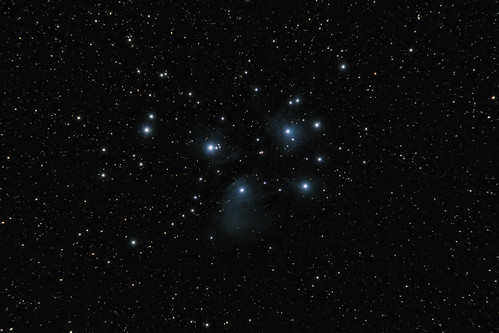
Started with a tour of the Auriga Messier clusters at 50x (24mm Panoptic) followed by a look at the Pleiades in Taurus, comparing it with the image I took with the TV60 the previous Saturday night. The nebulosity around Merope and Maia was just about visible, but I think it would need one of those rare nights of exceptional transparency to see any structure to it.

The Pleiades

I gave the Ethos a rest tonight (because of the condensation), so all subsequent observations at 133x (Nagler 9mm).

NGC 2281, open cluster, Auriga
Sparse collection of bright stars, four of them making a parallelogram at the western end of the cluster (the trailing two members of this shape are doubles). 133x is probably too high a magnification for this object; hard to tell where the cluster ended and the surrounding star-field began.

NGC 1931, “The Fly”, emission nebula / reflection nebula, Auriga
Little smear of light with 2 or 3 stars at centre. As noted before, quite bright for a non-Messier nebula. If the conditions were better I would have gone up to 240x. I also looked for neighbouring IC 417 (“The Spider”) and saw what appeared to be an extended patchy halo around a bright star, but difficult to say I saw it with any certainty.

NGC 1893, open cluster, Auriga
Sparse group of moderately bright stars. The area in and around the cluster seemed hazy, but not sure if that was because of unresolved stars or the surrounding nebulosity (IC 410). Might make an interesting imaging target if I get an appropriate filter.

Sigma Orionis, multiple star system
Impressive sight at 133x. Brightest component resolves into a wavy line of 4 stars. A pair of fainter doubles roughly northwest, and 2 even fainter stars between the two groups.

NGC 2261, Hubble’s Variable Nebula, Monoceros
Seemed more ghostly tonight (probably because of the transparency rather than the higher magnification). Averted vision showed a star-like point at the apex of the nebula. The “fan” of the nebula seemed brighter and fuller on the western side.

NGC 1535, planetary nebula, Eridanus
As per previous observation. The higher magnification showed a strong brightening towards the centre, but couldn’t isolate the central star with any confidence. Hint of brightness asymmetry with averted vision, but it came and went depending on which side of the nebula I was looking, so probably not a real feature. Colour less pronounced tonight – more grey than blue-grey.

NGC 1999, reflection nebula, Orion
As per previous observations. Relatively bright given the deteriorating transparency. Size increased with averted vision; star or star-like point at centre. Dark patch visible with averted vision, adjacent to the “star”.

From 20:15 onward the sky clouded over rather quickly, but the severe condensation had pretty much ended the session by that point anyway.

Nature note
Two frogs in the pond.


Tuesday, 11 February 2020

Winter Clusters

30 December 2019, 20:00 – 23:15 GMT


A cool, still night, but relatively mild for the time of year (although my feet were very cold towards the end of the session.

Seeing: good
Transparency: a slight haze mixed in with smoke from somewhere, but still much better than the 25th.

This time I came prepared with a makeshift dew-shield for the 9x50 finder – constructed from a piece of black card and some duct tape. It doesn’t look pretty, but it worked a treat. The condensation (while nowhere near as heavy as the previous session) started to appear on the body of the XT10 after about an hour, but the finder remained dry throughout. With hindsight the conditions were probably good enough for imaging too – and maybe I should have done; clear moonless nights seem to be rarer than usual this winter.

As before, I started with a tour of the Auriga Messier clusters using the 13mm Ethos. M37 was the highlight once again, with the dark rifts and overall “beetle” shape showing up particularly well.

Betelgeuse has made the headlines recently and it does look noticeably dimmer to the naked eye (though probably not for the reason most professional astronomers would like). It was one of the first stars I learned to recognise by name, and I can’t remember it ever looking this subdued. Through the eyepiece of my still cooling telescope it regained some of its lost grandeur, appearing as a bright, boiling red-hued star.

NGC 2169, open cluster, Orion
Follow-up observation from last week, at 92x and 133x. Tilting my head 90 degrees really made the “37” asterism become obvious, although the top-left star of the “7” is rather faint compared to its companions. The double star Struve 848 is located in the top right corner of the “3”.

NGC 2194, open cluster, Orion
Faint “boxy” cluster. Looks like an inconspicuous misty patch at first glance, but gets more impressive the longer you look at it. Some stars resolved; even more with averted vision. Quite rich and dense. Long tail of stars extending to the south.

NGC 1662, open cluster, Orion
Sparse but distinctive bird-shaped cluster with long wings and a diamond-shaped asterism forming the head. Red-hued star at the neck of the diamond.

NGC 1807 & 1817, open clusters, Taurus
The poor man’s double cluster. The northern one (1817) is rich and faint while the southern one (1807) is sparse and bright, with a prominent triangle asterism at its centre. Both clusters are well-framed in the Ethos.

NGC 2403, galaxy, Camelopardalis
A galaxy I've struggled to locate in the past (it resides in a barren area of the sky), but the new finder made it much easier. At 92x it appeared as an amorphous cloudy patch with two bright field stars at either end and a fainter one off-centre. Averted vision revealed an extended faint outer region, presumably corresponding with the spiral arms, although no structure was seen on this occasion.

M45, Pleiades, Taurus
Although this cluster doesn’t need a finder, it certainly helps me get my bearings when switching back to the eyepiece (M45 is too large for the fov even at 50x). At 92x the Merope reflection nebula was visible mainly by contrast with its surroundings. The nebula was large and fan-shaped, but I couldn’t see any of the banded structure apparent on photographs.

M78, reflection nebula, Orion
As previous observations. Two stars embedded in fan-shaped swathe of nebulosity (like condensed version of the Merope nebula). Prominent dark gap between M78 and the more diminutive NGC 2071.

M42, Orion Nebula
Spectacular in the Ethos despite condensation starting to creep in. Five stars resolved in the Trapezium at 92x. Exquisite detail in and around the Huygens region. The little arc of nebulosity in the opposite cavity wall showed up really well in the Ethos; it wasn’t quite so obvious at 133x, despite the better contrast. The higher magnification is better for picking out fine detail in the core, but overall, the view in the Ethos was much more majestic. Adding the OIII to the Ethos reinforced previous observations with this filter: it filled in the northern half of M42, giving the nebula a lopsided, asymmetric appearance.

NGC 2174-5, emission nebula + open cluster, Orion
Nebulosity (2174) faintly seen with Ethos and OIII. Switching to the 9mm Nagler (no filter) revealed the central cluster (2175) – stars arranged in a neat little parallelogram.

Rigel, Beta Orionis
0.1 magnitude blue-white star (currently considerably brighter than Betelgeuse) with 7th magnitude companion 10 arcseconds away. Clean split at 92x and 240x, not hindered by diffraction spikes on this occasion. The best view I’ve had of this double.

M1, Crab Nebula, Taurus
At 133x it appears as a faint, amorphous “puff of smoke”. Not a "frame-filler" by any means, but still a potential imaging target for the TV60, after M45 and the Horsehead.

NGC 2022, planetary nebula, Orion
Quick look at 133x. Pretty little disc of light, somewhat faint tonight.

NGC 1999, reflection nebula, Orion
At first sight it appears as a small hazy halo surrounding 11th magnitude V380 Orionis. At 133x the dark hole is visible with averted vision.

IC 418 (aka the Spirograph Nebula), planetary nebula, Lepus
Very small, looked like a bloated blue star even at 133x. Much more obvious at 240x (5mm Nagler). A pretty little blue-green disc surrounding a bright 10th magnitude star. Maybe a very slight yellowish tinge to the central star, but admittedly that’s a stretch. No structure apparent on this first viewing, but the northern half of the nebula seemed brighter than the southern half.

M79, globular cluster, Lepus
Viewed at 240x. Faint (very low in sky) grainy fuzzball with condensed core. Distinct 12th magnitude star north of core – as noted previously.

Hind’s Crimson Star (aka R Leporis), carbon star in Lepus
Viewed at 240x. Didn’t seem especially bright (though currently listed as 7.6m), but striking red colour, like a glowing ember or coal. One of the reddest stars I’ve seen.


Other notes:
Didn’t see any frogs when I looked in the pond (although I did see one when I was imaging the moon the previous month), but I did hear a distinctly frog-like “plop” at one point.

Tuesday, 4 February 2020

A Christmas Comet

25 December 2019, 19:00 – 21:00 GMT


Conditions: Cold evening (and getting colder), no wind. Slight haze affecting transparency. Condensation appearing after only a few minutes – by the end of the session the telescope was dripping wet and all exposed lenses were dewed over.

The session also served as the first test of a new Orion 9x50 RACI finderscope to go alongside the red-dot finder. It did a good job – until the condensation got to it.

After aligning the two finders (on Polaris), I began the session with a look at the Messier clusters in Auriga. All three showed up clearly in the finderscope, and looked particularly good in the Ethos 13mm, with M37 being the standout. M38’s neighbour NGC 1907 was partially resolved in the Ethos and more so in the 9mm Nagler. That extra 40x magnification does make a difference for pulling out faint stars.

M35 and NGC 2158, open clusters, Gemini
Again, M35 looked great in the Ethos, although I think M37 surpasses it (at least in the XT10). NGC 2158 started to show some resolution with averted vision, but not as good as 1907.

Comet C/2017 T2 (Panstarrs)
92x (Ethos). Small nebulous patch of about 9th or 10th magnitude high up on the Perseus/Camelopardalis border. Stellar nuclear region surrounded by a faint coma which swelled with averted vision. Suggestion of a faint tail fanning out to the south, but hard to be sure; the condensation was already starting to interfere. An improvement over the last comet I saw (ASASSN), but nothing to get too excited about. Still, at least I can say I made the effort to track it down.

M81, M82, galaxy pair, Ursa Major
The Ethos is large enough to show them in the same field of view, although both fall outside the central sharp zone. On individual examination both galaxies were bright and distinctive (shape-wise), but lacking detail on this occasion. Not really a night for galaxies.

NGC 2169, open cluster, Orion
The so-called Shopping Cart cluster or 37 cluster. A small but distinctive grouping of stars split into two halves. Comprising about 16 bright stars and a suggestion of fainter ones with averted vision. The Ethos resolved the brightest member of the cluster (in the eastern half) into a tight double: Struve 848, approximately 2.5” separation.

At this point the condensation had effectively taken both finders and the Ethos out of action. I struggled on with the 9mm Nagler for a while before eventually admitting defeat. The new finderscope proved its worth in the short time I was able to use it: it shows the same stars plotted in the Pocket Sky Atlas (and at the same orientation), which will make star-hopping much easier – particularly in galaxy season. I just need to make a dew-shield for it before I take the scope out again.

Sunday, 26 January 2020

Double Stars (and Galaxies) in the Moonlight

2 December 2019, 18:15 – 20:30 GMT


Not quite as chilly as Friday – at least not to begin with, but my feet were seriously cold after two hours. Negligible wind. No clouds until 20:30, but some patches of haze from what I think were lingering vapour trails (they were visible at sunset and didn’t look like they were going anywhere fast - unlike the planes that created them).

Transparency: Slightly better than Friday but some interference from six-day old moon (improving as it sank towards the horizon). I was able to see M74 through the scope so it couldn’t have been that bad.
Seeing: Good

The session began with a long-overdue first look at the Moon through the 13mm Ethos (with the Baader ND filter) and it didn’t disappoint. Wonderful, field-filling view with crisp detail right across the lunar surface. The image rippled a little bit (because the moon was low in the sky and near the rooftops), but the field was so large I could easily switch my attention to an unaffected part of the disc without having to touch the scope. Shadows were deep and very black, and (perhaps most impressively) the Ethos controlled the light scatter better than any other eyepiece I’ve looked through. I’ll be interested to see if this observation holds up at fuller phases. Notable features included the Theophilus crater group, Posidonius and the Messier A and B crater pair. The earthshine stood out clearly against the black sky and I was even treated to a bonus occultation at 18:26 of the 7.4mag star HIP 107610 (HD 207208) in Capricornus.

With the sky still relatively bright I exchanged the Ethos for the 5mm Nagler and observed a few double stars, including Polaris, Gamma Arietis and Almach (Gamma Andromedae). Zeta Persei looked much the same as it did on Friday, but the higher magnification revealed a few more faint stars in the background.

Omicron Persei wasn’t split, but it did look elongated, with the companion roughly due east of the primary. I noticed a small cluster of stars a few arcminutes south of Omicron, corresponding with the star forming region IC 348.

NGC 404 (Mirach’s Ghost), galaxy, Andromeda
Faint, but obvious at 240x. Clear brightening towards the core, even with Mirach still in the field of view.

Uranus
Similar view as Friday – tiny little green-grey disc. Titania suspected at 133x, but not at 240x.

M77, Seyfert Galaxy, Cetus
Viewed at 133x – obvious despite moonlight. Very bright nucleus; size of galaxy swells with averted vision. Could easily be mistaken for comet by unwary observer. Bright field star to west. Holds brightness well at 240x but no real increase in detail other than an extended core region (distinct from the nucleus).

Alpha Piscium (Alrescha), double star, Pisces
Very close double (1.8” separation), but clean split at 240x. Bright companion due west. Some occasional colour fringing where the diffraction rings overlapped, but the stars themselves looked white to me.

M74, spiral galaxy, Pisces
Viewed at 133x. Very faint, but not what I would class as difficult (at least compared to some of the Caldwell objects). Given the moonlight and the condensation I was surprised I could see it at all. Brighter towards the core with averted vision. With prolonged observation there almost seemed to be an impression of spiral structure, but I think this was an illusion caused by the 3 field stars east of the core and another one to the west.

At this point a combination of cloud, condensation and cold drove me back indoors.

Thursday, 16 January 2020

Perseus – Taurus Border

29 November 2019, 18:30 – 20:30 GMT


The first clear night in over a month(!), although there were some clouds passing over during the evening (moving from west to east to begin with; direction changing to north to south by the end).
A cold evening, temperature dropping steadily.

Transparency: average to poor
Seeing: very good, extremely steady once the scope had cooled down

Observations at 92x (Ethos 13mm) unless otherwise stated.

Zeta Persei, double? star, Perseus
Lovely multiple star system, labelled as Atik in the PSA (although other sources attribute this name to nearby Omicron Persei). Bright blue-white primary with close faint companion to the south and a fainter one further west. Two more stars of equal brightness further south (probably not physically associated with the main grouping).

Uranus
Distinct grey-green disc holding steady even at 333x (9mm Nagler + 2.5x Powermate). One moon suspected with averted vision to north; still present when I dropped down to 240x (5mm Nagler), although it was constantly flitting in and out of view, making it hard to be sure. A look at the S&T app later on confirmed there was a moon in that location and that I had most likely seen Titania.

NGC 1579, emission/reflection nebula, Perseus
Very faint, extended patch of light near field star. (Poor transparency made it tough to find, needed careful star-hopping to be sure I was looking in the right place.) Seemed mottled with averted vision. No improvement with OIII filter (if anything it made it even fainter).

NGC 1514, Crystal Ball Nebula, Taurus
Observation with the Ethos 13mm and Astronomik OIII filter. Delicate cocoon of light surrounding bright central star; quite large as planetary nebulae go. Flanked by two field stars. Seemed to have two or three dark bands cutting across the nebula. Somewhat faint without the filter. Not the best view I’ve had of it, but still a lovely sight.

By now the cloud cover was increasing overhead, so I spent the rest of the session looking for NGC 253 (the Silver Coin Galaxy) way down south in Sculptor. Unsurprisingly, that part of the sky was too bright for me to say I saw it with any degree of confidence. I think on an exceptional night (or an early morning in late August or September perhaps) I might be able to spot it, but any galaxy south of -15 degrees is always going to be a challenge from my location.