Showing posts with label televue. Show all posts

Thursday, 20 May 2021

Galaxies in Leo Minor and Coma Berenices

16 April 2021, 22:00 – 00:30 (BST)


Seeing: Good
Transparency: Average

Conditions: Chilly, but not quite as bitter as recent nights. Breezy again, but frequency of gusts declined over the course of the session. A few small patchy clouds passing over.

With a new lunar cycle already underway this is likely to be the last deep-sky session for a while. The eyepiece of choice was the 13mm Ethos at 92x.

NGC 3344, galaxy, Leo Minor
Revisiting an object I first saw in subpar conditions in March 2020. Large amorphous round haze; condensed core with averted vision. Two bright field stars superposed on the face of the galaxy in a line east of the core. This is probably the best of the galaxies in Leo Minor.

NGC 3414, galaxy, Leo Minor
Mottled round haze in a busy star-field (the galaxy is surrounded by several moderately bright stars). Bright core, but not star-like.

NGC 3486, galaxy, Leo Minor
Large round haze, gradually brighter towards the centre. The inner region seemed slightly clumpy with averted vision.

NGC 3504, galaxy, Leo Minor
Small oval galaxy, aligned NW-SE; seemed quite bright. Star-like nucleus with averted vision.

NGC 3245, galaxy, Leo Minor
Extended ellipse, aligned roughly N-S. Bright core with averted vision.

NGC 3277, galaxy, Leo Minor
Small, very faint haze east of NGC 3245 (there’s a bright double star about halfway between the two galaxies). Tough to spot; I saw the core (which shows a star-like nucleus with averted vision) before I saw the rest of the galaxy. 

NGC 4203, galaxy, Coma Berenices
Revisiting one from last year. Small round haze south of a bright 8th magnitude field star. Almost on the border with Canes Venatici. Bright core, stellar nucleus with averted vision.

NGC 3995, galaxy, Ursa Major
(Plotted in SA2000, not the PSA.) Very faint round haze, not helped by a bright 6th magnitude field star to the east hindering its visibility. Brighter towards the centre with averted vision.

At 23:10 I was distracted by some birds calling overhead and looked up to see a v-formation of what I assume were ducks or geese flying in an ENE direction, showing up quite pale against the night sky. The calls sounded higher in pitch than the honking I associate with species like greylags; white-fronted geese perhaps?

NGC 4062, galaxy, Ursa Major
Faint elliptical haze, aligned east-west, near the border with Coma Berenices. Not much in the way of detail other than a slight, very gradual brightening towards the centre.

NGC 4150, galaxy, Coma Berenices
Small oval haze; stellar core with averted vision. Faint field star SW, and a brighter one farther west. Another galaxy (NGC 4136) is plotted to the SW, but I couldn’t see it on this occasion.

NGC 4245, galaxy, Coma Berenices
Another round haze with a condensed core. Distinctive curved line of four 11th magnitude stars to the west.

NGC 4274, galaxy, Coma Berenices
Extended elliptical haze, east of NGC 4245. Aligned east-west. Brighter towards centre with averted vision.

NGC 4274 area in Coma Berenices (Stellarium)


NGC 4278 and NGC 4283, galaxies, Coma Berenices
Small pair of hazy elliptical galaxies separated by 3 or 4 arcminutes; south of NGC 4274 and in the same field (though only NGC 4278 is plotted in the PSA.) Both show star-like cores with averted vision, but the western member of the pair (NGC 4278) is clearly bigger, brighter and more intense than the other.

NGC 4314, galaxy, Coma Berenices
Faint streak of light NE of NGC 4274 (this is a busy part of the sky for galaxies!). Bright core with averted vision and a faint, approximately 13th magnitude star on the NW tip. (I had my hopes up for a supernova, but it is a foreground object.)

NGC 4251, galaxy, Coma Berenices
Bright little lens-shaped galaxy, aligned east-west. Star-like core with averted vision. 13th magnitude field star to east.

NGC 4448, galaxy, Coma Berenices
Oval haze half a degree NE of bright 4th magnitude Gamma Comae Berenices (occupies the same field in the 13mm Ethos). Brighter towards centre with averted vision.

At 00:10, while taking a break from the eyepiece, I saw a slow meteor pass between the bright stars of Lyra and Draco, heading towards the northern horizon.

With fatigue starting to set in I opted for one more galaxy in an under-explored (for me) part of the sky to round off the session.

NGC 6217, galaxy, Ursa Minor
Amorphous round haze, near a loose band of bright stars. Brightens smoothly towards the centre; has the “feel” of a spiral galaxy even if I can’t see the spiral.

Nature note:
As well as the flock of birds noted earlier, I heard a fox barking very loudly on the street and another flurry of late-night singing from the resident dunnock.

Sunday, 25 April 2021

More Spring Galaxies (Leo Minor to Boötes)

​6 April 2021, 21:30 – 00:30 (BST)


Seeing: Good 

Transparency: Average / good

Another very cold, gusty night, with another brief snow flurry during the day. Patchy clouds blowing south again (more so than the previous night). No condensation.

I started the session by revisiting Ursa Major’s two “Alula” doubles, but at a higher magnification.

Nu Ursae Majoris (Alula Borealis)
171x. As per last night: Pale yellow-orange primary and a faint secondary south. Oddly, despite there being a more comfortable gap between the two stars at this magnification, the secondary seemed fainter tonight.

Xi Ursae Majoris (Alula Australis)
171x. A paper-thin but clear split at this magnification. Two almost identical yellow-white stars; primary north, secondary south.

NGC 3430, galaxy, Leo Minor
133x. Very faint, amorphous patch of light; gradually brighter towards the centre with averted vision. This is the most prominent of a group of galaxies in the same small patch of sky, but only this one and NGC 3395 are plotted in the PSA.

NGC 3395 and 3396, interacting galaxies, Leo Minor
133x. Faint pair of galaxies angled towards each other, like a smaller, fainter version of NGC 4567/4568 in Virgo. The western one (NGC 3395) seemed slightly bigger and brighter. Averted vision suggested star-like cores in both galaxies.

NGC 3413, galaxy, Leo Minor
133x. (Plotted in SA 2000). Super faint smear of light, aligned north-south. Only visible with averted vision.

At this point the clouds were becoming larger and more frequent (blowing to the southeast), so I had to keep hopping from one clear patch of the sky to the next to stay ahead of them.

NGC 3242 “Ghost of Jupiter” (Caldwell 59), planetary nebula, Hydra
133x. Bright blue-green oval of light (seemed especially vivid after those faint galaxies). Appeared brighter on the northwest side. Similar impression at 171x, but less intense and softer-edged. Suggestion of darker core with averted vision.

65 Ursae Majoris
171x. Lovely triple star system; good split at this magnification. Two close stars with a more distant one trailing to the east.

NGC 4111, galaxy, Canes Venatici
171x. Bright streak of light with a bright core (as per last night).

NGC 4138, galaxy, Canes Venatici
171x. Faint round haze south of a field star. Brighter towards centre with averted vision.

I couldn’t locate the other galaxy (NGC 4143) plotted near here, so I spent the next few minutes revisiting some old favourites: M3 (showing a lot more stars at 171x), NGC 4565 (171x and 133x) and M51 at 133x. M51’s structure was visible with a little effort, but it looked more like a ring than a spiral tonight.

NGC 2300, galaxy, Cepheus
133x. One of the most northerly DSOs visible in my scope. Appeared as a small, condensed galaxy; bright core with averted vision. While using averted vision I had the impression of a larger, fainter galaxy above it (confirmed as NGC 2276), near a bright field star. 

NGC 2268, galaxy, Camelopardalis
133x. Very faint oval haze. Increased in size with averted vision, which also revealed a small bright core.

NGC 5448, galaxy, Ursa Major
133x. Very faint streak of light, a little brighter towards the centre with averted vision. Almost disappeared in direct vision. Located in the southeastern corner of Ursa Major, east of Alkaid.

NGC 5676, galaxy, Boötes
133x. Large faint oval galaxy, gradually brighter towards the centre with averted vision. The most prominent member of a small gathering of galaxies in northern Boötes.

NGC 5689, galaxy, Boötes
133x. Faint streak of light – lens-shaped or edge-on; smaller than NGC 5676. Stellar core with averted vision.

IC 1029, galaxy, Boötes
133x. Very faint streak of light west of a field star. Like a ghost of NGC 5689, but rotated 90 degrees. Brighter star-like core with averted vision. Located about half a degree from NGC 5676. 

NGC 5631, galaxy, Ursa Major
133x. Conspicuous round oval haze in a sparse star-field. Condensed stellar core with averted vision.

I couldn’t find nearby NGC 5585 (I think galaxy fatigue was setting in), but I did see a dramatic multiple star system west of its location (Struve 1831). I didn’t want to finish the night on a blank, so I tracked down one last galaxy just over the border in Draco:

NGC 5678, galaxy, Draco
133x. Slim oval smudge of light flanked by two field stars. Only very slightly brighter towards the centre with averted vision. Nice pale orange and blue double star due east (Struve 1872?).

Nature note: 
Aside from a fox barking in the distance and two cats fighting out the front, it was very quiet again.

Sunday, 18 April 2021

Spring Galaxies (Ursa Major to Corvus)

5 April 2021, 21:30 – 00:30 (BST)


Seeing: Average

Transparency: Average / good

A very cold night for April (there was even a light shower of sleet and snow during the day), with a strong gusty wind blowing from the north. No surprise then that I was wearing full winter gear, but at least the grass was dry and relatively mud-free. As I wanted to minimise the time spent taking my gloves on and off, I stuck with just one eyepiece for the entire session: the 13mm Ethos (a proven galaxy catcher) at 92x.

While my eyes were still dark-adapting, I warmed up with a couple of double stars in Ursa Major:

Nu Ursae Majoris (Alula Borealis)
Pale yellow-orange primary with a faint (possibly blue) secondary quite close to the south (10th magnitude at 7 arcseconds). A third (presumably unrelated) star nearby. An attractive sight to begin the session.

Xi Ursae Majoris (Alula Australis)
White “elongated” star, like a filled-in “8”. Not quite resolved at 92x, but enough to tell it’s a double.

At this point, while glancing away from the scope, I spotted two meteors. The first one (at approx. 21:45) passed through Sextans, heading southwest. About five minutes later another one flashed high overhead through Auriga, heading west. The second one was very bright, although not bright enough to leave a trail or be classed as a fireball. 

On a less interesting note, the sky was crawling with satellites tonight, though I suppose we’re entering that time of year when they’re visible for longer.

M81, galaxy, Ursa Major
For once I didn’t allow myself to get distracted by M82 and, after a while, there was a suggestion of a hazy extended halo, doubling the size of the galaxy. The spiral arms themselves remained elusive, but the haze on the eastern side seemed slightly more prominent, separated from the core by a darker area. The effect was so subtle I can’t really count it as a positive identification of spiral structure, but it does illustrate that most of the time when you’re looking at M81 through a small-to-medium scope, you’re really only seeing the galaxy’s innermost regions.

NGC 3079, galaxy, Ursa Major
Rather faint streak of light aligned roughly north-south. Somewhat brighter towards the centre with averted vision. Similar size to M82. Also: colourful orange / yellow-white double star in same field to east.

NGC 3432, galaxy, Leo Minor
Long, very faint streak of light aligned roughly NE-SW between two field stars. At least three faint field stars superposed over the galaxy.

NGC 3294, galaxy, Leo Minor
Large oval blur, roughly aligned east-west. A little brighter towards the centre with averted vision.

NGC 3310, galaxy, Ursa Major
Small, bright round galaxy south of a bright star. Bright core with averted vision.

NGC 3631, galaxy, Ursa Major
Large, round and diffuse; bright core with averted vision. Suggestion of asymmetry in the halo – I’m guessing this is a spiral galaxy. Also: a bright double star to the southwest.

NGC 3938, galaxy, Ursa Major
Another large round blur, gradually brighter towards the centre. Again, like 3631, a very vague suggestion of spiral structure – seemed brighter on the eastern side. This galaxy is a long way from any useful field-stars, making it tough to find via star-hopping.

NGC 4051, galaxy, Ursa Major
Amorphous round fuzz east of a field star. Star-like nucleus with averted vision.

NGC 4013, galaxy, Ursa Major
Small, lens-shaped streak of light aligned NE-SW. At first glance it appears to have an intense star-like nucleus glinting like a diamond, but I strongly suspect this is a foreground star. (Subsequently confirmed when I looked up the spectacular Hubble image of this galaxy.)

NGC 4111, galaxy, Canes Venatici
An oval smudge of light just over the border from Ursa Major. Bright core with averted vision; another double star to the north.

Next, a detour to Coma Berenices for one new galaxy and one old favourite:

NGC 4494, galaxy, Coma Berenices
Round fuzz ball near the Coma Star Cluster (Melotte 111). Bright core, stellar nucleus; looks a lot like a stray elliptical from the Virgo Cluster. Surprised I haven’t seen this one before, but there is a very distracting galaxy nearby…

NGC 4565, Needle Galaxy, Coma Berenices
Beautiful edge-on galaxy, a spring favourite. Dark dust lane visible with averted vision, becoming harder to see the farther it extends either side of the core. Field star NE of the core.

This was followed with a few more favourites in the shape of M101 and M51 and a quick trek along Markarian’s Chain in Virgo. I’ve had better views of these galaxies before so didn’t take any notes on this occasion. At this point the constellation of Corvus was emerging from behind the neighbour’s tree, so I made my annual attempt to track down the Antennae galaxies…

NGC 4038 and 4039 (Caldwell 60 & 61), interacting galaxies, Corvus
With the exception of M83, spotting galaxies south of about -15 degrees declination is a real challenge from my location. But after carefully sweeping north-northeast of 5th magnitude 31 Corvi I spotted an extremely faint glow within an upside-down y-shaped asterism of stars. With time and averted vision the glow took on a vague shrimp-like appearance, with the northern component looking slightly brighter. I made a rough sketch of the field just to make sure I wasn’t imagining it. Of course, the famous tidal tails would be beyond the reach of my telescope even if the galaxies were overhead, but I was pleased to confirm that the view tallied pretty well with Phil Harrington’s sketch on his challenge page , albeit much, much fainter.

I rounded off the session with quick looks at the globular clusters M5, M3 and M13. Compared to the other two with their tightly condensed cores, M13 looked like a bonbon coated with sugar crystals. (It was late; I was ready for chocolate.)

Tuesday, 13 April 2021

A Lunar Interlude

22 March, 18:30 – 20:00 

Technically not a deep-sky post, but with the Moon just past first quarter and about as high in the sky as it can get, there's no better time to observe our nearest neighbour. Highlights included the familiar Straight Wall plus the nearby Rima Birt. Another rille was visible inside the rim of the crater Pitatus, as well as a section of the Hesiodus rille (showing a distinctly flat floor). The full extent of the Hadley rille was visible (always an indicator of good seeing) – enabling me to pinpoint the Apollo 15 landing site. Lots of fine detail in and around the Fra Mauro region. Copernicus looming on the terminator (rim illuminated, interior shadowed) with super-fine detail in the surrounding ejecta pattern. This was one of those rare occasions where I used all five Tele Vue eyepieces, although the seeing wasn’t quite good enough to warrant going above 240x with the Powermate.

I also tried Sirius again (this time in deepening twilight, after seeing a tip on Cloudy Nights), but there was still no sign of the Pup. I think the main problem I have is that when Sirius is at its highest altitude from my location, the diffraction spikes from the secondary mirror are always going to obstruct the view of Sirius B.


Nature note:

The dunnock was singing sporadically again, but the most notable observation of the evening was the sheer number of birds seen silhouetted against the moon: waves and waves of them, mostly flying east – and at a very high altitude. The sky was still somewhat blue when I first noticed them through the eyepiece, but they were invisible to the naked eye. It was very difficult to tell exactly what they were, but I would guess they were winter thrushes (fieldfares, redwings) returning to their breeding grounds.


23 March, 19:00 – 20:00

The seeing was even better tonight (although it tailed off steadily once the Moon crossed the meridian). Observations carried out at 171x (DeLite 7mm), 333x (Nagler 9mm + 2.5x Powermate) and 428x (DeLite 7mm + 2.5x Powermate).

Highlights: The three largest Plato craterlets were resolved as actual craters, as opposed to white spots. I couldn’t see the rille in Vallis Alpes, though after reading up on it later I realised I’d underestimated just how narrow it is relative to the valley. Wealth of detail in and around Copernicus – easily the best view I’ve ever had of it. Wrinkle ridges in Mare Imbrium. Cape Laplace (on the edge of Sinus Iridum) casting a very long shadow.

Moving south to Mare Nubium: The rest of the Hesiodus rille was now visible. The concentric crater structure of Hesiodus A was showing very well. Dome visible in Capuanus crater. Ramsden rilles showing really well (reminiscent of the Triesnecker complex). Hippalus rilles (from Mare Humorum) near the terminator.

Also worthy of mention: A very bright ISS pass at 19:30, moving high over the Moon and almost touching Pollux in Gemini. While this was going on I also noticed an extremely bright flare in the east from another object which looked to be travelling on a similar orbit to the ISS, roughly 90 degrees ahead of it. I haven’t yet been able to determine what it was. Stellarium plots several satellites passing through that area around that time (including a few of the ubiquitous Starlinks), but none of them appear to be related to the ISS.

Nature note: 

Still a few birds flying across the face of the Moon, but not nearly as many as the previous evening.


Friday, 2 April 2021

Nebulae in Monoceros

15 March 2021, 19:45 – 22:30


Seeing: Average / Poor

Transparency: Average (cloud permitting)

A cool evening (after a mild day) with bands of high, hazy cloud drifting across the sky. Very light condensation on the telescope tube. The gentle breeze was a welcome change after a run of very blustery weather over the last few days. 

With the nights getting shorter and a new lunar cycle already underway, this was probably my last opportunity for a while to explore the winter Milky Way, so I started at low power (50x) with the 24mm Panoptic, plus the OIII filter to pick out some nebulae. When using this filter you have to cup your hands around the eyepiece to get the best out of it, as it does tend to reflect stray light bouncing off your eyeball. (I’ve noticed this before, but tonight it was more prominent than usual, particularly on the right hand side of the field of view.)


NGC 2359, “Thor’s Helmet”, emission nebula, Canis Major
50x + OIII filter. The nebula showed up clearly with this eyepiece/filter combination, but only the brightest sections were visible tonight. Averted vision showed a bright spot on the northern part of the nebula.

The area northwest of NGC 2359 is rich in nebulae according to every chart I’ve seen, but nothing obvious jumped out at me when I scanned this region. Pushing on into Monoceros, I arrived at…

NGC 2237-9, Rosette Nebula, Monoceros
50x + OIII filter. Visible as a very large, structureless haze surrounding open cluster NGC 2244. The nebula appeared widest and brightest on the north and west sides.

After sweeping north, to the Christmas Tree cluster, and then west, I stumbled upon something I hadn’t seen before:

NGC 2245, reflection nebula, Monoceros
50x + OIII filter. Although catalogued as a reflection nebula (I didn’t know this at the time, as the chart doesn’t make a distinction between reflection and emission nebulae), it showed up very clearly as a small, fuzzy patch of light immediately southwest of a bright 8th magnitude star. Averted vision showed it to have a bright core. Increasing the magnification to 171x (no filter) improved the view considerably: now I could see an 11th magnitude star embedded in a wide, comet-shaped swathe of nebulosity fanning out to the southwest. Reminiscent of nearby NGC 2261 (Hubble’s Variable Nebula) but with a curved rather than a pointy apex. There was a hint of similar (albeit fainter) nebulosity corresponding with the position of nearby NGC 2247, but some hazy cloud pushed in before I could confirm it.

Relocating to a cloud-free (for now) part of the sky:

M97, Owl Nebula, Ursa Major
50x + OIII filter. Viewed at low power with an OIII filter, the Owl Nebula actually looked “bright” for once, appearing as a round, soft-edged disc of light. At 171x (no filter), it was faint, but the dark “eyes” were just about visible.

NGC 3893, galaxy, Ursa Major
171x. Follow-up from the previous session. At this magnification the companion galaxy (NGC 3896) was visible with averted vision as a small, faint patch of light roughly east of the main galaxy, and adjacent to a 13th magnitude field star. Together, the two galaxies resembled a subdued version of the Whirlpool Galaxy (M51) and its neighbour as seen through a small telescope. Magnification makes the difference on this one; NGC 3896 was much harder to distinguish from the 13th magnitude star when I dropped down to 92x.

NGC 3166 and 3169, interacting galaxies, Sextans
92x. Pair of small oval galaxies in same field of view, separated by a few arcminutes. Similar in size, but the western galaxy (NGC 3166) has a much brighter core. The other galaxy (NGC 3169) is just west of an 11th magnitude field star.

With more clouds pushing across the sky from the west, I called it a night.

Thursday, 25 March 2021

Three Galaxies in Ursa Major

9 March 2021, 20:00 – 22:00


Seeing: Average

Transparency: Average to terrible (deteriorating because of high cloud)

It was relatively mild when I took the telescope outside, but the temperature plummeted over the next two hours (although there was no condensation). Very light wind. Hazy, high altitude cloud increasing steadily over the course of the session.


NGC 2261, Hubble’s Variable Nebula, Monoceros
133x and 171x. Appeared quite bright considering it had already crossed the meridian (into the more light-polluted part of the sky). Fan-shaped nebula pointing south. Star-like point at apex. No structure visible, but the nebula seemed more diffuse on the western side and sharper-edged on the eastern side.

Sirius: Viewed at 333x (9mm Nagler + 2.5x Powermate), but no sign of the Pup, even when I held Sirius just outside the fov. Possible it might have been covered by one of the diffraction spikes.

NGC 2392, Eskimo Nebula, Gemini
333x. Central star and shell structure showing well with averted vision. In moments of good seeing the inner shell seemed slightly misshapen with three bright segments, plus a small dark area around the central star (this may have been a contrast effect).

Zeta Cancri was a clean split at 333x, when the seeing allowed. This system is a good test for seeing conditions during late winter / early spring.

NGC 2841, galaxy, Ursa Major
133x. Large streak of light with a bright core. Star off western end. I’ve seen this galaxy before, but tonight it was a consolation prize after failing to spot NGC 3079 (that one will have to wait for a better night).

NGC 3675, galaxy, Ursa Major
133x. Oval patch of light aligned north-south. Brighter towards centre. One star off southern end. Appeared to be a dark cut-off on the eastern side.

NGC 3893, galaxy, Ursa Major
133x. Large oval haze, gradually brighter towards the centre. Faint star of approximately 13th magnitude just west of the core (not to be confused with a supernova). This one is worth revisiting as it has a faint companion galaxy on the opposite side which I might be able to spot on a better night.

NGC 4051 and 4111 were next on my target list, but the clouds got to them first. I did however stumble upon a nice triple star system southeast of Chi UMa: the western component being a very close double. (Identified in NSOG as 65 UMa.)

With haze now blotting out all the faint galaxies (even M106 was barely visible), I decided to quickly revisit a bright double star before packing up.

Algieba, Gamma Leonis
133x and 171x. One of the season’s best double stars. Orange primary (west), pale yellow secondary (east).


Nature note:
At least 11 frogs in the pond, some of them quite vocal. Another unexpected vocal performance came courtesy of a Dunnock which briefly burst into song at 9pm and again at 9:30.

Wednesday, 17 March 2021

Open Clusters in Canis Major and Puppis

6 March 2021, 19:30 – 21:30


Seeing: Average

Transparency: Poor / average

A bitingly cold, breezy evening with plenty of large low clouds scudding from northeast to southwest. Some fireworks were going off in the local park while I was setting up; I assume they were for someone’s birthday or anniversary, as I can’t think of anything else (on a national level) worth celebrating at the moment.

As I was uncertain how much observing time the clouds were going to allow me, I stuck to one eyepiece (the 13mm Ethos at 92x) for the entire session. The conditions weren’t great and my eyes weren’t properly “tuned in” for viewing faint objects (like any skill, averted vision can get rusty if you haven’t used it for a while), but it was a relief to do some actual deep sky observing again after what seemed like an eternity. On another plus note, I tightened up the azimuth bolt and the milk washer trick has worked – the scope turned like a dream, with no stiction. I’m not sure how long it will stay like that, but it’s a cheap and relatively easy fix.

After warming up with a look at the Orion Nebula (because it would feel like a crime not to, when you’ve got an Ethos in your scope), it was over to the other side of the sky to mop up some galaxies in Camelopardalis and Ursa Major.


NGC 2655, galaxy, Camelopardalis
Large round blur with a bright core surrounding a stellar nucleus. The PSA plots another galaxy (NGC 2715) nearby, but I wasn’t able to see it on this occasion.

More clouds obscured the view while I was looking for NGC 2366, so I was forced to relocate back to the far southern reaches of the sky, and an old favourite:

NGC 2362, Tau Canis Majoris cluster (Caldwell 64), Canis Major
Stunning as always; there’s no other cluster quite like it. Not much I can add to previous descriptions, but tonight the seeing steadied enough to show two faint companions east of Tau.

h3945, double star, Canis Major
Beautiful golden primary and duck-egg blue secondary. Another highlight I couldn't resist coming back to.

NGC 2367, open cluster, Canis Major
Small, triangular cluster with about a dozen stars visible.

NGC 2384, open cluster, Canis Major
Small, sparse cluster with meandering trail of stars to the northeast.

NGC 2421, open cluster, Puppis
Rich spray of faint stars. Averted vision suggests underlying haze on the brink of resolving into even more stars.


Another cloud pushed me south again, and while in the area I noticed an interesting asterism south of 3 Puppis which looked like a loose open cluster, but wasn’t marked as such in the atlas. Also, to the north, a beautiful bright double star (k Puppis) comprised of twin white stars. (If h3945 is the winter Albireo, this looked like the winter Gamma Arietis).

M93, open cluster, Puppis
Lovely, rich cluster which looked a bit like a butterfly tonight (brighter stars in the western wing). Two prominent red giant stars on the southern edge of the cluster.

NGC 2482, open cluster, Puppis
Sprinkling of medium-bright to faint stars; larger and looser than M93. Appeared to be an isolated knot of stars of the eastern side of the cluster. My initial impression was favourable, but this cluster seemed to get less impressive the longer I looked at it. (With hindsight, it’s possible there could have been a very thin layer of cloud passing slowly across it.)

NGC 2489, open cluster, Puppis
Small haze sprinkled with faint stars. Just north of three distinctive field stars. I didn’t spot it straightaway, but it is somewhat low in the sky.

With another cloud starting to creep across, I pushed north again and (thanks to the silky-smooth azimuth motion) I swung the scope back and forth between M46 and M47, comparing the two clusters. Photographs tend to bloat out the stars and perhaps make them seem more alike than they really are, but visually the difference between the very bright stars of M47 and the fainter but more homogenous stars of M46 was striking. Planetary nebula NGC 2438 on the northern edge of M46 was not quite as prominent tonight as previous viewings, but still obvious.

More clouds pushed me out of this part of the sky, so I resumed the galaxy hunt.

NGC 3198, galaxy, Ursa Major
Faint streak of light, brighter towards the centre with averted vision. Field star off the northwest edge.

Yet another cloud pushed me south to look for NGC 3432 in Leo Minor, but I couldn’t see anything on this occasion. At this point I realised I was fighting a losing battle (with the cold as well as the clouds), so I finished up with quick visits to NGC 2903, the Leo Triplet, and M81/M82 (including NGC 3077 and NGC 2976). None of them were looking anywhere near their best, so I called it a night.

Nature note:
The garden was quiet tonight; the frogs appear to have concluded their “business”, leaving one third of the pond full of frogspawn.

Monday, 8 March 2021

Zeta Cancri

2 March 2021, 19:30 – 20:30


Seeing: Poor – average

Transparency: Very poor

A cool night with a soupy haze that developed into mist and then cloud over the course of the hour. Only the brightest stars were visible to the naked eye; the Beehive Cluster (usually a good indicator of transparency at this time of year) wasn’t even visible with averted vision. I wouldn’t normally take the telescope out under such below-par skies, but I wanted to test the plastic milk-jug fix for the azimuth stiction (verdict: it still needs some work), and it was also an opportunity to revisit Zeta Cancri, subject of Phil Harrington’s latest Cosmic Challenge on Cloudy Nights.

Starting with something familiar, Rigel was an easy split this evening, compared to 12 January. Sirius however was dancing and swimming and hard to keep in tight focus. I returned to it a couple of times and viewed it at both 171x and 240x, and once or twice I did get a glimpse of something possibly glinting in its wake, but not to the point where I could I say I was confident of the sighting.

Zeta Cancri is a lovely triple star comprised of two very close stars (currently 1.2” apart) and another bright star following behind at a more comfortable 5 arcseconds. When the variable seeing allowed, Zeta Cancri A and Zeta Cancri B were cleanly split at 240x. The split was also visible (if not quite so obvious) at 171x, which is probably more testament to the sharpness of the 7mm DeLite than my eyesight.

I also had a look at the Gemini twins: Castor, a very bright double star; and Pollux, not a double star, but showing a distinct tangerine hue.

Nature note:
At least a dozen frogs in the pond – some mating, some croaking – and several clumps of frogspawn.

Thursday, 28 January 2021

Falling Stars and Grazing Planets

A short update to round off the 2020 log. The weather during December was mostly unsuitable for observing, with a couple of notable exceptions.

The Geminid meteor shower put on a really fine display on the night of Saturday 12 December to Sunday 13 December, despite this being a good 24 hours before the shower peaked. (The actual night of the peak was clouded out.) I went outside a little before midnight and lasted about 90 minutes before the cold drove me back indoors, seeing at least 30 meteors (including one sporadic) during that time. I didn’t observe any fireballs, but I did notice a strange effect during the first half-hour whereby the meteors appeared to arrive in pairs. After a gap of two or three minutes, one would flash through Orion or Taurus, quickly followed by another one on almost the same path. Then another gap of two or three minutes before the next pair. My attempts to photograph the Geminids were less successful; they seemed to know exactly when I had the shutter open, and the one meteor I did “catch” in the act wasn’t bright enough to register on the sensor.


The day of the Great Conjunction between Jupiter and Saturn was also clouded out, but on the evening before closest approach (Sunday 20 December) there was a period between about 16:00 and 16:30 where the clouds cleared briefly in the southwest. Viewing conditions were pretty terrible, but I was able to see both planets (plus several moons and an interloper star) in the same field of view at several magnifications all the way up to 240x (i.e. within a third of a degree). Sadly both planets slipped behind a tree just as I was about to start an imaging run (using the ZWO ASI120MM at 1,000 mm), but I don’t think the results would have been that great anyway. Seeing the conjunction in the scope was good enough. (The image above is a quick consolation shot taken with the TV60, showing the relative size/brightness of the two planets.)


Nature note:
With the dusk gathering, and while I was scanning the gaps in the clouds with my binoculars, one of the local sparrowhawks floated over the garden, heading towards the local park (where I presume it has a roost).

Sunday, 17 January 2021

A Gap in the Clouds

8 December 2020, 17:30 – 19:00


Conditions: Cold, clear, still (for once). Sky crawling with satellites. Very damp and muddy from recent rain. Smell of smoke in the air.

Seeing: All over the place – mostly poor but occasionally excellent

Transparency: Average / poor


The run of bad weather continues; the strong winds blow in a new batch of clouds almost as soon as the old ones have cleared, giving me barely enough time to observe with binoculars, let alone a telescope. Tonight’s 90-minute window felt like a luxury by comparison.


NGC 189, open cluster, Cassiopeia
133x. A pick-up from a previous session. (This is the first entry in O’Meara’s Hidden Treasures, but it’s not plotted in either the PSA or SA 2000.) Faint spray of stars in the rough shape of a Christmas star (appropriate for the time of year), though if you include the straight chain of stars trailing to the west it start to look more like a magic wand. Smaller than the nearby cluster NGC 225; would probably look better in a darker sky.

NGC 7293, Helix Nebula, Aquarius
50x + OIII filter. Very faint and ghostly tonight, even with the filter. Double-ring structure just about visible with some effort. Not a patch on last year’s viewings. It was at this point I had to concede that the low surface brightness objects on my target list (NGC 253, NGC 246, etc.) would have to wait for another night.

Mars: At 240x (plus the BCB filter) Mars was small and distinctly gibbous, but Syrtis Major was clearly visible. Increasing the magnification to 333x (same filter) made it easier to define the somewhat ragged outline of Syrtis Major, but the diminished SPC was hard to see. Looked as if there was a bright cloud extending from the Hellas region to the morning limb.


I also attempted (very optimistically) to track down IC 289 (a PN in Cassiopeia) and NGC 1275 (a galaxy in Perseus which has eluded me on several occasions) but the transparency wasn’t improving – if anything it was getting worse. Even M77 (one of the brighter Messier galaxies) was disappointingly faint. With the clouds gathering and the condensation increasing, I rounded off the session by popping the Ethos in the focuser and taking a quick look at – what else? – the magnificent Double Cluster.

Nature Note:
A fox casually trotting through the garden during the daytime, causing some anxiety among the local gulls.

Saturday, 26 December 2020

Mars and the Moon

28 November 2020, 19:00 – 20:00


Conditions: Quite cold (as you’d expect for the time of the year). Light film of condensation on the telescope.

Seeing: Good / excellent

Transparency: N/A


My run of good luck with the weather had to come to an end eventually, and so it proved with the months of October and November being pretty much a wash-out as far as deep-sky observing was concerned. The few windows of clear sky I did get were devoted to observing and imaging Mars, and fortunately I able to get just enough data to assemble a crude albedo map.

Tonight however was all about observing, with the seeing remaining unusually steady for once.


Mars: Good views at all magnifications from 171x up to 428x. Gibbous phase starting to become more obvious now. SPC tiny, but still bright. The albedo features were of much lower contrast than previous viewings, even with the Baader CB filter in place; but I was looking at the Tharsis / Solis Lacus region – the site of a recent major dust storm. There was a large – and prominent – bright yellowish haze near the limb (over Argyre?), plus a less obvious fainter haze further north.


The Moon: Nearly full, very bright. Viewed at 171x and 428x (with the Baader ND filter). As usual, the amount of detail on view was almost overwhelming, particularly at the higher magnification, but a few observations worthy of mention include:

At least three Plato craterlets “twinkling” in and out of view when the seeing allowed.

Mons Rümker region near the terminator, just a few days before the Chang’e 5 mission landed to collect samples.

Rimae Sirsalis showing particularly well (at 428x it looked more like a canyon than a rille).

Mare Humboldtianum visible close to the northern limb (the best view I’ve had of this elusive libration feature).


Nature note:
Tonight's soundtrack: The gentle “tseep” of winter thrushes passing overhead, and the not so gentle clattering of a fox jumping over the fence into the garden. Its eyes lit up when I shone the torch at it, but it didn’t leave until I cleared my throat.

Monday, 7 December 2020

Open Clusters in Cassiopeia

21 – 22 September 2020, 21:45 – 01:00


Conditions: Mild to begin with, but soon turning chilly. No wind. Condensation increasing over the course of the session.

Seeing: Average
Transparency: Poor

Again, with a couple of hours to spare before Mars reached a usable altitude, and the transparency no better than the previous night, I filled the time by touring some of Cassiopeia’s many open clusters.


M52, open cluster, Cassiopeia
133x. Rich, vaguely delta-shaped cluster with a bright star on the eastern corner.

Also of note: between 21:50 and 21:55 BST, while looking at this cluster I spotted an unusually slow-moving satellite of about 8th or 9th magnitude, winking into view every three seconds. It was travelling west to east, and passed just south of M52, taking about a minute to cross the field of view. Later, when I was back indoors, I used a quick back-of-the-envelope calculation to estimate it was on a 12-hour orbit. This puts it squarely in the Medium Earth Orbit (MEO) range; the first time (as far as I can remember) that I’ve observed one of these satellites.

NGC 7790, open cluster, Cassiopeia
133x. Compact cluster of about 20 faint stars with an underlying unresolved haze. Quite a nice view. In the same field of view to the NW was an even smaller triangular cluster of about 6 stars plus an unresolved haze – what I assume to be NGC 7788.

I looked (rather optimistically, it has to be said) for the galaxy IC 10, but couldn’t see it. However I did spot a very close double star nearby, just to the north.

NGC 129, open cluster, Cassiopeia
133x. Large, loose cluster with a mixture of bright and faint stars. No underlying haze that I could see.

NGC 225, open cluster, Cassiopeia
133x. Large cluster of about 20 to 30 similarly bright stars.

King 14, open cluster, Cassiopeia
133x. Faint stars plus haze in a rich star field, just NW of 15 (Kappa) Cas. It's a nice field in the Nagler, but the cluster doesn’t really jump out.

NGC 7789, open cluster, Cassiopeia
133x. Not so well resolved tonight as on previous occasions, but still wonderfully rich. Looked like a hazy “swarm” of stars.

NGC 559 (Caldwell 8), open cluster, Cassiopeia
133x. Small, hazy, rectangular cluster with bright stars on each corner; the brightest stars on the eastern side formed a triangle. More stars popped out with averted vision.

NGC 663 (Caldwell 10), open cluster, Cassiopeia
133x. Rich, large, lots of bright stars, plus that distinctive horseshoe shape. Always impressive.

NGC 659, open cluster, Cassiopeia
133x. Small, arrowhead-shaped cluster near NGC 663. Fainter stars of similar brightness plus two bright ones (are these foreground stars?).

IC 1747, planetary nebula, Cassiopeia
I added the 2.5x Powermate to boost the magnification to 333x, but before heading to Mars, I paid a return visit to this little planetary nebula. There wasn’t much to see other than a faint little disc – but at least it was an obvious disc as opposed to a bloated star. With averted vision it seemed slightly brighter on the western side, but this feature (if real) was very subtle.

Mars: 333x. The seeing wasn’t quite as good tonight as it had been over the weekend, but the Sinus Sabaeus region was still showing well, with just a hint of Syrtis Major on the evening limb.

Thursday, 5 November 2020

Nebulae in Cepheus and Cassiopeia

20 – 21 September 2020, 21:45 – 01:00


Conditions: Chilly, breezy. Light condensation appearing as the temperature dropped.

Seeing: Good
Transparency: Poor

With Mars now larger than the magic 20-arcsecond threshold, deep-sky observing (and indeed deep-sky astrophotography) will be playing second fiddle to the red planet for the next couple of months. (The autumn constellations will be back next year; Mars won’t be this good again until 2030-something.) That said, the nights are getting longer, so I was able to get a couple of hours of observing before Mars took centre stage.

I started with a short wander around Cygnus at 133x, during which I stumbled across 27 Cyg – a close double in a dark nebula (B146). The transparency in this part of the sky was very poor (the Crescent Nebula was disappointing – even with the filter it was barely visible ), so I relocated to Cepheus.


NGC 7538, emission nebula, Cepheus
133x + OIII filter. Initial impression was of an amorphous patch of light, like a puff of smoke, surrounding a pair of 11th magnitude stars. Averted vision showed some detail in the form of mottling, including what looked like a dark lane or rift on the eastern side of the nebula. Not a showpiece object by any means, but not bad given the middling conditions. Switching up to 171x plus the Ultrablock filter gave much the same view, but larger and fainter – although the two central stars were easier to see. The nebula was just barely visible without the filters.

IC 1470, emission nebula, Cepheus
133x + OIII filter. I never know quite what to expect when tracking down obscure IC-designated nebulae. Sometimes they’re surprisingly bright; other times they’re all but invisible. However this object was fairly easy to spot as a quite small, fuzzy round patch of light. The core appeared stellar with averted vision. Increasing the magnification to 171x (no filter) showed a star embedded in a wide, fan-shaped nebula, a bit like a comet. (It reminded me of Hubble’s Variable Nebula, NGC 2261.) The Ultrablock filter offered a little improvement: the central star became harder to see, while the nebula itself seemed more triangular and harder-edged.

A quick look at the eye-catching clusters NGC 7510 and Mrk 50 (see last year's notes on these) and then onto another nebula.

NGC 7635, Bubble Nebula (Caldwell 11), Cassiopeia
171x + Ultrablock gave the best view, though it wasn’t nearly as good as my previous look at this object (perhaps the Ethos plus the OIII filter would be a better combination). Bright star associated with a nebula of indistinct shape; with averted vision it looked a little bit like one half of a Yin-Yang symbol.

NGC 40, “Bow-Tie Nebula” (Caldwell 2), planetary nebula, Cepheus
171x + Ultrablock filter. While reading up on this nebula (after my observation on 16 September), I found some reports claiming it responds better to narrowband filters than OIII. Now I’ve tried both I do think the Ultrablock filter gives a slightly better view than the OIII, but this nebula is bright enough that it doesn’t really need it. The two arcs were a little easier to see (with averted vision), but of course it helps when you already know where they are.


Mars: The combination of the 9mm Nagler and the 2.5x Powermate (giving a magnification of 333x) seemed to hit the sweet spot tonight, giving me my finest view yet. The SPC was a brilliant little oval and the Sinus Meridiani (home of the Mars Opportunity rover) and Sinus Sabaeus regions were showing particularly well. I could also see a blue haze over the north polar region and brighter patches along the morning limb. I swapped the eyepiece for a camera and captured some videos, resulting in the image below:


Tuesday, 13 October 2020

Planetary Nebulae in Cygnus (again) and Cepheus

15 – 16 September 2020, 21:30 – 00:30


Conditions: Much the same as the previous night, but warmer(!) with heavier condensation.

Seeing: Average
Transparency: Poor

I warmed up with a look at globular clusters M15 and M2 with the 7mm DeLite (171x). As noted before, M15 has a significantly condensed core compared to the looser M2, but overall the brightest stars in M15 were brighter than those in M2, making it (M15) a little easier to resolve. M2 had one prominent star (noted on previous occasions) residing in a dark void just east of the core.

Then it was back to Cygnus to catch up on a few planetary nebulae I missed last night.


NGC 7026, planetary nebula, Cygnus
171x. Located just north of 63 Cyg (and easy to overlook on a star chart – which is why I missed it last night despite being in that area) – almost in the same field at 171x. The nebula itself appeared as a little ellipse of green-grey light immediately west of a bright star. Possible lobed structure with averted vision, but even at 171x it was so small it was hard to be sure.


I then spent an inordinate amount of time looking for PK 80-6.1, the so-called “Egg Nebula”. (I should know better than to go after PK-designated planetaries, but I figured that an object worthy of a nickname is probably worth tracking down … probably.) Eventually I did stumble upon a star-like point surrounded by a faint haze – looking more like a tiny galaxy than a PN. With averted vision it seemed doubled. By the time I’d put the OIII filter in, it had left the field and I couldn’t find it again (or if I did, I didn’t notice it). Not sure about this one.


NGC 40, “Bow-Tie Nebula” (Caldwell 2), planetary nebula, Cepheus
171x. Surprisingly faint in OIII, but when I removed the filter I could see a bright central star embedded in a round shell of nebulosity. Averted vision suggested an asymmetry in the form of brighter arcs in the SE and NW sides of the shell. Faint star due west of the nebula.

I failed to spot NGC 7139 in central Cepheus, but I had better luck with the next target:

NGC 7354, planetary nebula, Cepheus
171x. Faint oval disc; brighter with averted vision. A little brighter still with the addition of the OIII filter, plus a suggestion of “clumpiness” with averted vision. Plotted in SA 2000 but not the PSA.


I spent the remainder of the session looking at Mars before a combination of condensation and tiredness forced me back inside. It looked much the same as it had the previous night, although Solis Lacus was rotated a little closer to the limb.

Sunday, 4 October 2020

Planetary Nebulae in Cygnus

13 – 14 September 2020, 22:30 – 01:30


Conditions: Humid, hazy, no wind. Heavy condensation from about 23:15 onwards, particularly on the star atlas.

Seeing: Average
Transparency: Poor

Experience has taught me there’s no point trying for faint stuff like galaxies when the sky is like this, so I devoted the session to planetary nebulae … at least until Mars rose into view. But before that I warmed up with a quick look at Albireo at 133x. Not much I can add to previous superlatives, other than to say that the 9x50 finder does split this double, although you can’t really make out the colours of the two stars.


NGC 6884, planetary nebula, Cygnus
133x and 171x. Tiny blue-grey disc, almost stellar. Only really stood out with averted vision.

NGC 6826, “The Blinking Planetary”, Cygnus
171x. Slightly oval, bright green-grey disc. Seemed slightly brighter on eastern side. Central star showing clearly.

NGC 7008, “Foetus Nebula”, planetary nebula, Cygnus
171x. This one’s been on my target list for a while, but it was almost directly overhead when I looked for it, which made getting the scope on it somewhat tricky. Large (for a PN) kidney bean-shaped nebula associated with a pair of bright stars. Quite a distinctive shape compared to all the various “discs and doughnuts” I’m used to seeing when I look at planetary nebulae. Use of averted vision revealed three bright spots in the larger portion of the nebula. I’m not sure if one of these was the illuminating star as it’s hard to tell where the centre is. The nebula appeared much brighter when the OIII filter was added; in particular the larger lobe was enhanced to the point where it overwhelmed the aforementioned bright spots. There also appeared to be two dark lanes cutting into the nebula at right angles, giving it a segmented appearance. An unusual object worthy of its nickname.

NGC 7048, planetary nebula, Cygnus
171x + OIII filter. Amorphous patch of light, adjacent to a 10th magnitude star. (Not a small nebula, but needs the higher magnification to separate it from the star.) The shape becomes better defined with averted vision: oval with a possible lobed structure.

NGC 7027, planetary nebula, Cygnus
171x + OIII filter. Small, very bright nebula. Shape-wise, it seemed slightly “squared off”, with two bright components of unequal size separated by a narrow dark lane (just visible with averted vision). One very bright spot on the western lobe – not sure if this was the illuminating star (offset from the centre) or just a prominent condensation. There also appeared to be a hazy outer halo surrounding the nebula, but this may have been caused by condensation. The nebula appeared much the same without the filter, but boosting the magnification to 428x with the 2.5x Powermate emphasised the boxy shape and the clumpy structure – particularly in the larger lobe. This object really does benefit from as much magnification that you can reasonably throw at it.

While at 428x I couldn’t pass up the opportunity to revisit an old favourite in Andromeda:

NGC 7662, “Blue Snowball”, planetary nebula, Andromeda
7mm DeLite + 2.5x Powermate. Impressively large at 428x! Still bright at this magnification, but the colour was more subdued – a pale greenish-blue. Darker centre with averted vision; no sign of the central star. Faint star due east. The nebula seemed slightly brighter on the eastern side, with a possible faint halo extending NE-SW, though again, this may have been a side effect of the condensation.


The rest of the session (00:15 – 01:30) was devoted to observing and imaging this autumn’s star attraction, Mars. Even under favourable conditions it’s a challenging planet to view, but I’m finding that with practice I’m seeing a little more detail each time out. As noted before, the Baader Contrast Booster filter really helps with this. The bright South Polar Cap is still the most striking feature, despite its diminishing size. The dichotomy between the darker southern and lighter northern hemispheres was also fairly easy to see, and eventually I was able to make out an isolated dark spot – Solis Lacus – near the centre of the disc (as often happens in astronomical viewing, it was so obvious once I’d noticed it that I wondered why I hadn’t seen it straight away). This is the first feature on Mars, other than the polar caps and Syrtis Major, that I’ve been able to positively identify. In fleeting moments of good seeing I glimpsed subtle colour variations across the surface, including a bluish haze on the northern limb. As yet I’m not seeing anything at 428x that I haven’t seen at 171x; still waiting for that elusive window of perfect seeing!


Nature note:
Plenty of frogs on the move. I have to be very careful where I’m treading.

Wednesday, 23 September 2020

Exploring Lacerta and Pegasus

21 – 22 August 2020, 21:45 – 01:30


Conditions: Strong, frequent gusts of wind. More cloud than the forecast predicted, particularly early on.

Seeing: Good
Transparency: Average

Given the windy conditions (and the prospect of clouds forcing a premature conclusion) I stuck to one eyepiece (13mm Ethos, 92x) for almost the entire session. As it turned out I got more telescope time than expected, but with another moon cycle already underway and more stormy weather forecast, it’ll probably be the last session for a while.

After beginning with a look at the always-beautiful Albireo, I crossed the border into the constellation of Vulpecula.

NGC 6802, open cluster, Vulpecula
Moderately large hazy patch on the eastern end of Cr 399 (Coathanger cluster/asterism). A handful of stars resolved with averted vision, the brightest pair being near the centre; otherwise grainy. Nice to finally get a decent look at this cluster. The “Coathanger” of course looked better in the finder than it did in the eyepiece.

NGC 6882/6885 (Caldwell 37), open cluster, Vulpecula
Loose, large group of medium-bright and faint stars surrounding a bright blue-white star (20 Vulpeculae). The identification of this cluster (or clusters) is a thorny issue which I’m staying well clear of, other than to say this is a rich star-field, so it’s hard to tell where the boundaries of this cluster (or clusters) are.

NGC 7686, open cluster, Andromeda
Small group of faint stars surrounding a bright orange-yellow star. Again, sits in quite a rich star-field, so an easy cluster to overlook if you’re just sweeping through the area.

NGC 7296, open cluster, Lacerta
Compact little cluster in a rich section of the Milky Way. The stars form an outline vaguely resembling (to my eyes at least) a water lily flower on a lily pad.

NGC 7243 (Caldwell 16), open cluster, Lacerta
Large, rich cluster; on first glance vaguely triangular in shape. Over time it started to take on the outline of a rocket in flight, with a wide pair of bright stars near the base (the engines) and a closer double near the centre.

NGC 7209, open cluster, Lacerta
Large cluster of similarly bright stars. Quite rich but also loose and sprawling, not condensed. The stars seem to be arranged in a meandering trail, like a snake or a winding river.

While I was in the area I hopped over the border into Cygnus to look for the Cocoon Nebula, but couldn’t see anything obvious. At this point (23:00) the wind was getting really gusty, so I redeployed the telescope counterweight to hold down my star chart. Next stop, Pegasus.

NGC 7331 (Caldwell 30), galaxy, Pegasus
Quick look at an old favourite. Appeared as a bright streak of light at 92x.

NGC 7217, galaxy, Pegasus
Bright round galaxy, south of Pi Peg in western Pegasus. Brighter towards the centre, particularly with averted vision.

NGC 7662 (Caldwell 22), Blue Snowball Nebula, planetary nebula, Andromeda
Couldn’t resist a quick look at this one - another old favourite. Exquisite little blue-grey disc with a slightly darker centre. Definitely one to revisit with the DeLite on a less windy night.

I drew a blank on NGC 7640 (galaxy in Andromeda, south of the Blue Snowball), but I had more luck with the next three galaxies.

NGC 7457, galaxy, Pegasus
Small, faint round galaxy, north of Beta Peg (Scheat). Brighter core with averted vision.

NGC 7332, galaxy, Pegasus
Small streak of light (edge-on galaxy?) west of Lambda Peg, aligned roughly north-south. Bright, star-like nucleus with averted vision. Field star off the southern tip.

NGC 7177, galaxy, Pegasus
Small round galaxy in western Pegasus; somewhat faint. Brighter extended core with averted vision (not star-like).

I also looked for galaxy NGC 7448 near the bright blue-white star Alpha Peg (Markab), but again, failed to see this one.

NGC 7479 (Caldwell 44), galaxy, Pegasus
Faint streak of light, bar-like core with averted vision. Field stars either end of long axis. I remember seeing this one before; it has faint spiral arms which should be just about visible in my scope on a better night.

NGC 7814 (Caldwell 43), galaxy, Pegasus
Bright oval haze, a little brighter towards the centre with averted vision.

NGC 7619 & 7626, galaxies, Pegasus
Pair of small round galaxies in same fov, close to the Pegasus/Pisces border. The western one (7619) was a little brighter and larger; 7626 is 7’ to the east. Both galaxies showed star-like cores with averted vision. I didn’t know it at the time, but these are the brightest two members of the Pegasus I Galaxy Cluster, some 250 million light years away.

After drawing a blank on NGC 7741 (galaxy in the square of Pegasus), I relocated to Aquarius.

M72, globular cluster, Aquarius
A little condensed, grainy with averted vision. With time some faint stars became visible on the outskirts of the cluster, including two stars south of the core. Two bright field stars east of the cluster.

NGC 7009 (Caldwell 55), Saturn Nebula, Aquarius
Bright, pale aquamarine ellipse. Quite elongated for a planetary nebula.

At this point (1:30) I was almost ready to pack up for the night, but there was one last target rising from the east which demanded my attention (and a higher magnification).

Mars, 171x (7mm DeLite): The red planet is starting to look very impressive now. Still in its gibbous phase, but the SPC was very bright, and appeared to be surrounded by a dark hood. Syrtis Major was prominent and showed hints of finer detail, including a dark feature that appeared to divide as it extended towards the bright limb of the planet. The Baader Contrast filter didn’t show me anything that wasn’t visible in the unfiltered view, but it made it easier to see, and provided a warmer, more aesthetically pleasing image. Despite the wind and the fact it was still only just clearing the fence, this was definitely the best view I’ve had of Mars to date.

Nature note:
More frogs (at least 11); more bloody mosquitoes.

Thursday, 17 September 2020

Revisiting Old Favourites

18 – 19 August 2020, 22:00 – 00:30


Conditions: Mild to begin with, but started to turn chilly towards the end of the session. Patchy cloud passing overhead.

Seeing: Good
Transparency: Good

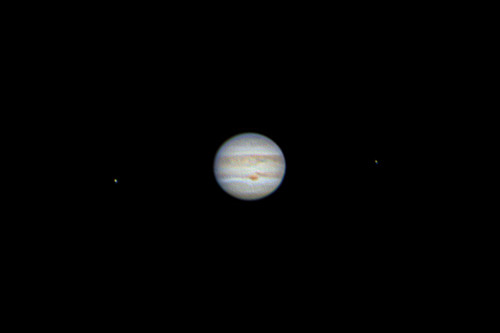
I began with a look at the two giant planets of the solar system (both of which are now one month after opposition). Jupiter’s Great Red Spot was visible, along with a very turbulent-looking NEB. Saturn could be seen casting a shadow across its rings and the Cassini Division was showing well. As the seeing was fairly good (considering Jupiter’s low altitude) I swapped the eyepiece for the Canon 80D and captured a few videos before the clouds got in the way.

Jupiter

I didn’t expect to get much else done tonight, so when the sky cleared again I decided to take a quick tour of some old favourites, as well as tracking down a couple of new targets.

Veil Nebula, supernova remnant, Cygnus
50x (24mm Panoptic) + OIII filter. Both sides of the loop and the inner triangle were visible, along with the “hooks” on the eastern veil. Like a lot of deep-sky objects, the more times you look at it, the easier it is to see the fainter details.

M31, Andromeda Galaxy
50x and 171x. Needs to be higher in the sky to get the best out of it, but the usual details were present and correct. Satellite galaxy M32 showed a star-like core.

M33, Triangulum Galaxy
50x. Ditto – needs to be higher in the sky, but quite bright considering, albeit lacking in detail. This is the first time I’ve looked at this galaxy since I got the 9x50 finder, and I’m pleased to say it was faintly visible in the finder – which means I won’t have to waste time sweeping for it anymore. I upped the magnification to 171x to look at NGC 604, which showed just a hint of the extended structure visible in photos, but I think I’ll need to go to a much higher magnification (on a really good night) to be sure.

NGC 404, Mirach’s Ghost, Andromeda
171x. As I thought it might be, the 7mm DeLite is the perfect eyepiece for observing this galaxy. Showed a bright core and the shell-like structure noted on previous occasions.

NGC 663, open cluster, Cassiopeia
171x. Large, rich cluster; visible in finder.

M103, open cluster, Cassiopeia
171x. Rich, condensed cluster. Red star in centre.

NGC 637, open cluster, Cassiopeia
171x. Small, triangular cluster with bright stars overlying an unresolved haze of fainter stars.

IC 1747, planetary nebula, Cassiopeia
171x. Nor far from Epsilon Cas. Very small round disc; perhaps brighter on one side, but hard to be sure even at this magnification. I wouldn’t have seen it if I hadn’t been specifically looking for it, and I imagine it appears star-like at anything under 150x. Not surprisingly, plotted in SA 2000, but not the PSA.

Nature note:
Not just the usual roaming frogs to contend with, but also plenty of spiders and bloodthirsty mosquitoes.

Thursday, 10 September 2020

Open Clusters and Falling Stars

11 August 2020, 22:00 – 23:30


Conditions: Very warm and muggy. Patchy cirrus (especially in the south) and distant flashes of lightning.

Seeing: Average
Transparency: Poor

A short observing session, curtailed by increasing cloud and mist and what I thought was an approaching thunderstorm. The lightning was flashing every few seconds after 11pm, but I never heard a single rumble, and the expected storm didn’t materialise in the end. I also tried – and failed – to photograph some Perseids, although I did see a couple of bright ones streaking through the haze as I was packing up. Typical meteors!

All observations at 92x (13mm Ethos).

M39, open cluster, Cygnus
Showed well in the finder as a triangular concentration of stars. At 92x it became a loose collection of about two dozen bright blue-white stars barely fitting in the Ethos field of view, plus a scattering of fainter ones blending into the rich Milky Way background.

M29, open cluster, Cygnus
Visible as a partially resolved fuzzy patch in the finder. The eyepiece view showed a compact, basket-shaped little group of eight bright stars and about half a dozen fainter ones (I expect a lot of them were washed out by the hazy sky). As noted before, this cluster is kind of like a pocket Pleiades. Not rich or condensed, but the wide field of view of the Ethos shows it quite nicely in the wider context of the surrounding Milky Way.

NGC 6709, open cluster, Aquila
Fairly rich v-shaped cluster comprised of stars with a mixture of brightnesses. The central region seemed somewhat hollowed out.

NGC 6760, globular cluster, Aquila
Round, condensed blur; very faint – only glimpsed with averted vision (although the sky was getting very hazy by that point). I’d like to try this one again on a better night.

Thursday, 3 September 2020

Nebulae in Sagittarius

22 – 23 July 2020, 23:00 – 1:00


Conditions: Breezy, partial cloud cover to begin with – clearing over the course of the session and then returning towards the end.

Seeing: Poor / average
Transparency: Average / poor

I know I’ve spent a lot of time exploring Sagittarius lately, but at the rate the neighbour’s trees are growing and the likelihood of local light pollution returning to its pre-lockdown levels, this might be the last best chance I get to study this object-rich part of the sky. With the nights growing longer again, the wonders of Cygnus and Cepheus will still be well-placed for the next two or three months; the same can’t be said for the southern Milky Way.

NGC 6440, globular cluster, Sagittarius
133x. Faint condensed blur in same field as NGC 6445, brightens with averted vision.

NGC 6445, planetary nebula, Sagittarius
133x (no filter) and 171x (OIII). Quite faint without the filter (one of the consequences of averted vision is that this nebula was easier to see when I was looking straight at 6440). With the filter in place, 6440 disappeared and 6445 became much more obvious. The higher magnification made the misshapen ring structure more apparent (it looked more like a buckled wheel than a box). Most prominent feature was a bright condensation on the northern rim.

M8, Lagoon Nebula, Sagittarius
171x + OIII filter. Obviously M8 loses a lot of its impact at this magnification, but the brightest part of the nebula is easier to study. Hourglass shape apparent, of which the southern component brighter. Smattering of embedded stars visible with averted vision.

M20, Trifid Nebula, Sagittarius
171x + OIII filter. M20 also loses some impact at higher magnification, but the central star system was easier to resolve (when the seeing allowed) as a line of three very close stars. Nebula and dark lanes best seen with averted vision.

M16, Eagle Nebula, Serpens
171x + OIII. Averted vision showed a dark patch at the centre of the nebula, but the contrast was still too low to make out any kind of shape or structure. Lower magnifications are better for this object.

M17, Swan Nebula, Sagittarius
171x + OIII. Nebula still very bright at 171x. This magnification doesn’t really add anything to this object although the dark lanes were a little easier to see, giving it a segmented appearance. The body section does appear remarkably straight, like it’s been “dragged” across the sky with a paintbrush.

NGC 6629, planetary nebula, Sagittarius
171x + OIII. Very small, bright little disc, north of M28. I may have seen the central star with averted vision, but it was tough to separate from the nebula.

I also looked for other Sagittarius planetaries 6537, 6567 and 6644 with this eyepiece/filter combination, but they eluded me on this occasion. Or to put it another way, nothing jumped out at me in the manner that 6445 and 6629 did.

M28, globular cluster, Sagittarius
133x. As per previous observations. Bright, condensed; grainy with averted vision.

M22, globular cluster, Sagittarius
133x. If this is my last look at Sagittarius for the year I had to finish with arguably its most spectacular object. Several dozen stars seen in direct vision. The low altitude can make this cluster look somewhat washed-out at first glance, but it's well worth investing the time to let the magnificent view build up on your retina like a developing photo.

As usual I closed the session with a look at Jupiter and Saturn. Jupiter was the stand-out tonight with the GRS on show and all four Galilean moons positioned on one side of the planet. However the seeing was too mushy to bother with an imaging run.

Thursday, 27 August 2020

From the Lagoon to the Eagle (in OIII)

21 – 22 July 2020, 23:00 – 1:00


Conditions: Started mild, ended chilly (much like the previous night). Light breeze. Some light pollution spilling over from next door (I’m glad I didn’t leave those last three Messiers until tonight).

Seeing: Poor
Transparency: Average

I’d been hoping to revisit the various Sagittarius nebulae with the Astronomik OIII and tonight seemed like the perfect opportunity to use a filter. Observations at 92x unless otherwise stated.

NGC 6445, planetary nebula, Sagittarius
Conspicuous-sized ghostly disc on the western side of the constellation. Quite bright in OIII. Averted vision transformed the disc into a ring, with brighter segments to the north and south.

M8, Lagoon Nebula, Sagittarius
The nebulosity becomes even more expansive in the OIII filter, filling most of the fov of the Ethos (at the expense of the starlight, which is greatly subdued). The large rift dividing the cluster from the brightest part of the nebula now looks like a dark crescent surrounded by nebulosity. On previous occasions I’ve found it difficult to reconcile the telescopic view of M8 with the familiar one seen in images, but tonight it really did start to resemble a photo (minus the colour of course).

Another bright ISS pass (nearly overhead) at 23:20 – 23:25.

M20, Trifid Nebula, Sagittarius
The Trifid seemed distinctly larger and – while not particularly bright – stood out from the background sky much better in the OIII filter. The dark lanes showed well in averted vision. It took a little more effort than M8, but again, it did start to resemble a black-and-white photo (but without the reflection nebula component).

M17, Swan Nebula, Sagittarius
Very bright in the OIII filter; the elongated swan shape is so distinctive that once you’ve seen it a few times it’s hard to see anything but a swan. It almost appeared to be frozen in the act of gliding through space. The area immediately to the north (directly beneath the “body”) was very dark by contrast, as if the swan is riding on black ice or on the surface of an impenetrably dark lake. The nebula itself was mottled, including a dark band cutting across the neck, although I think these dark features are easier to see at 133x. Also noticed a little detached portion of nebulosity directly above the head.

M16, Eagle Nebula, Serpens
Not especially bright, even in OIII, but the bird-like shape was more apparent. The filter transformed the nebula into a broad, diffuse band of light which appeared to curl (like wings) around the cluster. averted vision showed a wedge of darkness cutting into the nebula from the eastern side, but it was ill-defined, certainly not as dramatic as the photographic appearance.

Subsequent observations at 171x (no filter).

NGC 6717 (Palomar 9), globular cluster, Sagittarius
Small, grainy glow just south of 5th magnitude Nu2 Sgr – not hard to spot despite the glare from the star. Condensed with averted vision, which also revealed a second bright spot north-east of the core. An interesting object (the globular equivalent of NGC 404 in Andromeda).

Rounded off the session with a look at Jupiter and Saturn, followed by some imaging of the same. Variable seeing limited the quality of the results.