Friday, 6 September 2019

Three Globulars and a lot of Galaxies

26 February 2019, 19:15 – 22:15

Very mild for time of year, a little hazy; some condensation, but not as bad as the last few sessions. All observations with the 9mm Nagler at 133x.

M79, globular cluster in Lepus
Grainy fuzzball – small and condensed, but quite distinctive despite the light pollution in this part of the sky. A single faint star resolved on northern edge (and it is a cluster member, not a foreground star; see the DeepSkyVideos take on M79). I was amazed I could see it so well given its declination (-24 degrees = about 15 degrees above the horizon at culmination).

NGC 2355, open cluster in Gemini
The “leaf” cluster, as described previously. Looked a little hazy tonight.

NGC 2266, open cluster in Gemini
Rich little cluster. Shape resembles a triangle with caved-in sides. Brightest star at southern apex.

NGC 2129, open cluster in Gemini
Two bright stars with a retinue of fainter stars in two lines arranged roughly east-west (southern line straight, the northern one wavy – like an approximation symbol).

M35, NGC 2158, open clusters in Gemini
Latter partially resolved with averted vision; M35 fills the field of view at 133x.

NGC 2419, globular cluster in Lynx
Found it at last (on the third attempt!). The so-called “intergalactic wanderer”. Faint round blur in line with two bright stars. Averted vision increases its size but little else. A few faint foreground stars sprinkled around the cluster, but obviously not associated with it.

NGC 2841, galaxy in Ursa Major
Elliptical shape, stellar nucleus embedded in what looked like a bar-shaped core region. Faint foreground star on western end. Dark lane on southern edge of galaxy?

NGC 2681, galaxy in Ursa Major
Small, round galaxy, fainter than 2841. Stellar nucleus with faint outer envelope. Two stars on western side of galaxy and a fainter one to the east.

M108, galaxy in Ursa Major
Large, extended, seems “mottled” with averted vision. Foreground star near nucleus and another one to the west.

M109, galaxy in Ursa Major
Hazy round blur. Seems kind of faint for a Messier object (albeit a belated entry), especially given all the much more obvious NGC galaxies in and around the same constellation.

NGC 3613, galaxy in Ursa Major
Faint round blur midway between two field stars. Bright, bar-like core. This area (in the bowl of Ursa Major) is one that would benefit from a 50mm finderscope alongside the EZ finder (I was actually looking for 3619).

NGC 3898, galaxy in Ursa Major
Another one inside the body of the Bear. Bright, stellar core; faint outer envelope. Overall, similar in brightness to 3613.

At this point I took a temporary break from galaxies to revisit some familiar double stars:

Mizar / Alcor, Ursa Major
Famous double star in Ursa Major: Both stars well-framed at 133x; Mizar resolves into a pair of icy blue stars.

Cor Caroli, Canes Venatici
Nice split at 20 arcseconds (similar separation to Mizar). Pale yellow secondary?

Gamma Leonis
Closely-paired double. Narrow separation and variable seeing made it tough to discern colours but the primary seemed pale orange and the secondary seemed pale yellow.

Back to the galaxies...

NGC 3607, NGC 3608, galaxies in Leo
Another Leo pair, fairly close together in the field of view. The smaller one (3608) forms a triangle with two stars. Both with stellar cores. Seemed like there were other galaxies in vicinity, but transparency and condensation (and tiredness) made it hard to be sure.

NGC 4565, Needle Galaxy in Coma Berenices
Well this one snapped me out of my tiredness in a hurry. I may have been hasty in stating that M82 was the best edge-on galaxy. After star-hopping to what I hoped was the correct region, it suddenly appeared as a long stiletto of milky light sliding into the field of view. The central bulge was clearly visible with a field star just to the north. The dark dust lane was visible without too much difficulty using averted vision, offset slightly to the north. Easily the night’s highlight despite the conditions and the less than optimal placement. On this evidence, much better than NGC 891, the other well-known edge-on galaxy in Andromeda.

NGC 4631, Whale Galaxy in Canes Venatici
Large, extended. Western end brighter and fatter. Star on northern edge of central region.

NGC 4656/7, Hockey Stick Galaxy in Canes Venatici
Extended blur, smaller and fainter than its neighbour (4631). Tired eyes prevented me from seeing more detail.

I started the evening with a globular, so it seemed apt to finish with one:

M3, globular cluster in Canes Venatici
Rising into view out of the east. A dense fuzzball of stars, well resolved with averted vision despite conditions/tiredness and other factors. After all the colourless galaxies, it seemed to have a distinctly bluish tinge. Weather (and moon) permitting, I’ll be coming back to this object, so it will be interesting to see if this is a real effect (over-abundance of blue stragglers perhaps?).

As I was starting to pack up, the night was capped by a slow meteor which left a brief trail as it descended past Polaris towards the northern horizon.

Friday, 30 August 2019

Nebulae and Clusters in Gemini

23 February, 20:00 – 21:30


Sky transparency not as good as on the 10th. Heavy condensation curtailed the session after 90 minutes.


M44, Beehive Cluster in Cancer
Not surprisingly, too large for the field at 50x (24mm Panoptic), but still an attractive sight. Lots of bright stars arranged in twos and threes.

M67, open cluster in Cancer
Lovely sight at 50x; a “filmy” mass of stars which appears richer than it probably is due to the lower contrast. Bright star nearby (to north), which looks like it's trailing the rest of the cluster in its wake.

NGC 2392 (Eskimo Nebula), planetary nebula in Gemini
At 240x (Nagler 5mm), unfiltered, the central star was clearly visible, but with both filters it was overwhelmed by the surrounding nebulosity. Very bright in the OIII (a little more so than the Ultrablock). No structure seen other than the concentric rings (which showed up best at 133x).

NGC 2371-2, planetary nebula in Gemini
Small and faint (more so than the previous viewing). The OIII at 240x seemed to “fill in” the nebula: very faint nebulosity completing the circle. Western lobe brighter, with central knot or condensation.

NGC 2355, open cluster in Gemini
Large, fairly loose cluster – not particularly rich in stars, but still distinctive enough to be pretty. Brightest members form a leaf shape, with a stalk of fainter stars curling north to a bright field star. This cluster doesn’t appear to have a nickname so feel free to call it the “Leaf Cluster” (until O’Meara names it the “Hershey Kiss Cluster” or something similar in his next book!).

M42, Great Nebula in Orion
On the wrong side of the meridian now, but still a majestic sight. Seeing variable, but E and F stars in the Trapezium were occasionally visible at 240x. Lots of intricate dark structure even at this high magnification. The Trapezium seemed to reside in a dark “hollow” within the Huygens region, but this may well be an illusory effect caused by my eyes re-adjusting to the brightness of the stars.

Rigel was a fairly easy split at 240x despite poor seeing.

Castor split nicely at 240x. About a magnitude difference between the pair.

Subsequent observations at 133x (Nagler 9mm).

NGC 2903, galaxy in Leo
Not as good as the last time I saw it, but just a suggestion of spiral arms in an s-shape.

NGC 2683, galaxy in Lynx
Long, bright spindle. Dark lane on northern edge?

Gamma Leonis (Algieba)
Nice split (albeit tight) at 133x. Subtle colour variation (orange and yellow?); needs another look.

With the condensation building, I grabbed a quick look at the following objects (a preview of forthcoming attractions, so to speak):

M63 (Sunflower Galaxy) in Canes Venatici
Bright, finely mottled appearance.

M94, galaxy in Canes Venatici
Bright, suggestion of dark lane.

M106, galaxy in Canes Venatici
Quite large and bright – may well be bright enough to show structure on a better night. Oddly, this is the first time I’ve seen this galaxy. For some reason I always managed to overlook it with the 4-inch (even though I'm sure it would have been easily visible).

Cor Caroli
Double star, wider separation than the other doubles I looked at tonight.


Nature Note
Three frogs in the pond (two mating).

Tuesday, 13 August 2019

Lunar Detour

14 February 2019, 18:45 – 20:15


A chilly evening after an unseasonably mild day – resulting in the heaviest condensation I've experienced to date, particularly on the secondary mirror. Fortunately, there was only one target tonight - a high, bright gibbous moon.

Seeing was variable with occasional moments of exceptional clarity (a finding backed up by the imaging tests). The moon was dazzlingly bright even at 240x (5mm Nagler) – at least until the condensation set in.

Visually, I saw 3 craterlets in Plato, the centre one clearly resolved.

Rima Birt (adjacent to the Straight Wall) showed up very well despite being some distance from the terminator. (I imaged this with the SP-102, but I don’t think I was ever quite able to see it through the eyepiece.)

Rima Hesiodus was long and very distinctive.

At least one rille was visible inside the rim of Pitatus.

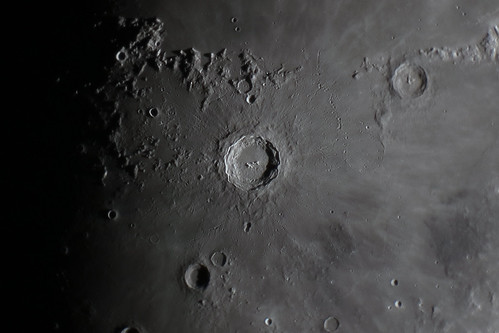
Copernicus of course was the highlight, showing far too much detail to describe here, but the image below gives an idea of what was visible (the eyepiece view occasionally exceeded this).

Copernicus

Tuesday, 23 July 2019

Galaxy Pairs in Leo

10 February 2019, 20:15 – 23:15


Conditions: Cold, but not freezing; light wind. Some interference from the crescent moon, but the transparency improved considerably once it got out of the way. Only meant to stay out for 90 minutes, but it turned into something of a marathon session.


Began with a low-power sweep across Auriga, stumbled upon M37: rich, lovely cluster. 50x really shows the cluster in context of its surroundings, at the expense of the fainter stars.

Then revisited some old favourites to test a new Astronomik OIII filter:
M42, Orion Nebula: western section greatly filled in. View similar to Ultrablock, but even more contrast between nebula and surrounding sky.
M1, Crab Nebula: OIII made it bigger; the edges seemed “crisper” and more defined, but as always, the Crab is one of those telescopic objects where expectation far exceeds reality.
Rosette Nebula: nebulosity more evenly distributed around cluster, more expansive.
Eskimo Nebula: very bright in OIII, overwhelming the central star.
M97, Owl Nebula: The OIII really benefits this planetary nebula, transforming it into a bright disc with sharper edges. Averted vision brings out the two dark cavities (the Owl’s “eyes”). Faint star adjacent to nebula. Otherwise there’s not much to choose between this (the OIII) and the Ultrablock, but still a huge improvement on the unfiltered view.

NGC 2022, planetary nebula in Orion
Small annulus of light, seemed to have brighter patches on opposite sides. Compared to previous observation, the OIII filter made it look even more like a mini M57.

NGC 2420, open cluster in Gemini
Rich, condensed mixture of directly resolved stars and underlying haze that resolves with averted vision. Brighter stars form a rough outline resembling a three-legged spiral or a propeller with swept-back blades.

NGC 2371-2, planetary nebula in Gemini
Small, elongated, bi-lobed nebula, like two tiny comets travelling in opposite directions. One lobe appeared slightly brighter than the other, with suggestion of a condensed core.

NGC 2683, galaxy in Lynx
Bright, lens-shaped galaxy. Suggestion of mottling around core and dark lane to north.

NGC 2775, galaxy in Cancer
Not as bright as 2683, but rounder, more face-on than previous galaxy. Averted vision shows stellar nucleus.

M67, open cluster in Cancer
Rich, fully resolved at 133x, though would probably look better at lower magnification to provide context.

M41, open cluster in Canis Major
Quick look: rich, sprawling cluster, bright stars forming curved lines. Unfortunately hampered by low altitude (-20 degrees declination) and local light pollution.

NGC 2903, galaxy in Leo
Large and bright as non-Messier galaxies go. Extended envelope surrounding bright core, with suggestion of at least one spiral arm. Slightly ragged appearance – arms not tightly wound, so in that sense intermediate between M81 and M33.

M95, M96, M105, NGC 3384, NGC 3412 and NGC 3377, galaxies in Leo
This was a pleasant surprise after the trouble I had picking out faint galaxies last autumn. A casual sweep of the area revealed six bright galaxies all within a few degrees of each other. M105 and NGC 3384 formed a close pair; M95 and M96 a wider pair. Initial impressions: all six galaxies showed condensed star-like cores and faint outer envelopes, with individual variations in size, brightness and roundness. M95 and M96 looked like they might show more detail with prolonged observation.

NGC 3190 and NGC 3193, galaxies in Leo
The atlas showed this pair positioned halfway between two naked-eye stars in the head of the lion – Gamma and Zeta Leonis (Algieba and Adhafera), so I knew I wouldn’t have to waste too much time sweeping the area. As it turned out, they showed up really well in the XT10. Smaller and fainter than previous set, but a pleasingly contrasting pair of galaxies in a star-rich fov. One circular, other edge-on, like mini version of M81 and M82.

NGC 3226 and NGC 3227, galaxies in Leo
As before, another easy star-hop from Gamma Leonis (Algieba). Slightly fainter than previous pair. Very close pair of galaxies, arranged end to end, long axes aligned. Condensed cores.

M65 and M66, galaxies in Leo
Larger, brighter than the M95/M96 pair, but the outer regions have lower surface brightness. Averted vision suggested brightness variations around the nuclei.

NGC 3628, galaxy, Leo
Third member of the Leo Triplet: faint bar of light perpendicular to M65/M66 pair. No central condensation; possible distortion/hook at one end? This galaxy (and the previous pair) was still fairly low down when I observed it – with higher altitude I might be able to see the dark lane.

M51 & NGC 5195, Whirlpool Galaxy in Canes Venatici
In a night of highlights, this was the undoubted stand-out. After staring at M51 for a couple of minutes I realised I could see the spiral arms quite clearly, defined by the dark space separating them. One arm curling out from core region around a foreground star. A magnificent sight at 133x, even though it was still some way from the zenith. With averted vision it started to look like a ghostly monochrome photo. A sketch might be in order.

M101, spiral galaxy in Ursa Major
Faint, hard to find (again). Hint of spiral structure, but my eyes were starting to feel tired by now.

M82, cigar galaxy in Ursa Major
Extended streak of light tapering to points at either end. High surface brightness, lots of detail in the form of bright condensations and dark dust lanes and notches. Best edge-on galaxy by far. Again, another sketch might be in order.

M81, spiral galaxy in Ursa Major
Bright core, extensive outer region. Possible dark patches near nucleus, but my eyes were getting really tired now, so time to call it a night.


Nature note 
Two frogs mating in the pond. I guess it’s never too early…

Monday, 15 July 2019

Orion in Forty Minutes

30 January 2019, 19:00 – 19:40


One of those frustrating nights where you collimate the mirror, extricate a spider (a real spider, not the structure that holds the secondary mirror in place) and its web, take the scope outside, let it cool down, and then – just as you’re ready to begin observing – the clouds start rolling in. That said, I did manage to see a few new targets through the ever-narrowing gaps, although the observations were brief and my eyes weren’t fully dark-adapted.

All observations with the Nagler 9mm (now established as my eyepiece of choice for this scope).


NGC 2169, open cluster in Orion
A small, condensed grouping of bright stars. Not particularly rich, but visually pleasing – worth a longer look under more favourable conditions. Begs the question: at what point does a multiple star system become a cluster?

NGC 2022, planetary nebula in Orion
Appeared as a small faint annulus at 133x, like a diminished version of M57. Suggestion of brightness variations – Ultrablock and/or higher magnification should give an improved view.

NGC 1999, reflection nebula in Orion
Small patch of nebulosity roughly south of M42. (I noticed this on the uncropped frames of my December image and thought it might be bright enough to detect visually.) The central condensation looked stellar, but I suspect that higher magnification may prove otherwise. Suggestion of dark patch/hole with averted vision. I wonder how many other DSOs are neglected because of their proximity to the Great Nebula?

Rigel (Beta Orionis)
Close double, easy split at 133x even though the companion coincided with one of the diffraction spikes. Cloud starting to interfere, but used this as an opportunity to fine-tune the alignment on the EZ Finder.

NGC 1788, reflection nebula in Orion
Very faint patch of light north of Beta Eri. Faint star at centre? Literally had less than two minutes to look at this before the clouds finally put an end to the session.