Showing posts with label panoptic. Show all posts

Thursday, 17 September 2020

Revisiting Old Favourites

18 – 19 August 2020, 22:00 – 00:30


Conditions: Mild to begin with, but started to turn chilly towards the end of the session. Patchy cloud passing overhead.

Seeing: Good
Transparency: Good

I began with a look at the two giant planets of the solar system (both of which are now one month after opposition). Jupiter’s Great Red Spot was visible, along with a very turbulent-looking NEB. Saturn could be seen casting a shadow across its rings and the Cassini Division was showing well. As the seeing was fairly good (considering Jupiter’s low altitude) I swapped the eyepiece for the Canon 80D and captured a few videos before the clouds got in the way.
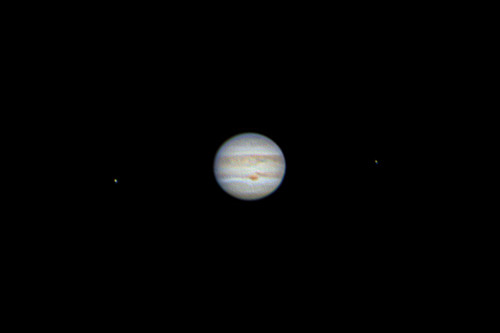
Jupiter

I didn’t expect to get much else done tonight, so when the sky cleared again I decided to take a quick tour of some old favourites, as well as tracking down a couple of new targets.

Veil Nebula, supernova remnant, Cygnus
50x (24mm Panoptic) + OIII filter. Both sides of the loop and the inner triangle were visible, along with the “hooks” on the eastern veil. Like a lot of deep-sky objects, the more times you look at it, the easier it is to see the fainter details.

M31, Andromeda Galaxy
50x and 171x. Needs to be higher in the sky to get the best out of it, but the usual details were present and correct. Satellite galaxy M32 showed a star-like core.

M33, Triangulum Galaxy
50x. Ditto – needs to be higher in the sky, but quite bright considering, albeit lacking in detail. This is the first time I’ve looked at this galaxy since I got the 9x50 finder, and I’m pleased to say it was faintly visible in the finder – which means I won’t have to waste time sweeping for it anymore. I upped the magnification to 171x to look at NGC 604, which showed just a hint of the extended structure visible in photos, but I think I’ll need to go to a much higher magnification (on a really good night) to be sure.

NGC 404, Mirach’s Ghost, Andromeda
171x. As I thought it might be, the 7mm DeLite is the perfect eyepiece for observing this galaxy. Showed a bright core and the shell-like structure noted on previous occasions.

NGC 663, open cluster, Cassiopeia
171x. Large, rich cluster; visible in finder.

M103, open cluster, Cassiopeia
171x. Rich, condensed cluster. Red star in centre.

NGC 637, open cluster, Cassiopeia
171x. Small, triangular cluster with bright stars overlying an unresolved haze of fainter stars.

IC 1747, planetary nebula, Cassiopeia
171x. Nor far from Epsilon Cas. Very small round disc; perhaps brighter on one side, but hard to be sure even at this magnification. I wouldn’t have seen it if I hadn’t been specifically looking for it, and I imagine it appears star-like at anything under 150x. Not surprisingly, plotted in SA 2000, but not the PSA.

Nature note:
Not just the usual roaming frogs to contend with, but also plenty of spiders and bloodthirsty mosquitoes.

Tuesday, 12 November 2019

The Helix Nebula and other Highlights

30 August 2019, 22:30 – 01:00 BST


Much better transparency tonight – ideal for photographing my primary target for the autumn: M33. And the previous sessions had given me enough confidence in the imaging and autoguiding rig to leave it alone while it captured two hours’ worth of data. (With no bright stars nearby, the hardest part was getting the galaxy centred in the camera’s field of view.)

After idly touring the Milky Way while my eyes fully adapted to the dark, it seemed only right that I open the session with a closer look at the object I was imaging:

Triangulum Galaxy

M33, Triangulum Galaxy
Viewed at both 50x and 133x; challenging as always. The northern spiral arm was easier to see than the southern one. The nucleus was star-like, with a faint star close to it (in line with NGC 604). Some of the other HII regions were suspected with averted vision, but not to the point where I could say I was confident of detecting them. I used a finder chart to pinpoint the location of the globular cluster C39 but, not surprisingly, it was below the threshold of visibility.

NGC 7331, spiral galaxy, Pegasus
Viewed at 133x and 240x. At the higher magnification there was perhaps a hint of one of the companion galaxies, but it was extremely subtle. Likewise, there was a very vague suggestion of a misty glow in the region where Stephan’s Quintet is supposed to be, but not convincing enough for me to call it.

NGC 7009, Saturn Nebula, Aquarius
Bright ellipse at 133x. At 240x with the OIII filter it became very bright, albeit devoid of detail. I couldn’t see the ansae directly, but with averted vision I could tell there was something “Saturn-like” about its shape. The nickname is well-deserved; at first glance it does look a lot like a ghost image of the ringed planet.

M2, globular cluster, Aquarius
Best view yet of this globular. Large, slightly elongated, well resolved, particularly with averted vision. The brightest member is just to the east-northeast of the core (though this may be a foreground star).

M15, globular cluster, Pegasus
Viewing one globular straight after another really allows you to appreciate the differences. M15 is brighter than M2 and clearly more condensed. Easier to resolve too (more stars visible in direct vision).

NGC 7293, Helix Nebula, Aquarius
With a declination of -21 degrees and a reputation for having a low surface brightness, I wasn’t sure if I was going to be able to see this planetary nebula, but a sweep of the area at 133x with the OIII filter quickly brought it into view. It showed up surprisingly well, looking not unlike its familiar photographic representation (albeit minus the colour). Even though I’d read about it before, I was still unprepared for just how big it appeared in the field of view. Overall it resembled a pair of large, ghostly overlapping smoke rings, with a darker cavity on the northwest edge and a hollowed-out interior. At 50x (still with the OIII filter) it was brighter still. The only other planetary nebula I can think of that vaguely resembles it is the Owl Nebula in Ursa Major, but the Helix is superior in every way (not just size). Easily the highlight of the evening. Afterwards, I removed the OIII filter to test if I could see it unaided, but it had left the field of view by the time I put the Panoptic back in and I couldn’t find it again. I’m pretty certain I was sweeping in the right area, so file that as another success for the OIII filter.

Nature note:
At least 10 frogs in the pond, including several of this year’s froglets and the large pale “telescope-hopper” from Monday night.

Friday, 30 August 2019

Nebulae and Clusters in Gemini

23 February, 20:00 – 21:30


Sky transparency not as good as on the 10th. Heavy condensation curtailed the session after 90 minutes.


M44, Beehive Cluster in Cancer
Not surprisingly, too large for the field at 50x (24mm Panoptic), but still an attractive sight. Lots of bright stars arranged in twos and threes.

M67, open cluster in Cancer
Lovely sight at 50x; a “filmy” mass of stars which appears richer than it probably is due to the lower contrast. Bright star nearby (to north), which looks like it's trailing the rest of the cluster in its wake.

NGC 2392 (Eskimo Nebula), planetary nebula in Gemini
At 240x (Nagler 5mm), unfiltered, the central star was clearly visible, but with both filters it was overwhelmed by the surrounding nebulosity. Very bright in the OIII (a little more so than the Ultrablock). No structure seen other than the concentric rings (which showed up best at 133x).

NGC 2371-2, planetary nebula in Gemini
Small and faint (more so than the previous viewing). The OIII at 240x seemed to “fill in” the nebula: very faint nebulosity completing the circle. Western lobe brighter, with central knot or condensation.

NGC 2355, open cluster in Gemini
Large, fairly loose cluster – not particularly rich in stars, but still distinctive enough to be pretty. Brightest members form a leaf shape, with a stalk of fainter stars curling north to a bright field star. This cluster doesn’t appear to have a nickname so feel free to call it the “Leaf Cluster” (until O’Meara names it the “Hershey Kiss Cluster” or something similar in his next book!).

M42, Great Nebula in Orion
On the wrong side of the meridian now, but still a majestic sight. Seeing variable, but E and F stars in the Trapezium were occasionally visible at 240x. Lots of intricate dark structure even at this high magnification. The Trapezium seemed to reside in a dark “hollow” within the Huygens region, but this may well be an illusory effect caused by my eyes re-adjusting to the brightness of the stars.

Rigel was a fairly easy split at 240x despite poor seeing.

Castor split nicely at 240x. About a magnitude difference between the pair.

Subsequent observations at 133x (Nagler 9mm).

NGC 2903, galaxy in Leo
Not as good as the last time I saw it, but just a suggestion of spiral arms in an s-shape.

NGC 2683, galaxy in Lynx
Long, bright spindle. Dark lane on northern edge?

Gamma Leonis (Algieba)
Nice split (albeit tight) at 133x. Subtle colour variation (orange and yellow?); needs another look.

With the condensation building, I grabbed a quick look at the following objects (a preview of forthcoming attractions, so to speak):

M63 (Sunflower Galaxy) in Canes Venatici
Bright, finely mottled appearance.

M94, galaxy in Canes Venatici
Bright, suggestion of dark lane.

M106, galaxy in Canes Venatici
Quite large and bright – may well be bright enough to show structure on a better night. Oddly, this is the first time I’ve seen this galaxy. For some reason I always managed to overlook it with the 4-inch (even though I'm sure it would have been easily visible).

Cor Caroli
Double star, wider separation than the other doubles I looked at tonight.


Nature Note
Three frogs in the pond (two mating).

Thursday, 11 July 2019

Winter Nebulae

28 January 2019, 19:15 – 21:15


The first clear, moon-free night in over a month. Cold, but not bitter. Light wind. Good transparency. Scope seemed to take longer to reach ambient temperature; best views were at 133x (9mm Nagler).

M45, Pleiades, Taurus
Viewing at 50x (24mm Panoptic); Merope nebula easier to see now I’ve got my bearings: visible as a misty patch fanning out from Merope to the south, framed by dark “lanes” on either side. The nebulosity in the Pleiades is much easier to see when you know which stars aren’t involved in it, such as the distinctive line of stars trailing from Alcyone.

NGC 2024, Flame Nebula in Orion
Tough to see because of the glare from Alnitak. Better contrast at 133x, but more condensed at 50x. IC 434 (the glow behind the Horsehead) was only suggested at best, but NGC 2023 clearly visible as a small patch of light surrounding a star, swelling with averted vision.

M78, reflection nebula in Orion
Twin stars immersed in a cloud, like headlights shining through fog. Some mottled structure apparent with averted vision, sharp cut-off on northern side – NGC 2071 visible on the other side of this dark gap: smaller and fainter than M78, no structure visible.


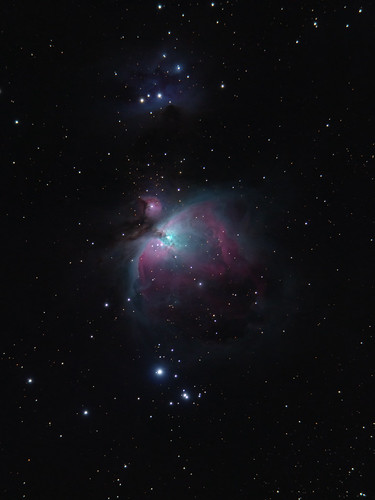
Orion Nebula (reprocessed)


M42, Great Nebula in Orion
Breathtaking spectacle; can appreciate it even more now I’ve photographed it (above). 133x gave the best view for contrast and detail even though it was too big for a single fov. Intricate detail seen with direct and averted vision, including nebulosity within the “fish-mouth” area. The dark lane between M42 and M43 contrasts nicely with the fainter nebulosity beyond the Huygens region, illustrating that the nebula is much more extensive than its initial bird-like appearance implies. Brighter arc seen on opposite side of cavity, corresponding with sculpted section seen in photos.

Trapezium stars E and (to a lesser extent) F were oddly easier to see at 133x than 240x (clearly not a night for high-power viewing).

The southern wing of the nebula was remarkable: long and irregular but with well defined edges, like a ribbon of light. The adjacent part of the nebula was not the same colour as the ribbon, but hard to say what exactly other than “not green”. Maybe the slightest hint of violet, but it was right on the limit of perception.

The Ultrablock significantly filled out the northern half of the nebula and made the Huygens region seem more boxy, sharper-edged, but otherwise not that much improvement (not a criticism of the filter; just that M42 is bright enough not to need it.)

M43, emission nebula in Orion
Comma-shaped haze surrounding single star. Dark lane visible with averted vision.

Also quick looks at NGC 1981 open cluster and the Running Man Nebula, the latter’s gauzy appearance clearly more akin to the Merope nebula than M42. Averted vision suggested a “bite” taken out of the southern edge.

NGC 2174-5, open cluster + emission nebula, Orion
Obvious and surprisingly large patch of light, somewhat elongated. Nebulosity seemed concentrated around central star, but no obvious cluster, at least not at low magnification.

NGC 2392, Eskimo Nebula, Gemini
Lovely winter planetary. Small, but immediately obvious fuzzy star at 50x. Nearby star helps confirm its nature. Central star visible at 133x. Averted vision showed two concentric rings of material. Seemed more blue-green than typical grey-green, but difference is subtle; certainly nowhere near as blue as the Snowball in Andromeda. Ultrablock filter improved contrast but not really required for such a bright nebula.

NGC 2264, Christmas Tree Cluster, Monoceros
Very pretty (and “right” way up for a change). Very bright blue star at “base” – seemed to be surrounded by haze, but hard to tell if it was genuine nebulosity. No obvious sign of the Cone Nebula, but while sweeping south I soon arrived at…

NGC 2261, Hubble’s Variable Nebula, Monoceros
Small and bright (but obvious even at 50x) fan-shaped nebula. 133x showed bright condensation at apex, but I think it would take a still higher power to show significant detail.

NGC 2237-9 (Rosette Nebula), surrounding open cluster NGC 2244 in Monoceros
Took a while to find – the lack of bright stars in Monoceros (not to mention the ever-present lure of Orion) make it a challenge to navigate via star-hopping. Appearance: Boxy cluster surrounded by large, diffuse nebula – too large for fov even at 50x. Brighter arc on northern side. Potential photographic target for TV60.

While sweeping across Monoceros I stumbled upon what I later identified as NGC 2301 – a distinctive rich cluster, well worth a return visit (if I can find it again).

Quick looks (cold, condensation and tiredness starting to play a part):

M97 (Owl Nebula), planetary nebula in Ursa Major
Large and faint (the opposite of the Eskimo). The Ultrablock dramatically improved the view. Hint of dark cavities (the owl's eyes).

M108, galaxy in Ursa Major
Faint sliver of light, with field star imposed over centre. Another potential photo target (pairing with Owl Nebula).

M81, M82, galaxies in Ursa Major
Not as impressive as previous observations – a sign it was time to pack up for the night.

Wednesday, 12 June 2019

Auriga and Beyond

30 November 2018, 20:30 – 22:30 GMT


Conditions: Good transparency - dark enough that the 24mm Panoptic wasn’t hindered by sky brightness. Clear at first, some bands of cloud later on. Cold, but not especially so for the time of year. Set up the XT10 on concrete for the first time rather than the lawn (so I could have a chance of seeing M42 rising) – despite this the scope seemed to cool down relatively quickly.

M37, Open Cluster in Auriga
Lovely rich cluster, roughly triangular – instantly recognisable. Dark lanes and chains of stars give it a symmetrical shape reminiscent of a crab or beetle (very much like O’Meara’s sketch in The Messier Objects). Best view probably at 50x.

M36, Open Cluster in Auriga
Smaller cluster than M37; individual member stars brighter but less numerous. Would be more highly regarded if it wasn’t outshone by its neighbours.

M38, Open Cluster in Auriga
Large, rich cluster; somewhat “straggly” compared to M37. NGC 1907 in same field of view at 50x: small, condensed cluster – some resolution with averted vision at 50x, giving it a “sparkling” appearance. More stars pop out at 133x

Located AE Aurigae in the eyepiece, but couldn’t discern the surrounding nebula with any degree of confidence. However I had more success with…

NGC 1931 (aka “The Fly”), Emission Nebula in Auriga
An obvious streak of nebulosity at all magnifications. Ultrablock filter improved the contrast – quite bright as nebulae go. Higher magnification revealed a tight triangle of stars at the centre.

M1 (Crab Nebula), Supernova Remnant in Taurus
Appeared as a “puff” of cloudy nebulosity. 133x (Nagler 9mm) + Ultrablock improved the contrast, but no detail to speak of other than a vaguely bi-lobed shape. One of those deepsky objects that can only really be appreciated when you think about what you're looking at.

NGC 1647, Open Cluster in Taurus
Large, sprawling cluster – needs a wider field to get the best view.

M77, Seyfert Galaxy in Cetus
Not the most prominent constellation, but this galaxy is helpfully within 2 fovs of Delta Ceti (a distinctly blue star). M77 itself appears as a very bright core embedded in a disc of nebulosity – immediately obvious even in this light-polluted part of the sky. A nearby 10th magnitude star helps with focus and averted vision. The galaxy holds brightness well at 240x, but I couldn’t see the recently discovered supernova. If it brightens by 1 or 2 magnitudes I might get lucky. (Postscript: it didn’t.)

Also: Mira (Omicron Ceti) was visible to the naked eye.

M35, Open Cluster in Gemini
Rich, large cluster; very distinctive chain of similarly bright stars forming an arc. Nearby cluster NGC 2158 was visible as a condensed patch of light – started to resolve (with averted vision) at 133x, but not as easily as 1907 in Auriga.

M42, Orion Nebula (and M43)
Had to peer between branches of neighbour’s tree to see it, but it was still spectacular despite the partial obstruction. Very bright, greenish core almost overwhelming the Trapezium at 50x, detailed structure apparent with direct vision. Long “wings”, one sweeping out towards NGC 1980. Ultrablock filter significantly increased the extent of the nebula, particularly on the northern side. Could easily spend a whole evening on this object.

Tuesday, 28 May 2019

A Crystal Ball in Taurus

2 November 2018, 19:45 – 21:45 GMT


Cold, very light wind, transparency improving over the course of the session.

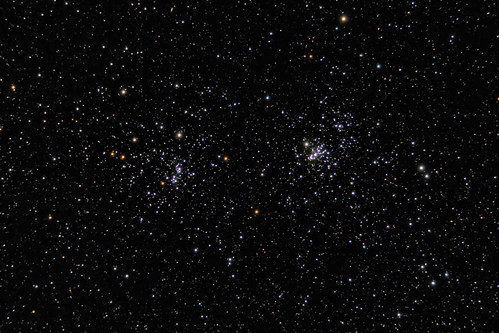
Double Cluster, Perseus

Double Cluster, Perseus
Viewed at 50x (24mm Panoptic). Comparing against recent photo (above). The lower magnification is better for framing the clusters – at the expense of some contrast – but the eyepiece view always beats the photographic representation. Red giant stars showing well.

Cr 466, open cluster in Cassiopeia 
Large and loose, would probably look better in a wide field refractor.

vdB 1, reflection nebula in Cassiopeia
First entry in O’Meara’s Secret Deep book. Despite its obscure designation it stood out reasonably well as an extended, if subtle, haze surrounding three stars. Not surprisingly the Ultrablock did nothing to improve the view (other than damping the glare from Beta Cas). Probably worth revisiting at higher magnification on a darker night.

M76, Planetary Nebula in Perseus
Prolonged averted vision (+ Ultrablock filter) seemed to reveal the faint “loop” extensions on either side of the main nebula (brighter on one side). Starting to wonder whether an O III filter might make a significant difference on this and similar nebulae.

NGC 1501, Planetary Nebula in Camelopardalis
133x + Ultrablock filter: green-grey disc which seemed to subtly change shape depending on which side of it I was looking. Otherwise, same details seen as on 9 October.

NGC 1514 (The Crystal Ball Nebula), Planetary Nebula in Taurus
The undoubted highlight of the session – a very pretty planetary nebula flanked by two nearby 8th magnitude stars (which help make the nebulosity obvious even at 50x). At 133x it appeared as a 9th magnitude star peering out from a cocoon of light. Obvious without the filter, but the Ultrablock really enhanced the view. The edges didn’t have a sharp cut-off (unlike other PN I’ve looked at recently), but the nebula had a certain indefinable quality about it that distinguished it as a Planetary Nebula rather than an Emission Nebula (like the difference between smoke and mist). It seems from my notes that I never tried for this with the 4-inch scope, but it doesn’t deserve its reputation as a difficult object. Having two similar-brightness stars in the same field-of-view really helps to “lock in” the averted vision.

Other notes: failed to find NGC 1275 (galaxy, Perseus), but did spot a lovely close double-star pair in the vicinity. Looked a little bit like a condensed facsimile of Eta Cas.

NGC 1342, open cluster in Perseus
133x. Fairly loose at this magnification. The “starfish” shape started to become apparent when I nudged the scope around, so would probably look better at 50x.

Also, a first look at M38 and NGC 1907, pair of open clusters in Auriga: very nice, well resolved at 133x. Two rich clusters presenting very different aspects – would definitely make a good imaging target for the TV60.

Condensation wasn’t so much of an issue this time, being noticeable only on the red dot finder.

Sunday, 26 May 2019

Cassiopeia – Camelopardalis

9 October 2018, 22:00 – 23:45 BST


Conditions: Transparency not great again, but still plenty of bright objects to look at.

NGC 281, nebula in Cassiopeia
Ultrablock filter helped a lot to improve the contrast at 50x (Panoptic 24mm). Central portion bright, contrasting against dark “maw”. Some mottled detail visible - dark lanes cutting through the nebula. Hard to determine overall size – nebula faded smoothly into background sky with no obvious cut-off.

Scanned the Cassiopeia/Perseus region for nebulae. Nothing popped out, but did sweep past some attractive open clusters, including Stock 23.

Gamma Arietis, double star in Aries
Pleasing blue-white pair of stars, equal brightness - like headlights.

NGC 1501, planetary nebula in Camelopardalis
Fairly bright medium-size PN, almost round. Slightly darker core revealed with averted vision, but not a “smoke-ring” like M57. Holds brightness at 240x (Nagler 5mm); appeared clumpy/mottled at higher magnification, seemed slightly brighter on north/south edges.

NGC 1502, open cluster in Camelopardalis
Viewed at 133x (Nagler 9mm); bright, rich cluster, pairs of stars running through middle. Triangular or wedge shape – like a racing yacht.

Tuesday, 14 May 2019

Double Stars and Double Clusters

16 September 2018, 22:00 – 00:00 BST


First quarter moon adding to the light pollution in the south-west, but at least the seeing was good.

M15, globular cluster in Pegasus
Examined at all three available magnifications. The sky background was too bright to resolve stars at 50x; there was an improvement at 133x, but on this occasion the best view came at 240x – pleasing contrast, lots of faint stars resolved.

Veil Nebula, supernova remnant in Cygnus
Hindered a little bit by moonlight, but with the Ultrablock to filter most of it out, plenty of detail still visible. The nebula had a winding, braided structure. Brightness held up well at 133x with the two main arcs extending across several fields of view. Pickering’s Triangle suspected, but not confirmed – if so, it was right on the threshold of visibility.

A quick tour of the open clusters in northern Lacerta was a little disappointing. The sky was too bright to do justice to the 24mm Panoptic, and at 133x the field of view was too small to properly frame the clusters. For the most part, they just looked like sparse associations of bright stars.

A similar tour of the Cassiopeia clusters at 50x fared better due to the richer clusters and the darker background in that part of the sky. An intermediate magnification might help with some of these NGC clusters.

Eta Cassiopeiae, double star 
Looked very nice at 133x, with the secondary appearing to have an unusual purple hue.

Double Cluster in Perseus
The red giant stars stood out more at 133x, but the two clusters lose some of their impact at this magnification. However, higher magnifications might be useful for separating close pairs and picking out fainter cluster members at 240x.

The following observations were all carried out with the Ultrablock filter.

M76, planetary nebula in Perseus
Holds brightness very well all the way up to 240x. Bi-lobed, boxy shape, with the brighter lobe appearing almost rectangular. No colour apparent. Prolonged examination suggested one or two knots/condensations within the brighter lobe.

NGC 404 (Mirach’s Ghost), galaxy in Andromeda
Only a quick look, but this little galaxy showed up surprisingly well. It seemed the Ultrablock dimmed the glare from Mirach more than it dimmed 404, but I’ll have to try this again without the filter to verify.

NGC 604, emission nebula in M33, Triangulum Galaxy
Perhaps it stood out a little more through the filter, but the difference seemed marginal at best.

NGC 1491, emission nebula in Perseus
I actually meant to look for a different nebula, but this one stood out surprisingly well as an extended misty patch with a single reasonably bright star offset from the centre. Suggestion of mottled structure at higher magnification. Faded smoothly into the background sky, unlike some of the nebulae I’ve been looking at recently.

Tuesday, 23 April 2019

Three More Clusters

31 August 2018, 22:00 – 23:00 BST

Just time to get in an hour of observing before the moonlight interferes.

Mars
240x (Nagler 5mm). Dust slowly clearing, hint of dark markings, polar cap very bright – like a sliver of fluorescent light.

NGC 6940, open cluster in Vulpecula
Best views at 50x (24mm Panoptic): an impressive sprinkling of stars with what looked like a central ribbon of brighter stars defining the long axis. Overall its shape vaguely resembled a tadpole or a deflating balloon on a string.

NGC 7063, open cluster in Cygnus
Loose, sparse gathering of bright stars – better suited to a wide-field refractor.

M15, globular cluster in Pegasus
The faintest stars were washed out by light from the rising moon, but it still looked impressive, particularly with averted vision.

Wednesday, 27 March 2019

Summer Clusters and Nebulae

14 -15 July 2018, 23:00 – 02:00 BST


A very clear night, if not completely dark; good enough to see 5th magnitude stars after dark-eye adaption, and the Scutum star-cloud with averted vision (although the latter seems to be more affected by light pollution than ever).

Saturn looked very impressive when I first pointed the telescope at it, with the usual moons in attendance and the Cassini Division visible most of the way around, but the seeing deteriorated rapidly as it passed the meridian. (Possibly due to warm air rising off the pond and the surrounding concrete.)

M39, open cluster in Cygnus
A sparse cluster of bright stars, spilling outside the edge of field of view even at 50x. Too loose and large for a big reflector; I wasn’t even sure I was looking at a cluster at first.

NGC 7062, open cluster in Cygnus
A grainy, fuzzy patch of nebulosity at 50x; starts to resolve at 133x. Faint stars.

NGC 6910, open cluster in Cygnus
A grouping of bright stars arranged in a kind of flattened Y-shape. Not rich, but well-framed at 50x. Quite pretty; would probably have greater appeal if it didn’t already reside in such a rich section of the Milky Way.

M29, open cluster in Cygnus
Boxy, like a mini version of the Pleiades. The extra aperture doesn't really add anything to this cluster that I hadn't already seen through the 4-inch.

NGC 7000, North America Nebula in Cygnus
Scanned region with Ultrablock, but too large for fov. Could tell that some areas were brighter than others but hard to distinguish nebulosity from the sheer number of background stars.

NGC 6888, Crescent Nebula in Cygnus
I spent a lot of time looking for this with the 4-inch and never convinced myself of seeing it, but I found it right away with the XT10 (Panoptic 24 mm + Ultrablock). Appeared as an elongated semi-circle of stars connected by bright streaks of nebulosity. Closer examination showed a faint haze filling the interior of the crescent, giving the impression of a baby wrapped in swaddling clothes, with a darker region where the face would be.

I left the Pan 24 and the Ultrablock in place and moved down to 52 Cygni and the Veil Nebula, supernova remnant in Cygnus: now high overhead and even more vivid than the previous sighting. The Witch’s Broom still looked like a frozen funnel cloud, a twisted spike of nebulosity extending beyond 2 fovs. The Eastern Veil showed more detail; both halves are very clearly “structured” nebulae, in that they have clearly defined edges as opposed to the more typical cloudy nebulae which just fade gently into the background sky.

M57, Ring Nebula in Lyra
Studied at 240x, with and without the Ultrablock filter. Holds its brightness well at high magnification in the XT10. Otherwise as per previous description. Slight green-grey colour.

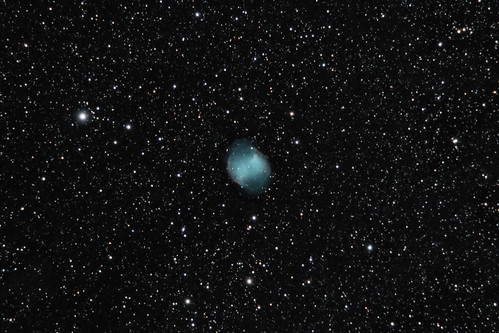
M27, The Dumbbell Nebula

M27, Dumbbell Nebula in Vulpecula
The "apple-core" took on a more boxy appearance at 240x. Distinct, sharp cut-off in brightness on one edge, and strong hints of structure within the nebula – most prominent being the diagonal bar commonly seen in photos like the one above.

M11, Wild Duck Cluster in Scutum
Not much I can add to the previous report. Just a fantastic cluster to look at in the XT10.

NGC 6712, globular cluster in Scutum
Stumbled upon this while sweeping south of M11. Fuzzy, circular blur at 50x, but starts to betray its true nature at higher magnification. Reminded me of M13 as seen in the smaller scope.

M15, globular cluster in Pegasus
Well resolved, very condensed core – more so than other globulars I’ve looked at. Definitely worth revisiting when it's higher in the sky. Nearby field stars really help frame this object at both 50x and 133x, giving it a 3D appearance.

NGC 7006, globular cluster in Delphinus
Small, circular blur. Relatively easy to see in the XT10, but no stars resolved.

NGC 7331, spiral galaxy in Pegasus
This galaxy displays a bright core nestled in a fainter disc, very much a mini M31. Suggestion of asymmetry on one side. Couldn’t see the companion galaxies (the “tadpoles”) on this occasion, but I think they should be visible on a darker night with higher magnification. (Ditto for Stephan’s Quintet.)

NGC 7662 (Blue Snowball), PN in Andromeda
I find it hard to distinguish between blue and green in low light, but this definitely has a bluish turquoise hue compared to, say, the grey-green of M57. Appeared circular at 133x, with a hint of a darker core.

Almach (Gamma Andromedae), double star
Lovely pairing of a pale yellow primary and a sky-blue secondary. (Looking back at the notes I made with the 4-inch, I've previously described the colours as straw and aquamarine.)

Tiredness was really starting to creep in at this point (and dew was forming), so subsequent observations fall into the “just one more object” category.

M52, open cluster in Cassiopeia
Rich cluster, worth revisiting in the autumn.

M31, Andromeda Galaxy
Showing a frustrating lack of detail despite its brightness. Obviously, higher altitude and darker skies should improve things, but perhaps higher magnification might increase the contrast at the expense of the “big picture”.

M33, Triangulum Galaxy
Large circular blur devoid of any real detail, but at least it was obvious (unlike in the 4-inch) despite being fairly low in the sky. Averted vision showed a distinct, almost star-like condensation at the nucleus – not something I recall seeing before.

Finished off with a first look at Mars through the XT10. As big as I’ve ever seen it (and ever likely to see it), but rendered featureless by the global dust-storm. Hint of a brightening at the poles, but low altitude causing a lot of colour dispersion. Even to the naked eye it looks pale yellow rather than its usual amber hue.


Tuesday, 19 March 2019

The Wild Ducks of Scutum

4 -5 July 2018, 23:30 – 01:00 BST


Another look at Saturn but (as on previous nights leading up to this), the seeing wasn’t good enough to justify setting up an imaging run. The moons were easier to see at 133x.

Epsilon Lyrae resolved much easier than the previous session - though this time, due to the seeing, the clearest separation came at 133x.

A quick first look at the Double Cluster and the Andromeda Galaxy, rising out of the northeast. The former looked spectacular at 50x, despite some obstruction from intervening foliage.

The Andromeda Galaxy (M31) showed a very bright core with a condensed, stellar nucleus. Too big for fov even at 50x. Lots of field stars superimposed over the galaxy; dark cut-off from dust lane clearly seen; M31 and M110 also showed up well. Outer environs of M31 not well seen due to sky brightness; dust lane aside, it was very hard to tell where the galaxy ended and space began, so to speak.

NGC 7000, North America Nebula in Cygnus
Scanned this region at 50x. Couldn’t be sure of seeing the nebula, but the richness of stars in this region was remarkable. Will revisit on a darker night.

M11 (the Wild Duck Cluster) in Scutum
The undoubted highlight of the night. Extremely rich, compact fan-shaped cluster at 50x. Switching to 133x showed the stars arranged in roughly half a dozen clumps separated by dark lanes – giving it a “fractured” appearance. Prominent 8th magnitude star at apex of fan; lots more stars revealed with averted vision. Better than any photo – has to be seen to be believed.

Saturday, 16 March 2019

First night out with the new scope

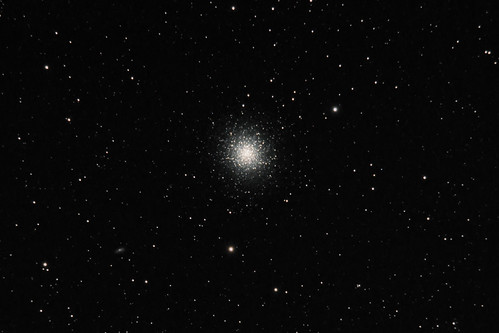
M13 Globular Cluster

18 – 19 May 2018, 22:30 – 02:00 BST


The sky was a little hazy and never completely dark, so for the most part I stuck to the bright showpiece objects. Best views came with the 9 mm Nagler – darker sky, better contrast. The scope took a good hour to cool down, but when it did the views were spectacular.

M13, great globular cluster in Hercules
In a word: wow! After switching from the 24 mm Panoptic to the 9 mm Nagler, pinpoint stars were resolved (in direct and averted vision) right across the face of the cluster, giving an impressive sense of scale and distance. After a while I could perceive chains of stars curving out from the centre. The first night was supposed to be a whistle-stop tour of some old favourites but I couldn’t tear myself away from this object. The longer I looked, the better the view got. I've viewed M13 many times with the 4-inch scope but now for the first time I could see it as a proper cluster of stars and not just a grainy snowball hovering on the threshold of resolution. (The photo above really doesn't do the spectacle justice.) At one point a satellite (space junk?) glided right across the middle of the cluster, followed a minute or two later by a second object travelling on the same path.

M57, Ring Nebula in Lyra
Very bright outer "donut", gauzy central region, brighter edge on one of the long sides. Faint star clearly seen adjacent to nebula.

M5, globular cluster in Serpens
Easier to find than I thought it would be. Smaller, more condensed than M13, but the XT10 resolved it well despite it being in a brighter part of the sky. Relatively bright star just off centre. It seemed (and I’ve thought this before with the Vixen SP-102) that although M13 is bigger and brighter overall, the brightest stars in M5 are brighter than the brightest ones in M13.

M81 and M82, pair of galaxies in Ursa Major
Not well-placed for observing now, but I couldn't resist looking at the Great Bear's famous galaxy pair. M81 showed a bright condensed core and not much else (I’ve no doubt the outer structure will be more evident on a better night). M82 was a surprisingly long streak of light (making me look forward to the likes of NGC 891, etc.) and the bisecting dark lane was clearly visible.

Despite its low altitude this year, Jupiter in the XT10 was as good as I’ve ever seen it. It was dazzlingly bright with the 9 mm Nagler, but the best view came with the 5 mm Nagler. Alt-Az tracking wasn’t any problem either, although it helped that it was near the meridian. Fleeting moments of good seeing revealed plenty of fine detail in and around the belts, with a noticeable “kink” in the NEB. The GRS was immediately obvious and – once my eye had adjusted to the brightness – its brick red hue stood out. All four Galilean moons were visible, but with no obvious signs of colour or resolution.

Veil Nebula, supernova remnant in Cygnus
I switched back to the 24 mm Panoptic for this one. As I anticipated, the sky wasn’t dark enough to see it with direct vision, but when I added the Ultrablock filter it immediately popped out. The Witch’s Broom (running through 52 Cyg) looked like a funnel cloud frozen in space, tapering to a sharp point. I had to sweep to find the other section, but again it popped out from the dark background, showing the distinct “chicken-bone” shape familiar from photographs, and a suggestion of a braided structure.

M27, Dumbbell Nebula in Vulpecula
Very bright with or without the Ultrablock. Appeared sharper on one side and ever so slightly bluer than M57. I need to spend more time on this object, but it's already clear that the XT10 is going to be an excellent scope for high-magnification viewing of planetary nebulae.

M71, globular cluster in Sagitta
Quick look, partly resolved. Loose for a globular.

NGC 6939, open cluster in Cepheus
Partially resolved, triangular shape. Appearance much the same as the photo I took recently.

Albireo, double star in Cygnus
One of the northern sky's showpiece doubles. Improved as it gained altitude; looked better at 50x, but perhaps the brightness was overwhelming the colours a little.

M51 and NGC 5195, Whirlpool Galaxy and companion in Canes Venatici
Again, not well placed, but both galaxies showed bright cores. A hint of spiral arm structure in M51, with a star superimposed over the face of the galaxy (definitely not a supernova).

Other impressions: lots of satellites/space junk seen passing through the field of view, often in pairs (According to Stellarium the brighter ones were from the GlobalStar family). The night included a very bright ISS passage - almost overhead - and visible most of the way down to the horizon.

Introduction

In April 2018, I made my first serious foray into astrophotography, as discussed here on telekilnesis, using a Tele Vue 60 refractor mounted on a Vixen Super Polaris equatorial mount. Of course, once an imaging session is up and running there's little for the astrophotographer to do other than wait for it to finish. Some choose to go back indoors and have a drink or watch TV, but I'm a visual observer at heart and it seemed like a missed opportunity.

My 102mm achromatic refractor (which used to sit on the Super Polaris) no longer had a mount, and I felt like I'd pushed the limits of what I could see through that scope (plus my eyes aren't getting any younger), so the inevitable craving began for a new, larger telescope.

The first part of the search wasn't difficult: if all you want is the pure observing experience (and you don't need a GOTO mount to navigate the night sky) then a basic Dobsonian design represents the biggest aperture for the least expenditure.

The second part took a little longer, but I eventually settled on the Orion SkyQuest XT10 Plus (other makes and models are available). A 10-inch reflector is probably the biggest scope I can safely carry out to the garden and back, and the eyepiece is almost always at a comfortable height for viewing while sitting down. (Equatorial mounts are great in so many ways, but I can't tell you what a relief it is not to have to contort my back anymore to look at objects near the zenith.)

So why keep a log?

Like other visual hobbies such as birdwatching or painting, telescopic astronomy rewards prolonged observation and careful study. If you look at a faint nebula or galaxy only once, you haven't really seen it. It takes time and techniques such as averted vision, scope-tapping and enhanced breathing to tease out the subtle details. And in most cases, it's not until you go back to it a second or third time that you really get a full appreciation for what you're looking at. But with so many objects to observe, if you haven't kept notes then how can you remember what you saw last time? For example, what was the optimum magnification for viewing a particular planetary nebula? Was it symmetrical? Was any colour apparent? Was it brighter on one or more sides? Was the central star visible? And so on...

I've tidied and expanded my notes to make them more presentable, but they were written largely for my own benefit and will probably read as such. But if you're curious to know what the universe looks like through a 10-inch reflector, or if you just want to compare my observations with your own notes, then you might find something useful here.

A final caveat: just so this blog isn't completely text-heavy, I will include some of the images I've taken with the TV-60. These aren't meant to represent the view through the eyepiece - no amateur telescope will show you the colour and detail in a long-exposure image. But then again, no photo will ever capture the immersive experience of gazing at a rich cluster of pinpoint stars through a wide-field eyepiece...


Equipment Summary


Orion XT10 with a Tele Vue 9 mm Nagler

Telescopes / Binoculars

Orion SkyQuest XT10 PLUS 254 mm f/4.7 Dobsonian Reflector (an enhanced version of the classic XT10 which comes with a dual-speed Crayford focuser and altitude tension adjustment, among other things)

Tele Vue-60 APO Refractor (which, when it isn't being used for photography, provides stunning widefield views of the night sky)

Swift 781 Aerolite 7x50 Binoculars


Eyepieces

Tele Vue 24 mm Panoptic (50x)
Tele Vue 9 mm Nagler (133x)
Tele Vue 5 mm Nagler (240x)

28 mm Deepview (43x)
10 mm Sirius Plossl (120x)
(The latter two eyepieces came with the XT10. They're perfectly fine as starter eyepieces go, but when you already own a set of Tele Vues, well...)

Barlows / Powermates

Tele Vue 2.5x Powermate
Orion 2x Shorty Barlow

Filters

Orion UltraBlock Narrowband 1.25"

Atlases

Each atlas has its own strengths and weaknesses, but if I had to recommend one it would undoubtedly be Sky & Telescope's Pocket Sky Atlas. This smartly-designed book divides the night sky into 80 charts mapping the stars down to magnitude 7.6, plus (in the jumbo edition) a further ten close-up charts depicting regions of interest such as Orion's belt and sword, and the Virgo galaxy cluster.

Observing Location

On a good night the limiting magnitude (NELM) from my back garden is about 5.5, which is equivalent to 6 on the Bortle Scale (Bright Suburban Sky). I find the best views are from the zenith towards the west and northwest (the shortest distance between me and the sea - and thus containing the least amount of light pollution).