Monday, 30 March 2020

First Light with the Tele Vue DeLite 7mm

12 March 2020, 19:30 – 21:45


Conditions: A chilly night (after a few mild days) with frequent strong gusts of wind (again). With the moon due to rise between 21:30 and 22:00, I had a roughly two-hour window to field-test my new acquisition: a Tele Vue 7mm DeLite. In the XT10 the DeLite gives a magnification of 171x, neatly filling the gap between the 9mm Nagler (133x) and the 5mm Nagler (240x).

Seeing: Poor to average
Transparency: Average to poor

The tube currents took a while to settle down, but once they did I turned my attention to:

NGC 2392, Eskimo Nebula, Gemini
At 171x the Eskimo was bright and nicely framed, with the central star clearly resolved as a tiny pin-prick of light. (It’s sometimes hard to separate the star from the nebula at other magnifications, but this eyepiece seems to hit the sweet spot.) There was even a hint of brightness variation in the outer shell of the nebula, but the variable seeing made this elusive.

h3945, double star, Canis Major
Viewed at 171x and 133x. I meant to look at this pairing last time out, but got distracted by NGC 2362. The seeing tonight was especially poor at this low altitude, but there was enough separation between the stars for it not to matter too much. h3945 (it deserves a catchier name) is a lovely double star comprised of a rich golden primary and a bright blue secondary (north). Some observers call it the Winter Albireo, and on this evidence I can see why.

Iota Cancri, double star, Cancer
Quite by chance (I was star-hopping to NGC 2683), the very next object I looked at was another colourful double, comprised of a pale yellow primary and a blue secondary (west). A very pretty pairing and another contender for the “Winter Albireo” label, but I think h3945 has the edge.

NGC 2683, galaxy, Lynx
Viewed at 133x and 171x. Bright, spindle-shaped galaxy aligned roughly NE-SW. Brighter towards the core, but no stellar nucleus as far as I could tell. Faint field stars across the eastern side of the galaxy. Dark cut-off along northern edge, indicative of a dust lane (like the one in NGC 7331).

NGC 3115, the Spindle Galaxy (Caldwell 53), Sextans
Follow-up from previous observation, viewed at 171x. Bright little galaxy, very bright towards the core. Much smoother outer envelope than 2683 (which seemed mottled by comparison).

M81 and M82, galaxy pair, Ursa Major
M81 was bright and large at 171x with a sprinkling of foreground field stars. Maybe a hint of spiral structure. I should really spend more time studying this galaxy, but it’s hard to concentrate on it when you know M82 is only a nudge of the scope away. Talking of which, M82 was also bright and large at 171x, with the main dark rift clearly visible, and a bright knot on the western side of the rift.

NGC 3077, galaxy, Ursa Major
An overlooked member of the M81 “family” (it’s taken me this long to get round to seeing it). Faint compared to M81 and M82, but not at all difficult in the DeLite. First impressions: an amorphous round blob near an 8th magnitude star; brighter towards the centre, but with a suggestion of asymmetry.

M40 (aka Winnecke 4), Ursa Major
An uninteresting pair of 9th magnitude stars – what more can I say about it? But I’ve seen it now (after many years of ignoring it), so let’s tick it off the list and move on. Fortunately M40 is en route (from Delta Ursa Majoris) to a much more worthy object…

NGC 4605, galaxy, Ursa Major
Faint, extended galaxy aligned roughly east-west. The DeLite showed a brighter bar-like core region which seemed to be at a slight angle to the rest of the galaxy. An intriguing object, made more interesting by the knowledge that it’s less than a degree away from the famous Hubble Deep Field.

NGC 4485 and NGC 4490, galaxy pair, Canes Venatici
Moonlight starting to interfere at this point, but both galaxies still clearly visible. The higher magnification and contrast of the DeLite showed a dark gap between the two galaxies, but 4490
was obviously distorted towards the smaller, fainter 4485.

M3, globular cluster, Canes Venatici
A little washed out by the rising moon, but still fairly well resolved. The dark lane on the eastern side (noted last time out) was more obvious at the higher magnification.

NGC 3242 (Caldwell 59), planetary nebula, Hydra
The so-called “Ghost of Jupiter”. I can’t say it looked anything like Jupiter, but it was brighter than I was expecting, and quite obvious despite interference from moonlight and obstructing foliage. Pale blue-green disc of light. Suggestion of darker core with averted vision, and apparent bright patch on southern edge, but detail elusive. Worth revisiting when it’s in a clear part of the sky.

Conclusions
While obviously not having the “wow” factor of a super-wide eyepiece like the Ethos, the renowned sharpness and contrast of the 7mm Delite should make it invaluable for detailed study of some of the showpiece DSOs where 133x is too little power and 240x is too much. (And, of course, I'm very much looking forward to viewing the moon through it.) I’ve never had a problem with the eye relief of the other eyepieces, but the extra 5mm of the DeLite does make a noticeable difference. It really is a very comfortable viewing experience. And the 62 degree field is ideal for sketching too if I ever get back into that dark art.

Nature note
The frog breeding season does seem to be over now, which is just as well because there’s barely room for any more frogspawn in the pond.

Sunday, 22 March 2020

Stargazing on a Windy Winter Night

27 February 2020, 19:30 – 22:30


Conditions: A very cold night with frequent strong gusts of wind – scuppering my original plan to view some planetary nebulae at the highest magnification the seeing would allow. (I stayed at 133x with the Nagler 9mm for most of the session.) No condensation.

Seeing: Good
Transparency: Poor to Average

The stormy winter continues; this was the first properly clear night for an entire month. I was hoping the storms might drag some clear air behind them, but the transparency didn’t really improve until the last half-hour of the session – by which point the cold was already becoming too much for me.

As usual, I began with a look at M42 (at 133x), before moving to Rigel. The companion star was easily visible, although partially obstructed by an extra diffraction spike. (I think this must have been something to do with the scope cooling down; the spike wasn’t present when I looked at Regulus later in the session with the same eyepiece.)

Betelgeuse is gradually starting to brighten again, according to recent reports. To the naked eye it seemed at least as bright as neighbouring Bellatrix, maybe fractionally brighter. Through the eyepiece it had a lovely orange/tangerine hue, strikingly different from the blue-white of Rigel. The colour was so vivid it prompted me to revisit another colourful star…

Hind’s Crimson Star, aka R Leporis, carbon star in Lepus
Seemed fainter than when I last looked at it, though the conditions (and/or the neighbours’ lights) might have had something to do with this. At 133x the blood-red hue contrasted nicely with the deep orange of Betelgeuse.

NGC 2170, reflection nebula, Monoceros
I drew a blank on NGC 2149, but 2170 was just visible as a very faint misty patch surrounding a star. Needed averted vision to be sure of seeing it.

M48, open cluster, Hydra
As noted previously, rich cluster of bright stars. Less impressive at 133x than at 92x in the Ethos, although the higher magnification does reveal some fainter stars near the middle. Distinctive two-arm flattened “spiral” of stars winding out from the centre along a N-S axis.

NGC 2506 (Caldwell 54), open cluster, Monoceros
Rich, small, condensed cluster. Several stars resolved with direct vision, with an underlying haze of unresolved stars. I think this cluster would look quite good on a better night. Seemed to be a dark “rift” protruding into the cluster from the south, giving it a bi-lobed appearance, like a sycamore seed.

NGC 2539, open cluster, Puppis
Rich, heart-shaped cluster, immediately west of 5th magnitude 19 Puppis. Brighter, larger and looser than 2506.

M67, open cluster, Cancer
Very rich cluster, perfectly framed at 133x. Stars arranged in tight clumps.

NGC 2362, Tau Canis Majoris cluster (Caldwell 64), Canis Major
Couldn’t resist another look at this spectacular cluster. I think the Ethos gives an aesthetically superior view, but the higher magnification does make it easier to resolve some of the close doubles lying within. Definitely one of the prettiest clusters I’ve seen – like fireflies gathering around a brilliant light.

NGC 2903, galaxy, Leo
Somewhat faint tonight compared to previous observations, but it still surprises me that this galaxy didn’t even make the Caldwell list. Condensed core, extended outer haze. With prolonged observation it seemed to take on a mottled appearance, with dark patches either side of the core. No spiral structure visible tonight.

I also looked for the dwarf galaxy Leo 1 near Regulus, but couldn’t see it on this occasion. Maybe an occulting bar would help…

I then pushed the scope towards Canes Venatici and Ursa Major to look at some old favourites (M108, M97 and M51). Nothing to add to previous notes (M51 wasn’t yet high enough to show much structure), but at approximately 21:25 I noticed an unusually slow-moving satellite or other object of about 9th or 10th magnitude pass just south of M51 (in the 9mm Nagler field of view), travelling in a roughly south-east direction. I checked Stellarium the following day, but it didn’t show anything in the vicinity at that time. Space-junk? One of SpaceX’s mega-constellation satellites? I have a feeling I’m going to be seeing a lot more of this stuff.

NGC 3631, galaxy, Ursa Major
Faint, round galaxy, brighter towards centre. Vaguely mottled with averted vision.

NGC 3756, galaxy, Ursa Major
Small, faint, featureless galaxy near field star. (I assume it was this I saw and not the nearby NGC 3738.)

M109, galaxy, Ursa Major
Large, faint galaxy extended along SW-NE axis; brighter towards centre. Bright star off south-western edge; fainter one off opposite edge.

NGC 3953, galaxy, Ursa Major
Moderately bright galaxy, rivalling nearby M109. Somewhat brighter towards centre. Misty/ghostly outer envelope – swells with averted vision.

I finished off the session by taking a quick tour of some spring favourites with the Ethos 13mm (92x):

M51 was high enough now to show some structure in the form of dark “crescents” between the spiral arms, although the spiral arms themselves remained elusive.

M101 was easy to find in the Ethos, but less easy to see any kind of structure beyond the core. The longer I looked, the brighter it got, with the suggestion of an isolated misty patch east of the nucleus (NGC 5462?) – but that was right on the limit of visibility. If I spent several hours on this galaxy over multiple nights, I think I could probably tease out more detail, but do I really want to devote all that precious time to one object when there are so many other galaxies to look at? (The deep-sky observer's dilemma...)

M106 was bright and obvious, but less detailed at this magnification.

NGC 4449 was small and bright with the now-familiar bright diagonal bar quite obvious across the face of the galaxy.

NGC 4565: a distinctive needle of light; dark lane visible with averted vision.

M65/M66/NGC 3628 (the Leo Triplet): M65 and M66 are well framed in the Ethos. NGC 3628 was significantly fainter, but not too difficult as galaxies go. The dark dust lane was visible with averted vision and was noticeably broader than the one running through 4565.

M3 was easy to find for once (thanks to the 9x50 finder). In the Ethos it appeared as a finely resolved ball of stars, with a very distinctive aquamarine tinge – backing up an observation I made last year with the 9mm Nagler. I think it’s easier to study this globular at the higher magnification, but the superfine detail in the Ethos was a sight to behold (it’s certainly something you’ll never see in a photograph). There seemed to be a dark lane on the eastern side of the cluster, giving it a vaguely squared-off appearance.

NGC 3115, the Spindle Galaxy (Caldwell 53), Sextans
This showed up as a bright little streak of light (one of the brightest galaxies I looked at tonight), well deserving of its nickname. Very bright towards the centre. For some reason I was sure I’d seen this galaxy before, but I can’t find any mention of it in my records (With hindsight I think I might have been confusing it with the similarly shaped NGC 2683 in Lynx). Definitely worth revisiting at a higher magnification.

Nature note:
After a couple of weeks of frenetic splashing, the frog breeding season seems to have been suspended, leaving a large clump of frogspawn at one end of the pond. But there may be more to come: torchlight revealed several large frogs lurking deeper in the water.

Monday, 9 March 2020

The Tao of Tau Canis Majoris

28 January 2020, 21:30 – 23:30


A cold, breezy night. My feet felt frozen by the end of the session despite two layers of socks. Some hazy bands of cloud moving slowly from the south-west from about 23:15 onwards. But no condensation for a change.

Seeing: Average
Transparency: Good to Average

I started with a tour of some old favourites using the Panoptic 24mm (50x), before switching to higher magnification once the scope had cooled to ambient temperature and my eyes had dark-adjusted.

M42, The Orion Nebula
Viewed at 50x and 133x, both with and without the OIII filter. Not much I can add to previous descriptions; with the filter in place the nebulosity almost overwhelmed the Trapezium, particularly at the lower magnification. The OIII also imparted a strong green colour, more so than any other object I’ve used it on.

NGC 2392, Eskimo Nebula, Gemini
Showed up nicely at 92x (13mm Ethos). Bright shell and central star seen with direct vision; double shell with averted vision. Pale blue colour.

NGC 2420, open cluster, Gemini
At 92x appeared as a condensed fuzz of stars, about a dozen resolved with direct vision – more with averted vision. Lines of stars appear to curl out to four “corner” stars, giving the cluster a shape resembling a Mermaid’s Purse.

NGC 2355, open cluster, Gemini
92x. Another condensed group of faint stars. Brightest member on southern edge. Curving chain of stars leading north to brighter star. Pretty cluster!

NGC 2395, open cluster, Gemini
92x. Kite-shaped cluster of stars. Sparse, loose; not as good as 2355.

M50, open cluster, Monoceros
92x. As noted previously: rich, large. Prominent red star on southern edge of cluster.

NGC 2335, open cluster, Monoceros
92x. Small, sparse cluster, but there seemed to be an underlying haze of unresolved stars.

NGC 2343, open cluster, Monoceros
92x. Small and sparse again, but brighter stars than 2335. Roughly triangular in shape.

W Canis Majoris, carbon star, Canis Major
92x. Scarlet-hued star; distinctive, but not as vivid as Hind’s Crimson Star.

NGC 2353, open cluster, Monoceros
92x. Rich, if sprawling cluster, gathered around a bright 6th magnitude star (apparently a foreground star rather than a cluster member).

NGC 2362, Tau Canis Majoris cluster (Caldwell 64), Canis Major
92x. In a word: wow! I’ve never seen a cluster quite like this before. A stunning sight in the Ethos despite its very low altitude (declination -25 degrees). A brilliant 4-5 magnitude star (Tau) surrounded by a rich swarm of bright stars. Tau (which apparently is a member and not a foreground star) has a faint companion a few arcseconds east. The cluster has a roughly triangular shape, with another bright star further to the east. It almost looks too good to be true, like it was designed by a VFX artist for a sci-fi film. The highlight of the night.

NGC 2354, open cluster, Canis Major
92x. Loose, filmy mass of stars somewhat washed out by light pollution. Would no doubt be more impressive if it were higher in the sky (and not so near to NGC 2362).

NGC 2360, open cluster, Canis Major
(Caldwell 58) 92x. As previous description. Rich, straggly cluster of moderately bright stars.

NGC 2359, “Thor’s Helmet”, emission nebula, Canis Major
Ethos 13mm + OIII filter. I remember seeing a colour photo of this nebula in an astronomy book when I was a kid, and I was struck by how dramatic it looked: like a spectral demon charging headlong through the heavens. It’s an image that has stayed with me (particularly when I read the epigraph of JG Ballard’s story The Illuminated Man), but I never imagined I would get to see this nebula with my own eyes. For some reason I thought it was only visible from the southern hemisphere (curiously, O’Meara, in his book The Secret Deep, was under the same impression), but while planning my exploration of this part of the sky I realised that not only was its declination just -13 degrees, but also – crucially – it might be bright enough to see in the XT10.

I couldn’t see any nebulosity when I scanned the region unfiltered, but when I added the OIII it was immediately obvious, appearing as a bowl-shaped hemisphere of light with a short bright extension angling away from the southern end (one of the “horns” of the helmet). After staring at it (and to the side of it) for a little while I was able to see the other “horn” as a longer, fainter extension angling from the northern end, pointing west, as well as a bright spot on the northern edge of the bowl. Comparatively, NGC 2359 reminded me of a ghostlier version of the Crescent Nebula (NGC 6888 in Cygnus), another object which responds similarly well to filters, and is itself also powered by a Wolf-Rayet star.

It has to be said that telescopically NGC 2359 looked less like a spectral demon and more like a spectral cauliflower, but as nebulae go it was still very impressive. If NGC 2362 was the night’s highlight, this was a close second.

NGC 2438, planetary nebula, Puppis
With the OIII filter still in place I moved the scope across to NGC 2438, which would arguably be one of the winter’s best planetary nebulae even if it didn't share a telescopic field with M46. The OIII filter dimmed the surrounding starlight, thus making 2438 much more distinct, although it’s nowhere near as bright as the Eskimo Nebula in Gemini. On this occasion it looked a little like M57, appearing as a ring with a darker centre – although the dark core was smaller in size compared to the ring, giving the nebula a more donut-like appearance. Also the nebula seemed larger than it did on 17 January, though this was probably an illusory effect caused by the filter subduing M46.

NGC 2440, planetary nebula, Puppis
Small disc of light a few degrees south of 2438. A field star to the east helps confirm its status; otherwise I think it would be easy to overlook, particularly at low magnification. A close double star to the southeast can also distract the unwary observer. Very bright in the OIII filter; direct vision suggested a bright core and averted vision suggested a faint outer halo, but my eyes were getting very tired by this stage so it was hard to be sure. One to revisit at higher magnification.

Nature note
One frog in the pond (the usual long-stayer), plus lots of wriggling insect larvae.

Friday, 28 February 2020

Auriga to Orion in 90 minutes

21 January 2020, 18:45 – 20:15


Very cold, slight mist coming in off the sea (condensation started appearing on the scope within minutes of my carrying it outside).

Seeing: poor to average
Transparency: average to poor

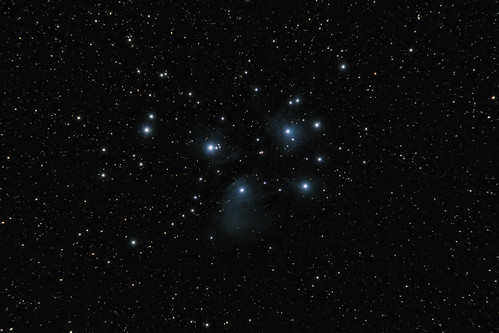
Started with a tour of the Auriga Messier clusters at 50x (24mm Panoptic) followed by a look at the Pleiades in Taurus, comparing it with the image I took with the TV60 the previous Saturday night. The nebulosity around Merope and Maia was just about visible, but I think it would need one of those rare nights of exceptional transparency to see any structure to it.

The Pleiades

I gave the Ethos a rest tonight (because of the condensation), so all subsequent observations at 133x (Nagler 9mm).

NGC 2281, open cluster, Auriga
Sparse collection of bright stars, four of them making a parallelogram at the western end of the cluster (the trailing two members of this shape are doubles). 133x is probably too high a magnification for this object; hard to tell where the cluster ended and the surrounding star-field began.

NGC 1931, “The Fly”, emission nebula / reflection nebula, Auriga
Little smear of light with 2 or 3 stars at centre. As noted before, quite bright for a non-Messier nebula. If the conditions were better I would have gone up to 240x. I also looked for neighbouring IC 417 (“The Spider”) and saw what appeared to be an extended patchy halo around a bright star, but difficult to say I saw it with any certainty.

NGC 1893, open cluster, Auriga
Sparse group of moderately bright stars. The area in and around the cluster seemed hazy, but not sure if that was because of unresolved stars or the surrounding nebulosity (IC 410). Might make an interesting imaging target if I get an appropriate filter.

Sigma Orionis, multiple star system
Impressive sight at 133x. Brightest component resolves into a wavy line of 4 stars. A pair of fainter doubles roughly northwest, and 2 even fainter stars between the two groups.

NGC 2261, Hubble’s Variable Nebula, Monoceros
Seemed more ghostly tonight (probably because of the transparency rather than the higher magnification). Averted vision showed a star-like point at the apex of the nebula. The “fan” of the nebula seemed brighter and fuller on the western side.

NGC 1535, planetary nebula, Eridanus
As per previous observation. The higher magnification showed a strong brightening towards the centre, but couldn’t isolate the central star with any confidence. Hint of brightness asymmetry with averted vision, but it came and went depending on which side of the nebula I was looking, so probably not a real feature. Colour less pronounced tonight – more grey than blue-grey.

NGC 1999, reflection nebula, Orion
As per previous observations. Relatively bright given the deteriorating transparency. Size increased with averted vision; star or star-like point at centre. Dark patch visible with averted vision, adjacent to the “star”.

From 20:15 onward the sky clouded over rather quickly, but the severe condensation had pretty much ended the session by that point anyway.

Nature note
Two frogs in the pond.


Tuesday, 18 February 2020

Orion to Puppis (via Monoceros and Canis Major)

17 January 2020, 21:45 – 00:45


Cold – but not excessively so for mid-January. Some cloud moving from the west which delayed my planned start time by 45 minutes. Condensation on lenses towards end of session.

Seeing: Good
Transparency: Average

I left the 13mm Ethos (92x) in the focuser for the entire session as I didn’t know how long I was going to get until it clouded over again – and I didn’t want to waste precious time changing eyepieces. As it turned out the sky was still clear when the moon rose later on.

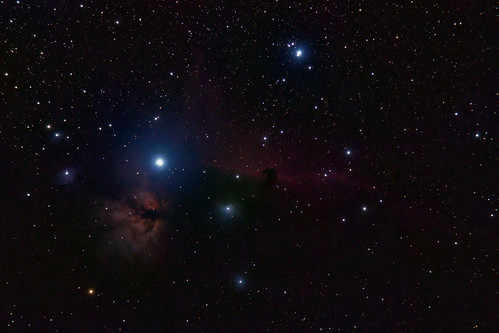
After spending some time on M42 (where else?) I moved north to the area around Alnitak and Sigma Orionis (a lovely multiple star system in its own right). The Horsehead Nebula was too faint to see (of course), but it did show up in images I took with the TV60 and an unmodded DSLR on Wednesday night (but only after extensive processing).

The Horsehead and the Flame

NGC 2023, emission nebula / reflection nebula, Orion
Visible as a fuzzy star with direct vision; size of nebulosity increasing with averted vision.

IC 435, reflection nebula, Orion
Like a smaller, fainter sibling of NGC 2023. Fairly obvious now I know it’s there, but easily overlooked – especially with all the other distracting objects nearby.

NGC 2024, Flame Nebula in Orion
Just faintly visible tonight. I don’t think the Ethos is the best eyepiece for this object; the super-wide field of view makes it almost impossible to separate the nebula from the glare of Alnitak.

NGC 1535, planetary nebula, Eridanus
Little blue-grey disc of light at 92x (unfiltered). It was already well past the meridian when I tracked it down, but it was quite obvious despite the light pollution. Averted vision suggested an extended outer fuzz. Need to catch this one earlier in the evening.

NGC 2324, open cluster, Monoceros
Loose group of stars shaped a bit like a letter K. Moderately bright.

NGC 2301, open cluster, Monoceros
Rich, condensed cluster (visible in finderscope). Bright tail of stars to the south, fainter one to the east. Bright yellow star near centre.

NGC 2254, open cluster, Monoceros
Very small “fuzz”, four stars resolved with direct vision. Oddly, looked much the same using averted vision. One of the two clusters plotted in the Pocket Sky Atlas lurking between the Christmas Tree and the Rosette.

NGC 2251, open cluster, Monoceros
Elongated “fang” of stars, forming a sort of bugle/horn outline. Larger, brighter than 2254. Second of the two PSA clusters lurking between the Christmas Tree and the Rosette.

NGC 2244, OC, Monoceros
The central cluster of the Rosette. Well framed in the Ethos, but magnification a little too high to separate the nebula from the surrounding star-fields. Might be worth trying this again with one of the filters.

NGC 2261, Hubble’s Variable Nebula, Monoceros
Bright little fan-shaped nebula. Bright spot or condensation at apex.

NGC 2264, Christmas Tree Cluster, Monoceros
Beautifully framed in the Ethos. Bright blue star at base (S Monocerotis) with fainter close companion to NE, both surrounded by haze/halo. Couldn’t see any other nebulosity on this occasion.

At around 22:45, while taking a break from the eyepiece, I saw two meteors travelling in opposite directions, one after the other in the space of a couple of seconds. The second one travelled from the east and passed directly in front of M44 (the Beehive Cluster). What a photo that would have made…

M41, open cluster, Canis Major
Looked good in the Ethos despite the low altitude. Bright stars, loosely concentrated. Arranged in a wavy “cross” shape, like a flattened hour-glass. Bright orange star near centre.

It’s worth noting here that the 9x50 finder really helped me locate the following open clusters (as well as the previous objects noted in Monoceros). I’ve struggled with these constellations in the past due to their southerly declination and absence of bright stars (my old Vixen 102 had a 6x30 finder), but the new finder showed me all the stars I needed to see – and often showed the clusters themselves.

M50, open cluster, Monoceros
Rich arrow-shaped cluster pointing west. Bright yellow-orange star on southern corner.

M48, open cluster, Hydra
Rich, large, loose cluster of bright stars – a “typical” Messier cluster if there is such a thing. Curving line of stars to east, close double near centre.

M47, open cluster, Puppis
Rich mixture of bright and faint stars – very attractive in the Ethos. Brightest members form a triangle, with prominent doubles at east and west corners angled towards each other (the eastern pair of equal brightness). This cluster is so prominent in the finder, I wondered if it might be visible to the naked eye; it is – with averted vision.

M46 & NGC 2438, open cluster + planetary nebula, Puppis
Rich cluster of moderately bright stars; a short hop east from M47. (Both clusters look great in the Ethos.) NGC 2438 immediately obvious as a grey disc of light on northern edge of cluster. Bright star on eastern edge of nebula, fainter one shining through. Probably the highlight of the evening.

NGC 2423, open cluster, Puppis
Moderately rich cluster overshadowed by nearby Messiers. Close double on western edge.

NGC 2396, open cluster, Puppis
Sparse cluster of stars just south of a bright double. The double was probably more interesting than the cluster: pale yellow primary, blue secondary (west), and a fainter third star southeast.

NGC 2374, open cluster, Canis Major
Small cluster, faint stars. Averted vision suggests underlying richness.

NGC 2360, open cluster, Canis Major
(Caldwell 58) Rich little cluster, well worth tracking down. Stars arranged in gently curving chains. Straight line of faint stars leading to bright star on NE edge of cluster.

M93, open cluster, Puppis
Another rich little cluster of bright stars, looked good in the XT10 despite low altitude (-24 degrees declination). Central triangle of stars surrounded by loose assembly of bright stars on either side.