Showing posts with label DeLite. Show all posts

Thursday, 5 November 2020

Nebulae in Cepheus and Cassiopeia

20 – 21 September 2020, 21:45 – 01:00


Conditions: Chilly, breezy. Light condensation appearing as the temperature dropped.

Seeing: Good
Transparency: Poor

With Mars now larger than the magic 20-arcsecond threshold, deep-sky observing (and indeed deep-sky astrophotography) will be playing second fiddle to the red planet for the next couple of months. (The autumn constellations will be back next year; Mars won’t be this good again until 2030-something.) That said, the nights are getting longer, so I was able to get a couple of hours of observing before Mars took centre stage.

I started with a short wander around Cygnus at 133x, during which I stumbled across 27 Cyg – a close double in a dark nebula (B146). The transparency in this part of the sky was very poor (the Crescent Nebula was disappointing – even with the filter it was barely visible ), so I relocated to Cepheus.


NGC 7538, emission nebula, Cepheus
133x + OIII filter. Initial impression was of an amorphous patch of light, like a puff of smoke, surrounding a pair of 11th magnitude stars. Averted vision showed some detail in the form of mottling, including what looked like a dark lane or rift on the eastern side of the nebula. Not a showpiece object by any means, but not bad given the middling conditions. Switching up to 171x plus the Ultrablock filter gave much the same view, but larger and fainter – although the two central stars were easier to see. The nebula was just barely visible without the filters.

IC 1470, emission nebula, Cepheus
133x + OIII filter. I never know quite what to expect when tracking down obscure IC-designated nebulae. Sometimes they’re surprisingly bright; other times they’re all but invisible. However this object was fairly easy to spot as a quite small, fuzzy round patch of light. The core appeared stellar with averted vision. Increasing the magnification to 171x (no filter) showed a star embedded in a wide, fan-shaped nebula, a bit like a comet. (It reminded me of Hubble’s Variable Nebula, NGC 2261.) The Ultrablock filter offered a little improvement: the central star became harder to see, while the nebula itself seemed more triangular and harder-edged.

A quick look at the eye-catching clusters NGC 7510 and Mrk 50 (see last year's notes on these) and then onto another nebula.

NGC 7635, Bubble Nebula (Caldwell 11), Cassiopeia
171x + Ultrablock gave the best view, though it wasn’t nearly as good as my previous look at this object (perhaps the Ethos plus the OIII filter would be a better combination). Bright star associated with a nebula of indistinct shape; with averted vision it looked a little bit like one half of a Yin-Yang symbol.

NGC 40, “Bow-Tie Nebula” (Caldwell 2), planetary nebula, Cepheus
171x + Ultrablock filter. While reading up on this nebula (after my observation on 16 September), I found some reports claiming it responds better to narrowband filters than OIII. Now I’ve tried both I do think the Ultrablock filter gives a slightly better view than the OIII, but this nebula is bright enough that it doesn’t really need it. The two arcs were a little easier to see (with averted vision), but of course it helps when you already know where they are.


Mars: The combination of the 9mm Nagler and the 2.5x Powermate (giving a magnification of 333x) seemed to hit the sweet spot tonight, giving me my finest view yet. The SPC was a brilliant little oval and the Sinus Meridiani (home of the Mars Opportunity rover) and Sinus Sabaeus regions were showing particularly well. I could also see a blue haze over the north polar region and brighter patches along the morning limb. I swapped the eyepiece for a camera and captured some videos, resulting in the image below:


Tuesday, 13 October 2020

Planetary Nebulae in Cygnus (again) and Cepheus

15 – 16 September 2020, 21:30 – 00:30


Conditions: Much the same as the previous night, but warmer(!) with heavier condensation.

Seeing: Average
Transparency: Poor

I warmed up with a look at globular clusters M15 and M2 with the 7mm DeLite (171x). As noted before, M15 has a significantly condensed core compared to the looser M2, but overall the brightest stars in M15 were brighter than those in M2, making it (M15) a little easier to resolve. M2 had one prominent star (noted on previous occasions) residing in a dark void just east of the core.

Then it was back to Cygnus to catch up on a few planetary nebulae I missed last night.


NGC 7026, planetary nebula, Cygnus
171x. Located just north of 63 Cyg (and easy to overlook on a star chart – which is why I missed it last night despite being in that area) – almost in the same field at 171x. The nebula itself appeared as a little ellipse of green-grey light immediately west of a bright star. Possible lobed structure with averted vision, but even at 171x it was so small it was hard to be sure.


I then spent an inordinate amount of time looking for PK 80-6.1, the so-called “Egg Nebula”. (I should know better than to go after PK-designated planetaries, but I figured that an object worthy of a nickname is probably worth tracking down … probably.) Eventually I did stumble upon a star-like point surrounded by a faint haze – looking more like a tiny galaxy than a PN. With averted vision it seemed doubled. By the time I’d put the OIII filter in, it had left the field and I couldn’t find it again (or if I did, I didn’t notice it). Not sure about this one.


NGC 40, “Bow-Tie Nebula” (Caldwell 2), planetary nebula, Cepheus
171x. Surprisingly faint in OIII, but when I removed the filter I could see a bright central star embedded in a round shell of nebulosity. Averted vision suggested an asymmetry in the form of brighter arcs in the SE and NW sides of the shell. Faint star due west of the nebula.

I failed to spot NGC 7139 in central Cepheus, but I had better luck with the next target:

NGC 7354, planetary nebula, Cepheus
171x. Faint oval disc; brighter with averted vision. A little brighter still with the addition of the OIII filter, plus a suggestion of “clumpiness” with averted vision. Plotted in SA 2000 but not the PSA.


I spent the remainder of the session looking at Mars before a combination of condensation and tiredness forced me back inside. It looked much the same as it had the previous night, although Solis Lacus was rotated a little closer to the limb.

Sunday, 4 October 2020

Planetary Nebulae in Cygnus

13 – 14 September 2020, 22:30 – 01:30


Conditions: Humid, hazy, no wind. Heavy condensation from about 23:15 onwards, particularly on the star atlas.

Seeing: Average
Transparency: Poor

Experience has taught me there’s no point trying for faint stuff like galaxies when the sky is like this, so I devoted the session to planetary nebulae … at least until Mars rose into view. But before that I warmed up with a quick look at Albireo at 133x. Not much I can add to previous superlatives, other than to say that the 9x50 finder does split this double, although you can’t really make out the colours of the two stars.


NGC 6884, planetary nebula, Cygnus
133x and 171x. Tiny blue-grey disc, almost stellar. Only really stood out with averted vision.

NGC 6826, “The Blinking Planetary”, Cygnus
171x. Slightly oval, bright green-grey disc. Seemed slightly brighter on eastern side. Central star showing clearly.

NGC 7008, “Foetus Nebula”, planetary nebula, Cygnus
171x. This one’s been on my target list for a while, but it was almost directly overhead when I looked for it, which made getting the scope on it somewhat tricky. Large (for a PN) kidney bean-shaped nebula associated with a pair of bright stars. Quite a distinctive shape compared to all the various “discs and doughnuts” I’m used to seeing when I look at planetary nebulae. Use of averted vision revealed three bright spots in the larger portion of the nebula. I’m not sure if one of these was the illuminating star as it’s hard to tell where the centre is. The nebula appeared much brighter when the OIII filter was added; in particular the larger lobe was enhanced to the point where it overwhelmed the aforementioned bright spots. There also appeared to be two dark lanes cutting into the nebula at right angles, giving it a segmented appearance. An unusual object worthy of its nickname.

NGC 7048, planetary nebula, Cygnus
171x + OIII filter. Amorphous patch of light, adjacent to a 10th magnitude star. (Not a small nebula, but needs the higher magnification to separate it from the star.) The shape becomes better defined with averted vision: oval with a possible lobed structure.

NGC 7027, planetary nebula, Cygnus
171x + OIII filter. Small, very bright nebula. Shape-wise, it seemed slightly “squared off”, with two bright components of unequal size separated by a narrow dark lane (just visible with averted vision). One very bright spot on the western lobe – not sure if this was the illuminating star (offset from the centre) or just a prominent condensation. There also appeared to be a hazy outer halo surrounding the nebula, but this may have been caused by condensation. The nebula appeared much the same without the filter, but boosting the magnification to 428x with the 2.5x Powermate emphasised the boxy shape and the clumpy structure – particularly in the larger lobe. This object really does benefit from as much magnification that you can reasonably throw at it.

While at 428x I couldn’t pass up the opportunity to revisit an old favourite in Andromeda:

NGC 7662, “Blue Snowball”, planetary nebula, Andromeda
7mm DeLite + 2.5x Powermate. Impressively large at 428x! Still bright at this magnification, but the colour was more subdued – a pale greenish-blue. Darker centre with averted vision; no sign of the central star. Faint star due east. The nebula seemed slightly brighter on the eastern side, with a possible faint halo extending NE-SW, though again, this may have been a side effect of the condensation.


The rest of the session (00:15 – 01:30) was devoted to observing and imaging this autumn’s star attraction, Mars. Even under favourable conditions it’s a challenging planet to view, but I’m finding that with practice I’m seeing a little more detail each time out. As noted before, the Baader Contrast Booster filter really helps with this. The bright South Polar Cap is still the most striking feature, despite its diminishing size. The dichotomy between the darker southern and lighter northern hemispheres was also fairly easy to see, and eventually I was able to make out an isolated dark spot – Solis Lacus – near the centre of the disc (as often happens in astronomical viewing, it was so obvious once I’d noticed it that I wondered why I hadn’t seen it straight away). This is the first feature on Mars, other than the polar caps and Syrtis Major, that I’ve been able to positively identify. In fleeting moments of good seeing I glimpsed subtle colour variations across the surface, including a bluish haze on the northern limb. As yet I’m not seeing anything at 428x that I haven’t seen at 171x; still waiting for that elusive window of perfect seeing!


Nature note:
Plenty of frogs on the move. I have to be very careful where I’m treading.

Thursday, 17 September 2020

Revisiting Old Favourites

18 – 19 August 2020, 22:00 – 00:30


Conditions: Mild to begin with, but started to turn chilly towards the end of the session. Patchy cloud passing overhead.

Seeing: Good
Transparency: Good

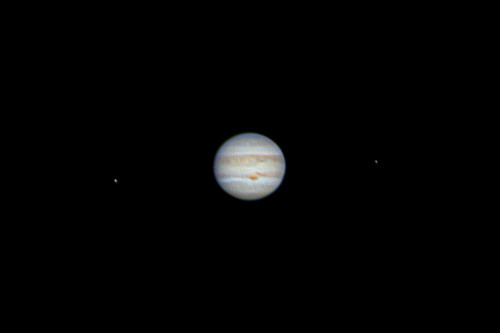
I began with a look at the two giant planets of the solar system (both of which are now one month after opposition). Jupiter’s Great Red Spot was visible, along with a very turbulent-looking NEB. Saturn could be seen casting a shadow across its rings and the Cassini Division was showing well. As the seeing was fairly good (considering Jupiter’s low altitude) I swapped the eyepiece for the Canon 80D and captured a few videos before the clouds got in the way.

Jupiter

I didn’t expect to get much else done tonight, so when the sky cleared again I decided to take a quick tour of some old favourites, as well as tracking down a couple of new targets.

Veil Nebula, supernova remnant, Cygnus
50x (24mm Panoptic) + OIII filter. Both sides of the loop and the inner triangle were visible, along with the “hooks” on the eastern veil. Like a lot of deep-sky objects, the more times you look at it, the easier it is to see the fainter details.

M31, Andromeda Galaxy
50x and 171x. Needs to be higher in the sky to get the best out of it, but the usual details were present and correct. Satellite galaxy M32 showed a star-like core.

M33, Triangulum Galaxy
50x. Ditto – needs to be higher in the sky, but quite bright considering, albeit lacking in detail. This is the first time I’ve looked at this galaxy since I got the 9x50 finder, and I’m pleased to say it was faintly visible in the finder – which means I won’t have to waste time sweeping for it anymore. I upped the magnification to 171x to look at NGC 604, which showed just a hint of the extended structure visible in photos, but I think I’ll need to go to a much higher magnification (on a really good night) to be sure.

NGC 404, Mirach’s Ghost, Andromeda
171x. As I thought it might be, the 7mm DeLite is the perfect eyepiece for observing this galaxy. Showed a bright core and the shell-like structure noted on previous occasions.

NGC 663, open cluster, Cassiopeia
171x. Large, rich cluster; visible in finder.

M103, open cluster, Cassiopeia
171x. Rich, condensed cluster. Red star in centre.

NGC 637, open cluster, Cassiopeia
171x. Small, triangular cluster with bright stars overlying an unresolved haze of fainter stars.

IC 1747, planetary nebula, Cassiopeia
171x. Nor far from Epsilon Cas. Very small round disc; perhaps brighter on one side, but hard to be sure even at this magnification. I wouldn’t have seen it if I hadn’t been specifically looking for it, and I imagine it appears star-like at anything under 150x. Not surprisingly, plotted in SA 2000, but not the PSA.

Nature note:
Not just the usual roaming frogs to contend with, but also plenty of spiders and bloodthirsty mosquitoes.

Thursday, 3 September 2020

Nebulae in Sagittarius

22 – 23 July 2020, 23:00 – 1:00


Conditions: Breezy, partial cloud cover to begin with – clearing over the course of the session and then returning towards the end.

Seeing: Poor / average
Transparency: Average / poor

I know I’ve spent a lot of time exploring Sagittarius lately, but at the rate the neighbour’s trees are growing and the likelihood of local light pollution returning to its pre-lockdown levels, this might be the last best chance I get to study this object-rich part of the sky. With the nights growing longer again, the wonders of Cygnus and Cepheus will still be well-placed for the next two or three months; the same can’t be said for the southern Milky Way.

NGC 6440, globular cluster, Sagittarius
133x. Faint condensed blur in same field as NGC 6445, brightens with averted vision.

NGC 6445, planetary nebula, Sagittarius
133x (no filter) and 171x (OIII). Quite faint without the filter (one of the consequences of averted vision is that this nebula was easier to see when I was looking straight at 6440). With the filter in place, 6440 disappeared and 6445 became much more obvious. The higher magnification made the misshapen ring structure more apparent (it looked more like a buckled wheel than a box). Most prominent feature was a bright condensation on the northern rim.

M8, Lagoon Nebula, Sagittarius
171x + OIII filter. Obviously M8 loses a lot of its impact at this magnification, but the brightest part of the nebula is easier to study. Hourglass shape apparent, of which the southern component brighter. Smattering of embedded stars visible with averted vision.

M20, Trifid Nebula, Sagittarius
171x + OIII filter. M20 also loses some impact at higher magnification, but the central star system was easier to resolve (when the seeing allowed) as a line of three very close stars. Nebula and dark lanes best seen with averted vision.

M16, Eagle Nebula, Serpens
171x + OIII. Averted vision showed a dark patch at the centre of the nebula, but the contrast was still too low to make out any kind of shape or structure. Lower magnifications are better for this object.

M17, Swan Nebula, Sagittarius
171x + OIII. Nebula still very bright at 171x. This magnification doesn’t really add anything to this object although the dark lanes were a little easier to see, giving it a segmented appearance. The body section does appear remarkably straight, like it’s been “dragged” across the sky with a paintbrush.

NGC 6629, planetary nebula, Sagittarius
171x + OIII. Very small, bright little disc, north of M28. I may have seen the central star with averted vision, but it was tough to separate from the nebula.

I also looked for other Sagittarius planetaries 6537, 6567 and 6644 with this eyepiece/filter combination, but they eluded me on this occasion. Or to put it another way, nothing jumped out at me in the manner that 6445 and 6629 did.

M28, globular cluster, Sagittarius
133x. As per previous observations. Bright, condensed; grainy with averted vision.

M22, globular cluster, Sagittarius
133x. If this is my last look at Sagittarius for the year I had to finish with arguably its most spectacular object. Several dozen stars seen in direct vision. The low altitude can make this cluster look somewhat washed-out at first glance, but it's well worth investing the time to let the magnificent view build up on your retina like a developing photo.

As usual I closed the session with a look at Jupiter and Saturn. Jupiter was the stand-out tonight with the GRS on show and all four Galilean moons positioned on one side of the planet. However the seeing was too mushy to bother with an imaging run.

Friday, 14 August 2020

Exploring Sagittarius

17 - 18 July 2020, 23:30 – 1:45


Conditions: Muggy, mild, breezy. Patchy cloud. Light condensation increasing over the duration of the session.

Seeing: Poor
Transparency: Average / poor

Comet C/2020 F3 NEOWISE has moved further into the evening sky, appearing a little faded since the previous weekend but still a relatively easy naked-eye object. Binocular view still good: the tail seemed longer, perhaps because I was seeing it against a darker sky.

Eyepieces used tonight were the 9mm Nagler (133x) and the 7mm DeLite (171x). The XT10 was balanced on the improvised “Observing table + bricks” platform again.

NGC 6522, globular cluster, Sagittarius
133x. Small, condensed fuzz with star-like core. Near Gamma Sgr. The low altitude and poor seeing made it hard to be certain but the core seemed to double with averted vision, possibly due to a foreground star nearby. Couldn’t confirm neighbouring globular NGC 6528.

M69, globular cluster, Sagittarius
133x. Definitely saw it tonight – visible as a soft round blur just south of an 8th magnitude star (which helps a lot when tracking it down). A little condensed with averted vision. In the brief window of time I had to look at it I was able to make out 2 or 3 speckles of individual starlight – possibly foreground stars, but overall this globular remained very faint.

M70 is harder to locate because there is no comparative star nearby. Again, I’m not confident I saw it this time – confirmation will have to wait for a better night. Likewise, M55 was right on the threshold of visibility; I think I glimpsed it with averted vision along with a few speckles of starlight, but I want to see it again to be sure.

I moved the XT10 to a less precarious spot and looked at Jupiter and Saturn at 171x. Both planets were visibly “rippling” with the seeing, so I abandoned my plan to do some imaging and returned to a couple of deep-sky objects.

M75, globular cluster, Sagittarius
Currently not far away from Saturn in the sky and quite obvious at 171x (though I suppose most DSOs would seem obvious after struggling with the previous three). Small, bright, condensed – swells in size with averted vision. Hint of graininess, but no stars popping out. Suggestion of dark area on the eastern side.

NGC 6818, “Little Gem Nebula”, planetary nebula, Sagittarius
171x. Small, fairly bright green-grey disc, slightly oval. Shows well at this magnification. Suggestion of darker centre. Oddly, with averted vision it seemed more blue-grey than green-grey.

Friday, 24 July 2020

Globular Clusters in Ophiuchus and Sagittarius

22 – 23 June 2020, 23:30 – 3:30


Conditions: Very mild, light wind with occasional gusts. No clouds and no condensation tonight.

Seeing: Good
Transparency: Quite good considering the time of year

Once again I set up two scopes in the garden: the XT10 with the 13mm Ethos (92x) and the TV60 with the 9mm Nagler (40x). The XT10 was balanced on my observing table, enabling it to point a little further south than usual (and also so I could observe while sitting down).

After warming up with views of M13, M57, M56 and Albireo, I turned my attention south to a selection of globular clusters.

M19, globular cluster, Ophiuchus
92x. Bright, condensed globular, about the same declination as Antares. Speckled appearance with averted vision. One star resolved north of the core, another one east of the core.

NGC 6284, globular cluster, Ophiuchus
92x. Small, condensed blur, a little north of M19. Swells in size with averted vision. Faint star east of core.

NGC 6293, globular cluster, Ophiuchus
92x. Another small, condensed blur. No resolution, but the core seemed particularly bright.

M62, globular cluster, Ophiuchus
92x. Large, condensed blur (one of the Messier globulars below -30 degrees). Bright core, a little grainy with averted vision.

NGC 6316, globular cluster, Ophiuchus
92x. Very faint round blur, east of M19 and M62, and about midway between them in terms of declination (-28 degrees). Condensed with averted vision. There were also a few stars superimposed over the top, surrounding the core; I assume these are foreground stars and not true cluster members.

M9, globular cluster, Ophiuchus
92x. Bright, asymmetric globular. Starts to resolve with averted vision, but really needs a darker sky to get the best out of it. Apparent dark patches southwest of core.

NGC 6342, globular cluster, Ophiuchus
92x. Faint, condensed blur, south of M9. Brighter core with averted vision. Faint star SW of core.

NGC 6356, globular cluster, Ophiuchus
92x. Bright, condensed globular, northwest of M9 and only a little smaller and fainter than its M-designated neighbour. No resolution, but some faint stars visible on the outskirts of the cluster.

M6, open cluster, Scorpius
92x (and skimming the neighbour's fence!). Better-framed at this magnification (than at 133x), but still a little too large for the fov. More stars visible, giving it an almost “chunky” appearance. On this occasion its overall outline reminded me a little of M24.

M7, open cluster, Scorpius: 40x (TV60 + 9mm Nagler)
A slightly better view tonight, reinforcing my initial impressions: a large, loose cluster with the dozen brightest stars arranged in a wavy x-shape.

NGC 6520, open cluster, Sagittarius
92x. I picked this up by accident while sweeping the area south of M8. A compact and very distinctive open cluster comprised of bright, colourful stars overlying a rich unresolved haze. Prominent orange star near the centre. This cluster stood out well despite its low altitude (-28 degrees declination).

M21, open cluster, Sagittarius
92x. Rich cluster with bright stars; not particularly condensed. Bright pair near centre.

M28, globular cluster, Sagittarius
92x. Bright, condensed globular. Grainy appearance. Hint of resolution with averted vision. Somewhat overshadowed by its illustrious neighbour…

M22, globular cluster, Sagittarius
92x. Very large “flattened” globular – spectacular in the Ethos. A few dozen stars resolved in direct vision; countless more with averted vision. Appeared to be a dark lane or rift on the western side. Tonight at least, it surpassed even M13 in visual splendour.

M24, star-cloud, Sagittarius
92x. Incredibly rich star-field. Even in the Ethos it covers several fields of view, but this is probably the best eyepiece for appreciating this region’s grandeur and sheer density of stars. I could easily spend an entire session here. The dark dust clouds which give M24 its distinctive sharp-edged appearance are conspicuous by their relative absence of stars. I know this region is actually a window into a deeper part of the galaxy, but the impression I get is of an iceberg of stars caught in the process of calving off from the Milky Way.

M18, open cluster, Sagittarius
92x. Bright little cluster; not particularly rich, but the brightest stars seem to form the shape of a pointy toadstool, or a partially opened umbrella.

M54, globular cluster, Sagittarius
92x. Small, round condensed blur. Prominent bright core, but not even a hint of resolution. Apparently gravitationally bound to the Sagittarius Dwarf Elliptical Galaxy (SagDEG).

M69, M70 and M55 (the only Messiers I haven’t yet observed) eluded me tonight. M69 and M70 are only a couple of degrees lower than M54, but that’s a lot of atmosphere to look through, making them too faint for the TV60. They also don't quite clear the fence as viewed from the XT10 - even with it balanced on a table. At -31 degrees, M55 should be viewable in the XT10, but – being further east than the other objects – the sky was too bright by the time it emerged from behind the tree. However, as a consolation, the conditions were just right for viewing the planets (with the 7mm DeLite).

Jupiter, 171x: Possibly my best view yet of the giant planet. Some sustained moments of excellent seeing revealed superfine detail, including festoons trailing from the notably turbulent NEB. Io’s shadow was visible as a perfect little dark spot on the NEB, and I was able to follow Io itself as it nudged across the darkened Jovian limb to begin its own transit. I did briefly add the 2.5x Powermate to increase the magnification to 428x, but the seeing wasn’t quite that good.

Saturn, 171x: Same detail as noted in the previous session, but holding steady for longer. The Cassini Division showed particularly well. Again, despite the brightening sky, Titan, Tethys, Dione and Rhea were clearly visible, along with a nearby faint star masquerading as a moon; I’d have to do a same-night comparison with the 5mm Nagler to be sure, but the DeLite does seem to control light-scatter better than any other eyepiece I’ve looked through.

Mars, 171x: First telescopic view of the red planet for this year. The seeing wasn’t quite as good here (it was still only just clearing the neighbour’s rooftop), but the gibbous phase was obvious along with some vague dark markings that showed a little better when I added the Baader Contrast Booster filter*. Disc still small at 11 arcseconds, but the best is yet to come (barring another dust storm like the one in 2018).

(* I bought the BCB years ago for the Vixen SP-102; I had no idea it was useful as a Mars filter until I read about it recently on Cloudy Nights.)

Sunday, 19 July 2020

The Southernmost Messier Object

14 June 2020, 00:30 – 03:30


Conditions: Mild, still (no wind), hazy and humid – heavy condensation. Cloud increasing over the course of the session.

Seeing: Average / poor
Transparency: Poor

I don’t normally observe in the two weeks either side of the summer solstice because the sky doesn’t get reasonably dark until gone midnight – and it doesn’t stay dark for very long. However, if I’m to do justice to the Scorpius/Sagittarius region I figured I should at least try to observe some of the brighter objects this month rather than tackle them all in a mad scramble in July or August. (And of course there’s no guarantee the skies will be clear then anyway.)

Also, encouraged by my glimpse of M7 last time out, I had the TV60 set up on the Super Polaris mount. However I hadn’t taken into consideration just how much the trees and plants can grow in barely a month, so I was contending with foliage as well as the neighbour’s fence. Fortunately, the TV60 is easier to move from side to side than the XT10.

After warming up with a look at M13 in both scopes (it appeared hazy and a little washed-out tonight, despite being nearly overhead), I switched to the main target for the evening.

M7, open cluster, Scorpius, 40x (TV60 + 9mm Nagler)
The scope was almost horizontal, but I was able to get just enough clearance over the neighbour’s fence to centre M7 in the field of view. The object itself appeared faint and washed out, but enough stars were visible to at least give a sense of a very large, splashy open cluster. The brightest stars seemed to form a distorted x-shape with a double star at the centre (although the atmospheric distortion and low magnification made it hard to split). There was also a haze of unresolved stars, plus an incomplete ring of brighter stars surrounding the central cluster. Even if M7 were high enough to be visible in the XT10, the TV60 would still be a better choice of scope to view it simply because of the larger field of view (2 degrees in the 9mm Nagler). By comparison, M6 – which is itself a fairly large cluster – appeared more traditionally condensed at the same magnification.

I also had the XT10 set up in the garden, but another thing I hadn’t taken into consideration was how bad the condensation would be tonight. I had planned to use the 13mm Ethos, but unfortunately the eye-lens misted over while I was looking at M7, so I swapped it out for the 9mm Nagler. The sky was getting hazier too, so I stuck to only the brightest objects. (The fainter stuff could wait for a better night.)

M21, open cluster, Sagittarius
133x. Loose, bright cluster, a little north of M20. Star pattern at centre in the shape of a teacup, or a backwards “3”.

M23, open cluster, Sagittarius
133x. Rich, large cluster. Uniformly bright stars filling the fov. Bright star to north. Concentration of fainter stars at western end of cluster.

M25, open cluster, Sagittarius
133x. Bright, large cluster, with a distinctive “D” shaped pattern of stars at the centre. Unlike M23, the stars come in a mixture of brightnesses.

With the condensation worsening and the sky already starting to brighten, it was almost time to pack up. However while taking the TV60 indoors I noticed that Jupiter and Saturn were starting to emerge from behind the tree, so I (carefully) moved the XT10 and changed the 9mm Nagler for the 7mm DeLite.

Jupiter, 171x: the seeing was variable but in the fleeting moments that it steadied, the DeLite gave a very sharp, comfortable view. All four Galilean moons were on view and I could see the Great Red Spot moving onto the disc, showing its familiar brick-red colour when the seeing allowed.

Saturn, 171x: Titan and three faint moons were visible, despite the brightening sky. Saturn was its usual exquisite self with the Cassini Division showing well in moments of good seeing, as well as the shadow of the planet on the rings, and the dusky equatorial band.

Saturday, 20 June 2020

The Cat's Eye Nebula and other Highlights

14-15 May 2020, 22:30 – 3:15


Conditions: Chilly, breezy; sky noticeably lighter along the northern horizon.

Seeing: Good
Transparency: Good overhead, average to poor everywhere else

M61, galaxy, Virgo
With the Virgo cluster already sliding past the meridian by the time it gets dark I wasn’t expecting to look at M61 again this year, but I’ve never seen a supernova before so I had to at least try to spot SN 2020jfo. After several minutes of careful observing (at 171x), using averted vision and enhanced breathing and all the usual tricks, I could intermittently see one or two faint stars west of the nucleus. So did I see it or was my mind filling in the gaps? Difficult to say, so I’ll leave that as a “maybe” rather than a definite “yes”. Had it exploded a month or so earlier (away from the Thanet light-dome) I think I would have caught it. (And yes, I know there was a brighter supernova in neighbouring Leo, but I’d like to be able to see the host galaxy as well. There will be other, better opportunities.)

M51, Whirlpool Galaxy, Canes Venatici
Having the galaxy almost directly overhead made for awkward tracking with the dob, but structure was clearly visible at 133x and 171x. The core of NGC 5195 appeared more condensed and stellar than that of M51, with a dark cut-off on the eastern side. The bright area noted last time was more apparent tonight, with a definite clumpiness to the spiral arm east of M51’s core.

M106, galaxy, Canes Venatici
171x. As per previous sightings. Northern spiral arm brighter as usual; appeared to be a dark lane on the western side of the galaxy, slanting diagonally south. At this higher magnification the core itself seemed slightly elongated in a NW-SE direction.

Using Sky Atlas 2000 I found three of the neighbouring galaxies (two of which I’ve seen previously):

NGC 4346, galaxy, Canes Venatici
171x. Small spindle galaxy with a bright stellar core aligned E-W. Located east (and a little south) of M106.

NGC 4220, galaxy, Canes Venatici
171x. Faint elongated galaxy N and W of M106, aligned NW-SE. Brighter towards centre with averted vision.

NGC 4217, galaxy, Canes Venatici
171x and 133x. Faint streak of light west of M106, aligned NE-SW. I missed this one last time, mostly because its visibility is hampered by a bright 9th magnitude star to the north and another fainter one west, lying almost on top of the core. Easy to overlook if you’re not paying attention.

NGC 4144, galaxy, Ursa Major
133x. Large, faint smudge of light. Brighter towards centre with averted vision. Close double star to north.

After quick looks at M5 and M13 I then turned my attention to a selection of the summer objects rising into view:

Epsilon Lyrae, “the Double Double”, Lyra
My previous views of this famous multiple system in the XT10 have been hampered by poor seeing, but tonight the stars were clearly split at 133x and 171x. Obviously the better view came at the higher magnification, with lovely contrast and clean space between the respective pairs.

M57, Ring Nebula, Lyra
171x. I was mostly plotting field stars in preparation for a sketch, but I also took a moment to jot down the key features of this famous nebula: bright oval ring of light, elongated NE-SW. Faint 12th or 13th magnitude star just off the NE edge. The NW and SE edges (on the minor axis) are noticeably brighter than the rest of the ring. The central portion of the ring is not completely dark, but has a slightly glazed appearance.

I took a break at 1:20 to watch a bright pass of the ISS, also noticing a few small clouds scudding across the sky. Then I returned to another planetary nebula:


NGC 6543, “Cat’s Eye Nebula”, Draco
Viewed at 133x and 428x (7mm DeLite + 2.5x Powermate) in preparation for a sketch (above). The seeing perhaps wasn’t quite good enough to justify such a high magnification, but the view occasionally came close to the one I got on 20 April. I notice that getting the correct eye placement is a lot more critical at 428x. Key features: pale green oval disc (at 428x); bright and sharp-edged. Seemed to be a hint of a yellow tinge to the central star, but this might be a contrast effect. When the seeing steadied there was also the suggestion of a tiny dark gap between the central star and the nebula, but oddly this seemed more apparent at the lower magnification. The “arm” features weren’t quite so apparent tonight, showing fleetingly as bright fringes, but the western (long) edge of the nebula did seem slightly misshapen, appearing to extend beyond the main disc.

NGC 6826, “The Blinking Planetary”, Cygnus
A beautiful sight at 171x, much improved on the last time I saw it. Bright central star, dominating the view in direct vision. The nebula was very bright in averted vision; rounder and softer-edged compared to 6543. Colour was less intense too, appearing as a pale green-grey.

At 1:50 a lovely meteor flashed through Cygnus, heading towards the eastern horizon.

M4, globular cluster, Scorpius
133x. A little washed out (as usual), but still plenty of stars resolved. The central N-S “bar” was very prominent tonight.

M11, the Wild Duck Cluster, Scutum
133x. A wonderfully rich cluster, one of the very best in the sky (or at least, the part of it that I can see). Bright lucida surrounded by a somewhat squared-off dense mass of stars. The overall impression is that of a fractured globular cluster.

The cloud cover was increasing at this point – and in a haphazard fashion, effectively pushing me from one clear part of the sky to the next.

M26, open cluster, Scutum
133x. Small cluster somewhat overshadowed by M11 to the north. The brightest 4 stars make a kite shape, surrounded by a swarm of fainter stars, although the central part of the cluster seems strangely vacant. I also noticed a curved tail of stars on one side before the clouds got in the way.

M107, globular cluster, Ophiuchus
133x. Follow-up observation. Faint (for a globular) – washed-out appearance. Grainy in averted vision with a brighter, mottled core.

M14, globular cluster, Ophiuchus
133x. Large, reasonably bright globular. A few stars on the outskirts resolved with averted vision, but otherwise unimpressive.

M80, globular cluster, Scorpius
133x. As noted previously: small, bright, condensed and grainy – but not resolved.

The ISS made another dazzling pass at 3 AM, travelling almost directly overhead. With the sky starting to brighten, there was just time for a quick look at a couple of prominent open clusters.

IC 4756, open cluster, Serpens
133x. Large, loose cluster comprised of bright stars. Not really suited for the XT10.

NGC 6633, open cluster, Ophiuchus
133x. Bright, wedge-shaped cluster. Comprised of bright stars, loosely arranged. Shows up very well in finder and binoculars.

I also used the binoculars to look for M7 and Comet C/2020 F8 (SWAN), but the sky was too bright to see either. Realistically I think my only chance of seeing the latter is by making a trip to the North Foreland lighthouse (from where I saw Comet C/2006 P1 McNaught), but the latest reports suggest it isn’t bright enough to justify the effort.

Nature note:
The usual pale frog in the pond (surrounded by the ever-growing tadpoles). The local herring gulls were restless tonight, frequently taking off and occasionally calling for no apparent reason. Perhaps their eggs are close to hatching…

Wednesday, 3 June 2020

Galactic Multi-tasking

25 April 2020, 22:15 – 00:30


Conditions: Cold, with a light breeze

Seeing: Good
Transparency: Average

Lately I’ve been using one telescope at a time (i.e. observing or imaging, but not both). On the evening of 24 April, with clear skies forecast for the entire night, I hauled both rigs into the garden and began the careful process of assembling, balancing and polar-aligning my astrophotography set-up. An hour later I was ready to begin imaging … at which point clouds rolled in from the north and completely covered the sky. This isn’t the first time this has happened to me, and it probably won’t be the last, but that’s English weather for you.

Undaunted, I repeated the process the following evening and this time the skies stayed clear. My imaging target was M101 (more on that in the next post), and while that was in progress I used the XT10 to track down some more galaxies around the Virgo/Coma border. (As I’ve discovered this spring, there are always more galaxies…)

All observations carried out at 133x (Nagler 9mm) unless otherwise stated.

NGC 4212, galaxy, Coma Berenices
Smooth oval glow, gradually brighter towards the centre. Possible extended bar-like core. (Photographs show no such feature, although there does appear to be a brightening along the long axis, which is possibly what I saw.)

NGC 4216, galaxy, Virgo
Pretty impressive edge-on (or close to edge-on) galaxy with very bright core. Suggestion of dark cut-off on eastern side.

NGC 4267, galaxy, Virgo
Round haze with bright core. Averted vision revealed stellar nucleus and several faint field stars.

NGC 4168, galaxy, Virgo
Faint round haze west of NGC 4216. Brighter towards centre with averted vision.

NGC 4178, galaxy, Virgo
Very faint extended haze west of bright star. Low surface brightness object; easier to see when the star is out of the field.

NGC 4124, galaxy, Virgo
Another very faint oval haze, aligned roughly east-west. Brighter core and stellar nucleus with averted vision.

NGC 4293, galaxy, Coma Berenices
As per previous observation of this object. Extended lens-shaped galaxy. A little brighter towards the centre with averted vision.

NGC 4147, globular cluster, Coma Berenices
I’ve seen this cluster before, but it makes a refreshing change from all the galaxies nearby. That said, it’s a typical NGC globular: round, condensed, grainy with averted vision, but not resolved.

24 Comae Berenices, double star
Attractive pairing. Yellow primary and a pale blue secondary (some 20 arcseconds west).

NGC 4651, “The Umbrella Galaxy”, Coma Berenices
Large oval haze, aligned east-west. Brighter towards centre, mottled envelope.

NGC 4710, galaxy, Coma Berenices
Edge-on “spindle” galaxy, quite bright, aligned SW-NE. Field star east of nucleus. Seemed mottled with averted vision, particularly north of the core.

NGC 4689, galaxy, Coma Berenices
Large round haze, low surface brightness. A little brighter towards the centre with averted vision, but otherwise featureless. Two field stars to north.

I took a break from galaxies to look at M5 again, before revisiting one of the galaxies I saw on Monday.

NGC 5846, galaxy, Virgo
Appeared as before, but this time I could just about see the bright spot (corresponding with NGC 5846A) south of the nucleus with averted vision. It almost looks like the core of NGC 5846 has split into two unequal parts.

With the imaging run nearing the end of its sequence, I changed the Nagler 9mm for the DeLite 7mm (171x) and rounded off the session with a look at two planetary nebulae in Hercules.

NGC 6210, planetary nebula, Hercules
Very bright blue-green ellipse. Seemed brighter on the western (leading) side.

IC 4593, planetary nebula, Hercules
Very small, almost stellar disc of blue-grey light, east of bright star. Best seen using averted vision (because the 11th magnitude central star overwhelms the nebulosity in direct vision). Nice close double star to the east.


Tuesday, 19 May 2020

Dusk till Dawn

19 – 20 April 2020, 22:15 – 04:15


Conditions: Windy, cold (for time of year).

Seeing: Average
Transparency: Average

The evening got off to an inauspicious start when I was “treated” to a display of the infamous Starlink satellites. They were already crossing the sky when I took the scope out at 21:30 and the grim spectacle carried on in a continuous procession for another fifteen minutes. The occasional straggler was still passing overhead at 22:00, following the same path as the others. Each satellite reached a peak brightness of about 2nd magnitude, rivalling the primary stars in Ursa Major. I suppose I’m fortunate in that I’m primarily an old-school observer who dabbles in astrophotography, so I have less at stake than those who’ve spent vast sums of money on dedicated astro-cameras, high-end mounts etc., but I am worried about the impact these mega-constellations will have on professional astronomy – particularly the various wide-field survey programmes.

Anyway, satellite trains aside, as the previous session had gone so well I wanted to try something longer, perhaps even an all-nighter (clouds and energy levels permitting). I had no specific plan, other than revisiting a few old favourites, as well as picking up a few objects I’d missed along the way.

All observations carried out at either 133x (Nagler 9mm) or 171x (DeLite 7mm).

M53, globular cluster, Coma Berenices
Viewed at 133x and 171x. As per previous observations. Dark lane on the north side separating a moderately bright star (noted previously) from the core of the cluster.

NGC 5053, globular cluster, Coma Berenices
Finally tracked it down (at 133x) after who knows how many attempts. Visible as a large, hazy patch of very low surface brightness. A little speckly with averted vision, and a field star to the east. Not impressive. Definitely my least-favourite globular cluster.

M51, Whirlpool Galaxy, Canes Venatici
133x. Best view of M51 this season. Ghostly spiral arms visible. With time and careful use of averted vision, there were even hints of brighter spots within the arms, most prominently on the arm immediately east of the core.

M101, Pinwheel Galaxy, Ursa Major
133x. Tantalising hints of structure with averted vision but, as usual, little more than that. Now I’ve seen it a few times I’m more confident of the nebulous spot east of the core (most likely NGC 5461 or 5462). There also seemed to be a tiny faint spot (possibly a star) west of the core.

Porrima (Gamma Virginis), double star, Virgo
133x. Close “headlight” double. Identical white stars 38 light-years away on a 169-year orbit.

NGC 4684, galaxy, Virgo
133x. Small, faint streak of light, aligned NE-SW. Brighter towards centre with averted vision.

NGC 4691, galaxy, Virgo
133x. Another small faint ellipse, aligned E-W. Bright core with averted vision.

NGC 4697 (Caldwell 52), galaxy, Virgo
133x. Bright oval galaxy. Stellar core with averted vision, surrounded by a large extended envelope. Faint star to north; brighter one east.

While I was in this part of the sky I ventured south to Corvus to look for the Antennae galaxies again, but couldn’t detect anything with any degree of confidence.

M99, galaxy, Coma Berenices
133x. Ghostly round galaxy. Dark patch west of nucleus. Suggestion of reverse-s spiral.

M98, galaxy, Coma Berenices
133x. Large faint streak of light, aligned NW-SE. Brighter towards centre with averted vision.

NGC 4262, galaxy, Coma Berenices
133x. Small round fuzz. Bright stellar nucleus with averted vision. (Plotted on Sky Atlas 2000, not PSA.)

M100, galaxy, Coma Berenices
133x. Large round galaxy with bright fuzzy core. Possible bright spot east of core but tough to discern detail in this one.

NGC 4340 & 4350, galaxy pair, Coma Berenices
133x. Pair of similar sized galaxies in same field of view; both with stellar nuclei. The eastern one (4350) clearly brighter and more elongated.

NGC 4450, galaxy, Coma Berenices
133x. Large round haze, brighter towards the centre with averted vision. Stellar nucleus. Another reverse-s spiral?

M85, galaxy, Coma Berenices
133x. Bright, round, with very bright core. Star north of nucleus. NGC 4394 in same field to east-northeast. Similar size, but fainter than M85. Brighter towards centre with averted vision.

I then pushed the scope south again to confirm my previous observation of M83. It was still visible, albeit not as clearly as on 15 April, with only the core region standing out from the background.

As I don’t normally observe for much longer than three hours, this seemed like a good point to stop for a coffee break and a cereal bar. Q1: How do you make a hot drink with only a dim red light for illumination? Answer: very carefully. Q2: How do you get the milk in and out of the fridge without ruining your night vision? Answer: close (and cover) your eyes and do it quickly (practice in daylight if you have to). Who needs a thermos?

I resumed the session with one of my favourite globular clusters:

M5, globular cluster, Serpens Caput
133x and 171x. See previous observation for superlatives. This time I remembered to check the cluster for colour; it was subtle: a pale aquamarine tinge. The bright star (SE of the core) I noticed last time out didn’t seem as bright tonight. At 171x the cluster was spectacular; the greater contrast allowing me see even more faint stars. The core wasn’t fully resolved, but definitely speckled.

NGC 5838, galaxy, Virgo
133x. Small round galaxy with bright core. One of a group of several galaxies (I picked up 8 tonight) clustered around 110 Virginis, a few degrees west of M5.

NGC 5854, galaxy, Virgo
133x. Faint ellipse, a little brighter towards the centre. (Sky Atlas 2000)

NGC 5846, galaxy, Virgo
133x. Round fuzzball, somewhat brighter towards the centre. Visually, this appears to be the dominant galaxy of this cluster.

NGC 5850, galaxy, Virgo
133x. Large hazy patch east of 5846 in same field. Very low surface brightness.

NGC 5831, galaxy, Virgo
133x. Small ellipse; sharp stellar nucleus with averted vision. (Sky Atlas 2000)

NGC 5813, galaxy, Virgo
133x. Small, fuzzy oval at the centre of a square formed by four stars. Brighter core with averted vision.

NGC 5806, galaxy, Virgo
133x. Very faint oval galaxy, brighter towards the centre with averted vision. (Sky Atlas 2000)

NGC 5864, galaxy, Virgo
133x. Very faint streak of light. Brighter along central axis with averted vision. (Sky Atlas 2000)

NGC 6309, “Box Nebula”, planetary nebula, Ophiuchus
133x. Small disc of light with a very close star off the western edge. Suggestion of asymmetry – northern half brighter?

NGC 6503, “Lost in Space Galaxy", Draco
133x. Large, bright lens-shaped galaxy. Unusually, no brightening towards the centre that I could see. Some nostalgia attached to this galaxy as it’s one of the select non-Messier/Caldwell galaxies that I tracked down with the SP-102 years ago. It's also one of the rare bright DSOs that wasn't discovered by a member of the Herschel family.

NGC 6543, “Cat’s Eye Nebula”, Draco
Viewed at 133x and 171x. Very bright blue-green ellipse near a bright star. 171x showed the central star embedded in the nebula and – in moments of fine seeing – a suggestion of structure in the form of two curved arms extending through and just beyond the nebula. The colour also seemed more intense at the higher magnification. On this evidence, the Cat’s Eye ranks high on the list of beautiful planetary nebulae.

M4, globular cluster, Scorpius
133x. Large, grainy globular; a little washed out, but still impressive. Amazingly, given its low altitude, I counted at least two dozen stars resolved. It may be an illusion due to the way the brightest stars are arranged, but the core region seemed more bar-shaped (on a north-south axis) than round. This must be a superb sight from more southerly latitudes.

M80, globular cluster, Scorpius
133x. Small, bright, condensed globular. Grainy, but no stars resolved.

While I was in Scorpius I took the opportunity to look at the red supergiant star Antares. It was a remarkable sight in the XT10, with the thick atmospheric turbulence at that altitude making it appear to seethe and boil, as well as cycling through a range of vivid colours from blood red to apple green.

M19, globular cluster, Ophiuchus
133x. Large, grainy – and faint – globular. A few stars resolved with averted vision. Pretty good considering its low altitude.

I had to balance the XT10 on my restored observing table to see two of the remaining three objects, such was their low altitude. The rubber feet were a little too near the edge for my liking, but otherwise it was fine.

M62, globular cluster, Ophiuchus
133x. Small condensed globular. Quite bright, but no resolution.

M9, globular cluster, Ophiuchus
133x. Grainy globular; not particularly bright. Starts to resolve with averted vision. Apparent dark patches give it a misshapen appearance.

It was 4:15 at this point, and the morning twilight was becoming ever more apparent, but there was just time for one last object.

M6, “Butterfly Cluster”, open cluster, Scorpius
133x. Glimpsed through a convenient gap in the neighbour’s tree, and still only just clearing the fence. But even then the distinctive pattern of bright stars which gives it its name was visible. Will try and revisit this one with the Ethos. Also worth noting there are only three Messier objects more southerly than this one…

Nature note:
A robin started singing from about 3:20 onwards (the beginning of astronomical twilight, but still well before dawn).

Saturday, 9 May 2020

Hickson 68

12 April 2020, 21:30 – 22:45


Conditions: getting chilly, breeze picking up. Cloud cover increasing gradually. Sporadic flashes of lightning way off in the northeast.

Seeing: Poor to average
Transparency: Poor

The original plan was to photograph a galaxy or two, but as the sun set and patches of haze and cloud began to advance across the sky I abandoned that idea and hauled out the XT10 for an impromptu observing session. It was also an opportunity to put my newly restored wooden garden table to the test. (As I found out on 22 March, balancing Sky Atlas 2000 on a chair is not a practical way of going about things.)

I started with some double stars again, looking at Polaris, Cor Caroli and Izar (Epsilon Bootis). The latter was more challenging than it should have been due to the indifferent seeing, but still an impressive sight with a distinctive orange primary and a very close secondary lurking within the diffraction rings.

M94, galaxy, Canes Venatici
171x. Bright fat oval, like an unresolved globular (as noted previously). Very bright towards the centre.

I then moved over to the eastern part of Canes Venatici to investigate HCG 68, one of the few Hickson Compact Groups within range of my scope. According to sources online, these galaxies are 100 million light years away.

NGC 5353 & 5354, interacting galaxies, Canes Venatici
133x and 171x. A pair of small, very close galaxies, resembling eyes in a mask. Their long axes were angled towards each other, not unlike the 4485/4490 pair (also in CVn), although this pair were more closely matched. The southernmost galaxy (5353) was a little brighter and more condensed than 5354.

NGC 5350, galaxy, Canes Venatici
133x and 171x. Very faint round haze close to bright orange-hued star. In same field as 5353/5354 pair.

NGC 5371, galaxy, Canes Venatici
133x and 171x. Very faint amorphous haze; quite large. A little brighter towards the centre with averted vision.

The observations at 171x were mirrored at 133x: the lower magnification had less contrast, but this was balanced by the surface brightness being concentrated in a smaller area. Either way, these galaxies were a lot easier to see than Stephan’s Quintet (arguably the most famous Hickson group).

The clouds were starting to gather overhead at this point, so I called it a night.

Nature note
Two large frogs in the pond and 1000+ tadpoles!

Wednesday, 6 May 2020

Venus and the Moon

31 March 2020 and 4 April 2020


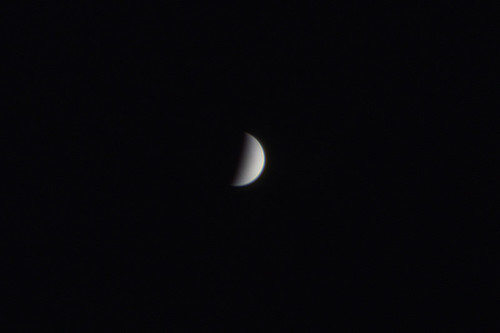
Okay, so not a post on deep-sky observing, but still worthy of mention because Venus was high enough and bright enough to be viewable from my back garden (as it is every eight years). To get the best view I had to locate it against a blue sky - which can be tricky if the moon isn't nearby. It was a very pretty sight at 171x, with none of the halo or colour distortion that I often got with the SP-102. On 31 March the phase was similar to that of the moon, but there was no detail in the cloud tops (not that I was expecting to see any.)

Venus

I didn’t photograph the Venus/Pleiades conjunction (a fast 300mm lens or one of those RedCat scopes would be better suited for that), but I did get a nice view of it through binoculars over several consecutive evenings.

I also got to study the moon with the 7mm DeLite and it was every bit as good as I’d expected: crisp, contrasty, and a good complement to my other magnifications. On 31 March I had my best ever view of the Triesnecker rille system, with the detail visible through the eyepiece exceeding the stacked image for once.

Lunar Rilles

On 4 April the seeing was good enough for me use the 2.5x Powermate, pushing the magnification up to a whopping 428x. I previously wrote that the DeLite doesn’t have the “wow” factor of the Ethos, but this was definitely a “wow” moment of a very different kind; I’ve never seen the moon quite like that before. The detail visible in Gassendi alone was almost too much to take in. The seeing is consistently better in late summer / early autumn (in my neck of the woods at least), which bodes well for the upcoming Mars apparition.

(Back to galaxies in the next post!)


Monday, 20 April 2020

Galaxies, Globulars and a Comet

23 March 2020, 20:30 – 23:30


Conditions: Another cold, breezy night. The wind wasn’t as excessive as it was on Sunday, but still too severe for astrophotography. After the rigours of the Virgo Cluster this session was somewhat unstructured, and it took me a long time to properly get going. Though with hindsight I think my eyes hadn’t fully recovered from the previous night. Peering at faint galaxies can be surprisingly tiring.

Seeing: Good
Transparency: Average

Comet C/2019 Y4 (Atlas)
Viewed at 133x (Nagler 9mm) and 171x (DeLite 7mm). Other than having moved near a different star it appeared much the same as it did the previous night. Though without the glare of Rho UMa affecting it, there did seem to be a hint of a stubby tail to the southeast.

While I was in the area I took another look at M81, M82 and NGC 3077 at 133x and 171x. Nothing to add to previous notes. I think I’ve reached the point with these galaxies (particularly M81 and M82) where I’d need one of those rare nights of excellent transparency to eke out any more detail.

M94, galaxy, Canes Venatici
171x. Bright core; mottled outer envelope. Again, not much to add to previous notes.


Leo Galaxy Triplet (plus an asteroid)
The Leo Triplet, as imaged on the following night (24 March)


M65, galaxy, Leo
133x. Large, extended galaxy with bright core. Suggestion of dark and light bands on eastern side (dust lane and spiral arm).

M66, galaxy, Leo
133x. Initially appears smaller than M65, but with time the fainter outer regions became more apparent and the overall shape seemed more irregular than M65. Stellar nucleus, but the surrounding core region seemed larger than the one in M65.

NGC 3628, galaxy, Leo
133x. Third member of the Leo Triplet. A large, faint, boxy galaxy. The dust lane was just about visible with averted vision, but this galaxy really needs a night of excellent transparency to get the best out of it.

NGC 3521, galaxy, Leo
133x. Large oval galaxy, aligned north-south. Bright stellar nucleus. With averted vision it seemed more elongated and elliptical, with a suggestion of a dark lane on the western side. Quite an impressive galaxy tucked away in the southern reaches of Leo.

NGC 4429, galaxy, Virgo
133x. A quick sweep along Markarian's Chain and then south to pick up a galaxy I missed last night. Bright smudge of light, aligned east-west, just south of bright star. Core seemed slightly offset to the east.

M53, globular cluster, Coma Berenices
133x. Subtle, very pale blue tinge. Quite well resolved with averted vision. Large outer halo of faint stars at this magnification; loses starfish shape noted previously. Still no sign of NGC 5053!

M3, globular cluster, Canes Venatici
133x. Bigger, brighter, bolder than M53. Lots of stars resolved with direct vision. Averted vision revealed a roughly triangular pattern of star chains pointing west.

NGC 5466, globular cluster, Boötes
133x. A first foray into the hinterlands of Boötes. After drawing a blank on NGC 5053 I wasn’t confident of finding this one, but it showed up without too much difficulty, appearing as an extended misty patch. Rich sprinkling of faint stars with averted vision, but no sign of the central condensation typically seen in globular clusters. Not striking as globulars go, but certainly unusual and worth tracking down.

NGC 5248, galaxy, Boötes
(Caldwell 45) 133x. Faint oval, brighter towards the centre. Faint stars SW and S of core.

NGC 5866 (M102?), galaxy, Draco
Viewed at 133x and 171x. Bright little lens-shaped galaxy forming a triangle with two field stars. Symmetrical shape and no detail that I could see (I think I’ll need higher power to stand a chance of spotting the central dust lane), although the 7mm DeLite seemed to show fainter “extensions”, increasing the length of the galaxy. Worth seeing, regardless of its disputed Messier status.


Sunday, 5 April 2020

300 Million Light-Years from Home

16 March 2020, 20:00 – 23:30


Conditions: no wind (at last). Somewhat chilly, but no condensation.

Seeing: Good
Transparency: Average

I started the session looking at a selection of double stars in Cancer (at 171x with the 7mm DeLite).

Iota Cancri: as per previous observation – a lovely, colourful double.

Phi-2 Cancri (Σ1223): tight “headlight” pair of equally matched 6th magnitude stars. No colour discernible.

24 Cnc (Σ1224): similar separation to Phi-2, but primary was brighter.

Zeta Cancri: neat little triple star system; the primary pair are so close that they only appeared separated during moments of really good seeing.

Leo 1, dwarf galaxy, Leo
171x. I know I was looking in the right place this time, and with averted vision there was perhaps the merest hint of an extended misty patch. Tube-tapping seemed to help with its visibility, but it was immediately extinguished the moment Regulus strayed into the field of view. It was so faint I’m not even sure I can count this as a positive sighting, but I do think this new eyepiece gives me the best chance of spotting it (under perfect seeing conditions).

NGC 3077, galaxy, Ursa Major
At 92x (Ethos 13mm) this galaxy was clearly visible with just a slight nudge of the scope away from M81. In fact it was so obvious, I’m kind of embarrassed that I never noticed it before 12 March. But, like many DSOs, once you know it’s there… Visually it appeared much as it did on the previous session, albeit a little brighter (and at a smaller scale, obviously).

NGC 2976, galaxy, Ursa Major
92x. Another overlooked member of the M81 family. Appeared as a large, faint ellipse (perhaps irregular?), not as bright as 3077, with a faint star just off the southern edge.

I couldn’t find Comet C/2019 Y4 (Atlas), though I later found out I was sweeping in the area it was heading towards rather than where it actually was. Turns out it was nearer NGC 2976 than I realised, so I can’t have missed it by much. There will be other opportunities.

M101, galaxy, Ursa Major
92x. The core of the galaxy was the only part visible with direct vision. The faint star just north of the nucleus is useful for getting your bearings. This time there seemed to be a hazy patch west of the core, though I’m not sure what – if anything – this corresponded to. Out of curiosity, I added the Ultrablock filter to the Ethos to see if this would bring out any of the HII regions. The core was still just about visible and there was a suggestion of vague mottled patches which seemed to come and go depending on which side I was looking, but (like Leo 1) whatever was there was right on the threshold of visibility.

IC 3568, planetary nebula, Camelopardalis
Failed to find this last year because I didn’t appreciate how tiny it was (though my notes indicate that I did see the nearby double star Sigma 1694). This time I used the Ultrablock filter to help pick it out in the Ethos (it stood out as a prominent green “star”). At 171x it appeared as a bright perfectly round little disc of light with a star right next to it. It’s circumpolar from my location, so now I know where it is, I can observe it on any clear night of the year (though I don’t expect to see much detail, even at very high power).

NGC 3184, galaxy, Ursa Major
171x. Very faint, round galaxy, with a field star on its north edge. Visibility hampered by bright star to west.

NGC 4725, galaxy, Coma Berenices
One of the bright Coma galaxies that I overlooked last year. At 92x it appeared as a large misty ellipse with a bright core and a stellar nucleus.

NGC 4889 (Caldwell 35), galaxy, Coma Berenices
Another one I missed out on last year, but the finderscope helped me to quickly pinpoint the nearby 7th magnitude star HD 112887. Even then I wasn’t sure if I would be able to see the galaxy, but it was almost immediately obvious at 92x as a tiny round fuzz surrounding a bright core. So visually it was unimpressive, but as with 3C 273, the “awe-factor” comes from knowing its distance: a whopping 300 million light-years (a good 5 or 6 times further away than most of the galaxies I typically observe at this time of year). NGC 4889 is the giant elliptical powerhouse at the centre of the Coma Cluster of galaxies. Most of them are beyond the reach of my scope, but I was able to see nearby NGC 4874 as a small, faint hazy patch east of NGC 4889, somewhat hampered by the glare from HD 112887. In fleeting moments of really good seeing NGC 4889 appeared to be doubled, with a tiny companion next to it (in line with HD 112887) perhaps corresponding to NGC 4886.

NGC 3242 (Caldwell 59), planetary nebula, Hydra
No obstructing foliage this time. Very bright at 92x; blue-green disc. Seemed brighter on northern and southern edges.

I spent the rest of the session revisiting a galaxy-rich area of Leo. All observations with the 13mm Ethos at 92x.

M95, galaxy, Leo
Large, brighter towards the core. Stellar nucleus. No detail apparent.

M96, galaxy, Leo
Similar size to M95. Brighter core, also stellar nucleus.

M105, galaxy, Leo
Round, condensed. Bright, stellar core.

NGC 3384, galaxy, Leo
In same field as M105 but smaller. Also has a bright, stellar core.

NGC 3389, galaxy, Leo
In same field as M105 and NGC 3384. Visible with averted vision as a faint ellipse, angled away from M105 towards 3 field stars. Easy to overlook (I missed it last year).

NGC 3412, galaxy, Leo
Small ellipse with a bright stellar core.

NGC 3377, galaxy, Leo
Same again – a little fainter than 3412, but another ellipse with a stellar core. The print-out I was using showed a 3377A galaxy in the same field, but I couldn’t see anything at that location.

NGC 3489, galaxy, Leo
Extended ellipse with a stellar core; suggestion of a dark cut-off along its southern edge.

At this point galaxy fatigue was setting in (although they’re bright and numerous, a lot of the Leo galaxies just don’t have the “wow” factor of the ones in Canes Venatici and Coma Berenices), so I called it a night.

Monday, 30 March 2020

First Light with the Tele Vue DeLite 7mm

12 March 2020, 19:30 – 21:45


Conditions: A chilly night (after a few mild days) with frequent strong gusts of wind (again). With the moon due to rise between 21:30 and 22:00, I had a roughly two-hour window to field-test my new acquisition: a Tele Vue 7mm DeLite. In the XT10 the DeLite gives a magnification of 171x, neatly filling the gap between the 9mm Nagler (133x) and the 5mm Nagler (240x).

Seeing: Poor to average
Transparency: Average to poor

The tube currents took a while to settle down, but once they did I turned my attention to:

NGC 2392, Eskimo Nebula, Gemini
At 171x the Eskimo was bright and nicely framed, with the central star clearly resolved as a tiny pin-prick of light. (It’s sometimes hard to separate the star from the nebula at other magnifications, but this eyepiece seems to hit the sweet spot.) There was even a hint of brightness variation in the outer shell of the nebula, but the variable seeing made this elusive.

h3945, double star, Canis Major
Viewed at 171x and 133x. I meant to look at this pairing last time out, but got distracted by NGC 2362. The seeing tonight was especially poor at this low altitude, but there was enough separation between the stars for it not to matter too much. h3945 (it deserves a catchier name) is a lovely double star comprised of a rich golden primary and a bright blue secondary (north). Some observers call it the Winter Albireo, and on this evidence I can see why.

Iota Cancri, double star, Cancer
Quite by chance (I was star-hopping to NGC 2683), the very next object I looked at was another colourful double, comprised of a pale yellow primary and a blue secondary (west). A very pretty pairing and another contender for the “Winter Albireo” label, but I think h3945 has the edge.

NGC 2683, galaxy, Lynx
Viewed at 133x and 171x. Bright, spindle-shaped galaxy aligned roughly NE-SW. Brighter towards the core, but no stellar nucleus as far as I could tell. Faint field stars across the eastern side of the galaxy. Dark cut-off along northern edge, indicative of a dust lane (like the one in NGC 7331).

NGC 3115, the Spindle Galaxy (Caldwell 53), Sextans
Follow-up from previous observation, viewed at 171x. Bright little galaxy, very bright towards the core. Much smoother outer envelope than 2683 (which seemed mottled by comparison).

M81 and M82, galaxy pair, Ursa Major
M81 was bright and large at 171x with a sprinkling of foreground field stars. Maybe a hint of spiral structure. I should really spend more time studying this galaxy, but it’s hard to concentrate on it when you know M82 is only a nudge of the scope away. Talking of which, M82 was also bright and large at 171x, with the main dark rift clearly visible, and a bright knot on the western side of the rift.

NGC 3077, galaxy, Ursa Major
An overlooked member of the M81 “family” (it’s taken me this long to get round to seeing it). Faint compared to M81 and M82, but not at all difficult in the DeLite. First impressions: an amorphous round blob near an 8th magnitude star; brighter towards the centre, but with a suggestion of asymmetry.

M40 (aka Winnecke 4), Ursa Major
An uninteresting pair of 9th magnitude stars – what more can I say about it? But I’ve seen it now (after many years of ignoring it), so let’s tick it off the list and move on. Fortunately M40 is en route (from Delta Ursa Majoris) to a much more worthy object…

NGC 4605, galaxy, Ursa Major
Faint, extended galaxy aligned roughly east-west. The DeLite showed a brighter bar-like core region which seemed to be at a slight angle to the rest of the galaxy. An intriguing object, made more interesting by the knowledge that it’s less than a degree away from the famous Hubble Deep Field.

NGC 4485 and NGC 4490, galaxy pair, Canes Venatici
Moonlight starting to interfere at this point, but both galaxies still clearly visible. The higher magnification and contrast of the DeLite showed a dark gap between the two galaxies, but 4490
was obviously distorted towards the smaller, fainter 4485.

M3, globular cluster, Canes Venatici
A little washed out by the rising moon, but still fairly well resolved. The dark lane on the eastern side (noted last time out) was more obvious at the higher magnification.

NGC 3242 (Caldwell 59), planetary nebula, Hydra
The so-called “Ghost of Jupiter”. I can’t say it looked anything like Jupiter, but it was brighter than I was expecting, and quite obvious despite interference from moonlight and obstructing foliage. Pale blue-green disc of light. Suggestion of darker core with averted vision, and apparent bright patch on southern edge, but detail elusive. Worth revisiting when it’s in a clear part of the sky.

Conclusions
While obviously not having the “wow” factor of a super-wide eyepiece like the Ethos, the renowned sharpness and contrast of the 7mm Delite should make it invaluable for detailed study of some of the showpiece DSOs where 133x is too little power and 240x is too much. (And, of course, I'm very much looking forward to viewing the moon through it.) I’ve never had a problem with the eye relief of the other eyepieces, but the extra 5mm of the DeLite does make a noticeable difference. It really is a very comfortable viewing experience. And the 62 degree field is ideal for sketching too if I ever get back into that dark art.

Nature note
The frog breeding season does seem to be over now, which is just as well because there’s barely room for any more frogspawn in the pond.