Thursday, 30 September 2021

Cassiopeia through the Haze

2 September 2021, 21:40 – 23:10 (BST)


Seeing: Average / poor

Transparency: Poor – very poor

Conditions: Patchy cloud with an overlying haze; moderate breeze. The nights are drawing in quickly now. This was the first “clear-ish” evening in several weeks, but the hazy transparency that seems to bedevil autumn skies was particularly bad tonight, ruling out any plans I had of going after faint galaxies.

So instead I took a leisurely stroll along the Milky Way at 92x (Ethos 13mm), starting at M57, and visiting M71, M27, the Veil Nebula (with the OIII filter), before arriving at the rich area of sky near M52 in Cassiopeia.

The Bubble Nebula (NGC 7635) was visible in the same field as M52 at 92x (with the OIII filter). It was also visible without the filter with averted vision, although the poor transparency made it even more subtle than usual. While sweeping with the OIII filter I also stumbled across NGC 7538 (the Northern Lagoon). Nearby clusters NGC 7510 and Markarian 50 also showed well, sharing the same field of view at 92x (unfiltered).

Collinder 463, open cluster, Cassiopeia
92x. One I’ve been meaning to revisit for a while, but the poor conditions may have compromised it somewhat. Appeared as a misty patch in the finder. In the main scope it showed as a large, sprawling cluster – even in the Ethos it seemed very loose. Comprised of mostly blue-white stars, interspersed with a few red-orange stars. One for smaller wide-field scopes.

With the transparency visibly deteriorating, I gave up on deep-sky targets and rounded off the session with a look at Saturn at 240x, glimpsed through a gap in the neighbour’s jungle. The seeing wasn’t great tonight either, but the planet’s post-opposition shadow was visible on the rings, and the moon Iapetus was showing well (for once).

Sunday, 26 September 2021

Perseid Meteors and an Io Transit

12-13 August 2021, 23:00 – 02:00 (BST)


Seeing: Good to poor (and back again; sometimes in the space of a couple of minutes)

Transparency: Good / Average

Conditions: Mild, with a light breeze. The temperature dropped noticeably after midnight, and there was a thin layer of condensation on the scope by the end of the session. The transparency was quite good for the time of year (both M31 and the Double Cluster were visible to the naked eye without too much trouble), although Jupiter was so bright you could almost regard it as a source of light pollution.

Tonight the Perseids took centre-stage and they didn’t disappoint, although the first two meteors I saw were both sporadics, including a bright one flashing from the zenith towards the west. I didn’t see any fireballs, but several of them were bright enough to leave trails. In between being distracted by meteors, I found time to revisit a few telescopic targets:

RS Ophiuchi, Recurrent Nova, Ophiuchus
133x. The nova had noticeably dimmed since Tuesday night (to about 6th magnitude), but was still obvious in the finder. Through the eyepiece it had a strong red hue which was quite striking. According to the Astronomer’s Telegram service, the nova has been monitored intensively at wavelengths right across the EM spectrum, so I look forward to finding out what new discoveries have been made about this intriguing object.

I then spent a few minutes looking at M11 and M57 (again). At around 23:40 a very bright Perseid flashed south of Pegasus, leaving a long trail glowing in its wake for a second or two. A couple of minutes it was followed by two more fast meteors which also left brief trails.

M52, open cluster, Cassiopeia
133x. Expanding on previous observations. Rich, delta-shaped cluster in a busy Milky Way star-field. This shape tends to be lost in photographs but it’s quite distinct though the eyepiece. Member stars have a range of magnitudes. Bright yellow-orange star at the apex of the delta on the southwest corner. Elongated clump of stars on the northeast side of the cluster (at the back of the delta).

At around midnight I took another short break for meteor-spotting, including a super-short Perseid coming straight from the radiant near the Double Cluster. I then pointed the telescope south to revisit some targets in Aquarius.

M72, globular cluster, Aquarius
133x. Large round glow, brighter towards the centre. Two bright field stars to the east. Two stars just southeast of the cluster and a fainter one to the northeast (presumably these are field stars too). At 171x the cluster was fainter, but did appear speckly with averted vision. The core seemed to have a triangular shape (reminiscent of M71), pointing west. The effect was enhanced by what appeared to be a dark lane (running north-south) just east of the core. At 240x I could just make out little pinpricks of light winking in and out of view, but this was right on the limit of what I could see. I certainly wouldn’t regard this cluster as anywhere near “resolved”. It’s not a bad object, but I can think of a few NGC globulars visible at this time of year that are at least as good, if not better, such as NGC 6712 in Scutum.

M73, asterism, Aquarius
171x. As noted previously, four stars in a Y-shaped asterism pointing west. I hadn’t noticed this before (because the magnification wasn’t high enough) but M72 points roughly towards a very tight 10th magnitude double star, with north-south components separated by only 2 or 3 arcseconds. 171x barely splits it, but it’s a little easier at 240x. Aladin Lite lists it as HD 199524.

NGC 7009, “the Saturn Nebula”, planetary nebula, Aquarius
171x. Bright blue-green ellipse aligned east-west; compared to M72 and M73 it really does jump out. I couldn’t see any structure in the nebula (or the central star), but there was just a hint of the projections (the ansae) with averted vision, particularly on the western side. I doubt I would have noticed anything if I hadn’t already known they were there. Similar impression at 240x; this nebula holds its brightness well at high magnifications even without a filter.

It only seemed appropriate to follow the Saturn Nebula with Saturn itself (at 240x). The seeing was initially very poor in this part of the sky, but after a few minutes it stabilised, allowing a brief but very sharp view of the ringed planet. In addition to Titan, three other moons were visible: Tethys west, Dione and Rhea east.

I then switched to Jupiter, just in time to catch Io’s shadow moving onto the disc followed closely by Io itself, which surprisingly remained visible even after it had passed beyond the darker part of the limb (appearing as a bright spot against the equatorial zone). The Great Red Spot was also on show, although its colour still seemed rather subdued compared to recent years (more of a coral pink compared to its previous brick red). I increased the magnification from 240x to 343x (7mm DeLite + 2x Barlow) and the seeing was good enough for me to resolve the moons as tiny discs, with Ganymede appearing noticeably larger than the other three. The view was so good it was an effort to tear myself away from the eyepiece, but fortunately I got the laptop and the camera ready in time to capture one decent set of images before the seeing deteriorated. (South at the top to match the eyepiece view.)


Here's an attempt at a sketch in pastel showing the beginning of the transit, but even with a bit of tweaking in Photoshop I still think the result looks less like the eyepiece view than the digital image. With hindsight, perhaps watercolour or coloured pencil would be a better choice of medium for planetary sketching. 


Two more Perseids closed the show as I was packing up.

Also:
Tonight’s soundtrack came courtesy of frogs roaming in the garden, drunken revellers singing in the town, and police sirens (it was the penultimate night of Folk Week).

I also noticed several bright satellites (presumably Starlinks, although there haven’t been any launches recently) following near-identical paths from the west, disappearing into the Earth’s shadow somewhere north of the zenith. There were also a lot more planes in the sky – some travelling east, but the majority travelling west (i.e. into the country).

Tuesday, 7 September 2021

Nova RS Ophiuchi

10 August 2021, 21:30 – 22:00 (BST)


Conditions: Warm, breezy. Hazy bands of cloud moving across the sky from the southwest.

2021 is turning into quite the year for novae, with news breaking on 8-9 August that recurrent nova RS Ophiuchi had flared up after a 15-year lull. Despite the sky not being completely dark and some interference from hazy cloud, the nova was easily visible in 7x50 binoculars, forming a triangle with Nu and Mu Ophiuchi. (It doesn’t appear in the PSA, but it is plotted on chart 15 of SA 2000 as N1967.)

The variable haze made it hard to estimate its brightness, but after comparing it with other stars in the field of view, I’d guess it was somewhere between magnitude 5.5 and 5.0 (perhaps a little closer to the brighter end of that scale). When not in outburst it normally lurks at somewhere around 12th magnitude.

This is the third bright nova of the year and – even more remarkably – all of them have been easily visible from the northern hemisphere at convenient times of the evening. See more at:

Also: While I was looking at the nova, two satellites and a faint Perseid meteor passed through the field of view.

Friday, 27 August 2021

Saturn at Opposition

3-4 August 2021, 23:30 – 01:30 (BST)


Having spent a good portion of the day walking round Stodmarsh Nature Reserve (for the first time in forever) in dazzling sunshine, my eyes weren’t really up for the challenge of observing faint objects, so I spent most of the session in the company of the two giant planets.

I caught Jupiter just as the GRS was disappearing around the limb. Unfortunately the neighbour’s tree seems to have put on a growth spurt, so I may not get an uninterrupted view of Jupiter this year after all.

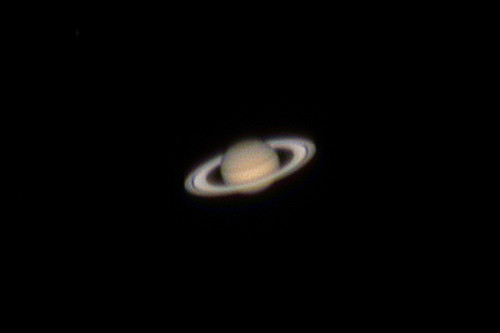
Saturn was a couple of days past opposition, with the rings still glowing brightly, and I was even able to grab a half-decent image (below):

Saturn

Titan and several moons were visible through the eyepiece, with Rhea, Dione and Tethys in a straight line just north of the planet.

I also had a quick look at NGC 7814 at 240x. Despite my eyes being nowhere near properly dark-adapted, I was still able to see Supernova 2021rhu. It was difficult to judge its brightness, but it seemed to have faded to somewhere around 13th magnitude.

Sunday, 22 August 2021

Rhubarb Supernova

16-17 July 2021, 23:45 – 01:15 (BST)


Seeing: Average

Transparency: Average/poor

Conditions: After a run of cloudy nights, a very mild, cloudless evening with a light breeze blowing from the north. (And a near first-quarter moon sinking in the west.) I spent a lot of time carefully aligning and calibrating the astrophotography rig, only to find out later (for reasons I haven’t yet figured out) that it had stopped tracking after a few minutes, leaving me with over an hour’s worth of star trails. Oddly, it started tracking again (or attempted to, given that the autoguider had long since lost its target star) on the last few frames. I suspect a loose or snagged cable is the culprit, but I haven’t been able to replicate the fault in daylight. (This is the experience I expected to have when I first attempted this type of astrophotography back in 2018, not three years in. Oh well…)

While that was in progress (or not), I revisited some summer favourites with the XT10 at 133x: M57, M56, Albireo and M27. The dumbbell’s central star was visible again (with averted vision), but not as easily as it was at 171x.

Then, with my eyes sufficiently dark-adapted, it was onto some special extragalactic targets: 

BL Lacertae, Active Galactic Nucleus / Blazar
133x. Not the most visually exciting object (it looks like a faint, inconspicuous star in a field full of stars), but at approximately 900 million light years this is the second-farthest thing I’ve seen (after quasar 3C 273). I had to consult the MSA (chart 1123) to track it down, and even then I had to make a rough sketch of the field stars to be sure I had seen it.

BL Lac usually fluctuates between magnitudes 14 and 17, which would normally put it out of range of my scope, but it’s been exhibiting a lot of activity over the last few months and is now brighter than it’s ever been, currently pushing 13th magnitude.

SN 2021rhu, Supernova in galaxy NGC 7814, Pegasus
At long last, a supernova bright enough for my scope, and in a place where I could see it. That said, I had to wait for Pegasus to clear the neighbour’s fence before I could get the XT10 on it, but even though it was still low in the sky, the supernova was immediately obvious at both 133x and 171x, shining relatively brightly against the faint haze of NGC 7814 at approximately magnitude 12.5. It appeared as an intense star-like point slightly east of the galaxy’s centre (I wasn’t able to see the galaxy’s dark lane). Quite an impressive sight considering it’s 40 million light years away (but bad news for anyone unfortunate enough to be within a few light-years of the explosion).

Apparently SN 2021rhu (with that name I can’t help but think of it as the “rhubarb supernova”) is a type 1a supernova. This is caused by a white dwarf accreting matter from a nearby companion star until electron degeneracy pressure can no longer support its mass – resulting in a rapid collapse, a runaway nuclear reaction and a spectacular explosion that rips apart the entire star.


Also: I was treated to three very bright passes of the ISS over the course of the evening. One pass was so bright I could see a halo around it.


I went out again the following night (17 July – 18 July) for another attempted imaging run which resulted in 8 minutes of perfect data followed by another hour or so of trailed images. [Insert expletives here.]

Fortunately I was able to salvage something from the session by sticking the camera on the XT10 and grabbing some data on Jupiter while a Ganymede shadow transit was in progress (below).

Ganymede Shadow Transit

Detail-wise, there wasn’t much to choose between the image and the eyepiece view (at 240x): the brown barges above the NEB showed up well, but I didn’t spot the string of white ovals in the southern hemisphere (which are just about visible in the full-size image).

I also had a look at Saturn as it emerged from behind the neighbour’s tree. Several moons were visible and lots of fine detail was briefly visible in the planet and the rings, although the seeing quickly deteriorated.

I also had another look at SN 2021rhu (at 240x). The supernova was still quite prominent despite my eyes not being properly dark-adapted. It’ll be interesting to see if it’s still visible in August once the moon has got out of the way.

Nature note
The mosquitoes were out in force on both nights; in all the years I’ve been doing astronomy I’ve never been bitten quite like that before.