Showing posts with label planets. Show all posts

Friday, 27 August 2021

Saturn at Opposition

3-4 August 2021, 23:30 – 01:30 (BST)


Having spent a good portion of the day walking round Stodmarsh Nature Reserve (for the first time in forever) in dazzling sunshine, my eyes weren’t really up for the challenge of observing faint objects, so I spent most of the session in the company of the two giant planets.

I caught Jupiter just as the GRS was disappearing around the limb. Unfortunately the neighbour’s tree seems to have put on a growth spurt, so I may not get an uninterrupted view of Jupiter this year after all.

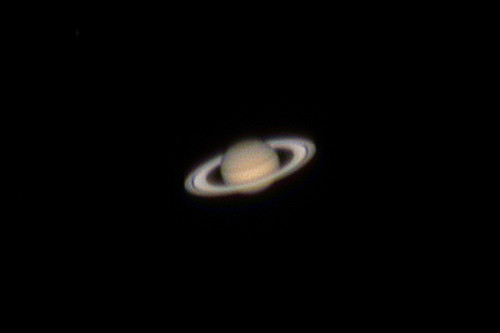
Saturn was a couple of days past opposition, with the rings still glowing brightly, and I was even able to grab a half-decent image (below):

Saturn

Titan and several moons were visible through the eyepiece, with Rhea, Dione and Tethys in a straight line just north of the planet.

I also had a quick look at NGC 7814 at 240x. Despite my eyes being nowhere near properly dark-adapted, I was still able to see Supernova 2021rhu. It was difficult to judge its brightness, but it seemed to have faded to somewhere around 13th magnitude.

Thursday, 28 January 2021

Falling Stars and Grazing Planets

A short update to round off the 2020 log. The weather during December was mostly unsuitable for observing, with a couple of notable exceptions.

The Geminid meteor shower put on a really fine display on the night of Saturday 12 December to Sunday 13 December, despite this being a good 24 hours before the shower peaked. (The actual night of the peak was clouded out.) I went outside a little before midnight and lasted about 90 minutes before the cold drove me back indoors, seeing at least 30 meteors (including one sporadic) during that time. I didn’t observe any fireballs, but I did notice a strange effect during the first half-hour whereby the meteors appeared to arrive in pairs. After a gap of two or three minutes, one would flash through Orion or Taurus, quickly followed by another one on almost the same path. Then another gap of two or three minutes before the next pair. My attempts to photograph the Geminids were less successful; they seemed to know exactly when I had the shutter open, and the one meteor I did “catch” in the act wasn’t bright enough to register on the sensor.


The day of the Great Conjunction between Jupiter and Saturn was also clouded out, but on the evening before closest approach (Sunday 20 December) there was a period between about 16:00 and 16:30 where the clouds cleared briefly in the southwest. Viewing conditions were pretty terrible, but I was able to see both planets (plus several moons and an interloper star) in the same field of view at several magnifications all the way up to 240x (i.e. within a third of a degree). Sadly both planets slipped behind a tree just as I was about to start an imaging run (using the ZWO ASI120MM at 1,000 mm), but I don’t think the results would have been that great anyway. Seeing the conjunction in the scope was good enough. (The image above is a quick consolation shot taken with the TV60, showing the relative size/brightness of the two planets.)


Nature note:
With the dusk gathering, and while I was scanning the gaps in the clouds with my binoculars, one of the local sparrowhawks floated over the garden, heading towards the local park (where I presume it has a roost).

Saturday, 26 December 2020

Mars and the Moon

28 November 2020, 19:00 – 20:00


Conditions: Quite cold (as you’d expect for the time of the year). Light film of condensation on the telescope.

Seeing: Good / excellent

Transparency: N/A


My run of good luck with the weather had to come to an end eventually, and so it proved with the months of October and November being pretty much a wash-out as far as deep-sky observing was concerned. The few windows of clear sky I did get were devoted to observing and imaging Mars, and fortunately I able to get just enough data to assemble a crude albedo map.

Tonight however was all about observing, with the seeing remaining unusually steady for once.


Mars: Good views at all magnifications from 171x up to 428x. Gibbous phase starting to become more obvious now. SPC tiny, but still bright. The albedo features were of much lower contrast than previous viewings, even with the Baader CB filter in place; but I was looking at the Tharsis / Solis Lacus region – the site of a recent major dust storm. There was a large – and prominent – bright yellowish haze near the limb (over Argyre?), plus a less obvious fainter haze further north.


The Moon: Nearly full, very bright. Viewed at 171x and 428x (with the Baader ND filter). As usual, the amount of detail on view was almost overwhelming, particularly at the higher magnification, but a few observations worthy of mention include:

At least three Plato craterlets “twinkling” in and out of view when the seeing allowed.

Mons Rümker region near the terminator, just a few days before the Chang’e 5 mission landed to collect samples.

Rimae Sirsalis showing particularly well (at 428x it looked more like a canyon than a rille).

Mare Humboldtianum visible close to the northern limb (the best view I’ve had of this elusive libration feature).


Nature note:
Tonight's soundtrack: The gentle “tseep” of winter thrushes passing overhead, and the not so gentle clattering of a fox jumping over the fence into the garden. Its eyes lit up when I shone the torch at it, but it didn’t leave until I cleared my throat.

Tuesday, 21 May 2019

Galaxies and Ice Giants

4 October 2018, 21:45 – 00:00 BST


Conditions: The seeing was quite good but the sky was a little hazy, affecting the transparency.

NGC 7479, galaxy in Pegasus
Viewed at 133x (9mm Nagler): faint, extended streak of light with bright star at one end and a fainter one at the other. First impression - not unlike NGC 891. Sky transparency not good enough to see spiral arms, but suggestion of mottled structure along central axis.

NGC 404, Mirach’s Ghost, galaxy in Andromeda
Follow up observation at 240x (5mm Nagler). Showed up very well. High power made it easier to keep Mirach out of the field of view and to see more detail in the galaxy itself: condensed core and suggestion of nested structure rather than smooth gradation – arranged in two or three “shells” of brightness.

Neptune
Appeared as a blue “out of focus” star. The colour made it stand out from neighbouring stars. Hard to resolve, even at 240x. Two faint stars in vicinity.

Uranus
Obvious green-grey disc even at 133x. Clearly resolved at 240x – no detail or moons seen.

NGC 7331, spiral galaxy in Pegasus
Bright core, extended envelope, sharp cut-off on one side, indicative of dust lane. Very much like a smaller copy of M31. Could probably take 240x.

M74, spiral galaxy in Pisces
Faint, but still obvious despite its reputation as the toughest Messier. At 133x it showed a condensed core surrounded by a large faint disc. Hard to see any detail, but darker areas possibly indicating regions between spiral arms.

NGC 772, spiral galaxy in Aries
Small asymmetric patch of light, lacking same degree of condensation as M74. Seemingly irregular. My old notes tell me that I did see this with the Vixen 102, describing it as looking like a "ghost globular".

NGC 925, spiral galaxy in Triangulum
Extremely faint, amorphous patch of light. Could be easily overlooked if just sweeping through the area.

M33, spiral galaxy in Triangulum
Seemed positively bright compared to the previous three galaxies. One spiral arm clearly seen: clumpy patch of light curling from core towards a bright field star. The question remains (as with NGC 891) as to how much of this I would be able to see if I wasn’t already familiar with the photographic representation.

A quick look at the M31 satellite galaxies:
M32, Andromeda: star-like core.
M110, Andromeda: faint field star nearby perhaps matching location of globular? Maybe that's wishful thinking, but the G1 globular should just about be within my the range of my scope. Will need a detailed finder chart or photo to verify.

A quick look at two open clusters in Perseus:
NGC 1528 & NGC 1513: misty patches at 50x, partially resolved.

NGC 1664, open cluster in Auriga
Very distinctive cluster; stars form an outline resembling a kite or a stingray.

NGC 1579, emission nebula in Perseus
Very faint patch of light, possibly doubled. Somehow managed to lose track of it when I put in the Ultrablock. Though I might have been hampered by condensation.


Eventually the session was curtailed by condensation on the secondary mirror (although the primary remained dry). Could mean that I’ll be limited to two-hour sessions between now and spring.

Nature Note:
3 frogs in the pond: 1 big, 2 small.

Monday, 18 March 2019

Observing in the Astronomical Twilight

25 June 2018, 23:30 – 01:00 BST

Deep-sky observing (of faint objects at least) is limited in the few weeks either side of the summer solstice, but fortunately the moon and the planets were on show. After a week of observing (and imaging) Jupiter (and properly seeing the moon’s Hadley Rille for the first time despite less than ideal seeing conditions), Saturn finally took centre-stage. While waiting for it to emerge from behind the neighbour’s tree, I looked at the following:


Epsilon Lyrae (The Double Double)
At 133x the stars showed obvious elongations, but no clear split. At 240x both pairs were resolved, but the stars had a spiky appearance, sometimes interfering with each other’s diffraction patterns.

Mu Cephei (The Garnet Star)
I wouldn’t go so far to describe it as red, but it definitely had a rich orange hue. Would be interesting to gauge the effects of different magnifications and seeing conditions on the perceived colour.

Saturn
The rings were wide-open and bright (with opposition only a few days away). Despite the low altitude (it barely cleared the fence) and variable seeing (a feature of the evening), this was by far the best view I’ve ever had of Saturn. The Cassini Division was easily resolved almost all the way around; the inner B ring was clearly brighter than the outer A ring. Saturn’s globe was well defined against the rings, giving it a 3D appearance; the usual darker equatorial cloud belt was also visible. Multiple moons seen despite the glare from the rings; according to the Sky & Telescope online app I saw Dione, Tethys, Rhea, Titan and (fleetingly) Enceladus.

Nature Note:
Another reason to tread carefully while moving the telescope from inside to outside (and vice versa): I’ve shared my recent observing sessions with dozens of tiny froglets which emerge from the pond every evening after dark.