Showing posts with label saturn. Show all posts

Friday, 27 August 2021

Saturn at Opposition

3-4 August 2021, 23:30 – 01:30 (BST)


Having spent a good portion of the day walking round Stodmarsh Nature Reserve (for the first time in forever) in dazzling sunshine, my eyes weren’t really up for the challenge of observing faint objects, so I spent most of the session in the company of the two giant planets.

I caught Jupiter just as the GRS was disappearing around the limb. Unfortunately the neighbour’s tree seems to have put on a growth spurt, so I may not get an uninterrupted view of Jupiter this year after all.

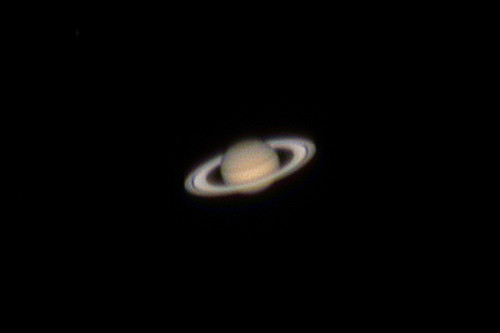
Saturn was a couple of days past opposition, with the rings still glowing brightly, and I was even able to grab a half-decent image (below):

Saturn

Titan and several moons were visible through the eyepiece, with Rhea, Dione and Tethys in a straight line just north of the planet.

I also had a quick look at NGC 7814 at 240x. Despite my eyes being nowhere near properly dark-adapted, I was still able to see Supernova 2021rhu. It was difficult to judge its brightness, but it seemed to have faded to somewhere around 13th magnitude.

Sunday, 22 August 2021

Rhubarb Supernova

16-17 July 2021, 23:45 – 01:15 (BST)


Seeing: Average

Transparency: Average/poor

Conditions: After a run of cloudy nights, a very mild, cloudless evening with a light breeze blowing from the north. (And a near first-quarter moon sinking in the west.) I spent a lot of time carefully aligning and calibrating the astrophotography rig, only to find out later (for reasons I haven’t yet figured out) that it had stopped tracking after a few minutes, leaving me with over an hour’s worth of star trails. Oddly, it started tracking again (or attempted to, given that the autoguider had long since lost its target star) on the last few frames. I suspect a loose or snagged cable is the culprit, but I haven’t been able to replicate the fault in daylight. (This is the experience I expected to have when I first attempted this type of astrophotography back in 2018, not three years in. Oh well…)

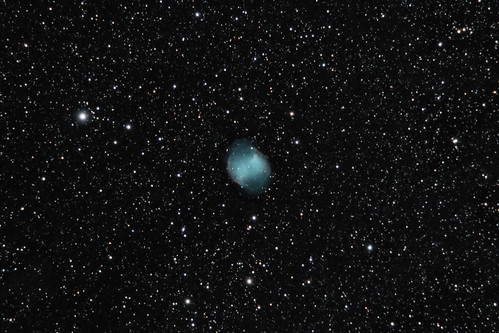
While that was in progress (or not), I revisited some summer favourites with the XT10 at 133x: M57, M56, Albireo and M27. The dumbbell’s central star was visible again (with averted vision), but not as easily as it was at 171x.

Then, with my eyes sufficiently dark-adapted, it was onto some special extragalactic targets: 

BL Lacertae, Active Galactic Nucleus / Blazar
133x. Not the most visually exciting object (it looks like a faint, inconspicuous star in a field full of stars), but at approximately 900 million light years this is the second-farthest thing I’ve seen (after quasar 3C 273). I had to consult the MSA (chart 1123) to track it down, and even then I had to make a rough sketch of the field stars to be sure I had seen it.

BL Lac usually fluctuates between magnitudes 14 and 17, which would normally put it out of range of my scope, but it’s been exhibiting a lot of activity over the last few months and is now brighter than it’s ever been, currently pushing 13th magnitude.

SN 2021rhu, Supernova in galaxy NGC 7814, Pegasus
At long last, a supernova bright enough for my scope, and in a place where I could see it. That said, I had to wait for Pegasus to clear the neighbour’s fence before I could get the XT10 on it, but even though it was still low in the sky, the supernova was immediately obvious at both 133x and 171x, shining relatively brightly against the faint haze of NGC 7814 at approximately magnitude 12.5. It appeared as an intense star-like point slightly east of the galaxy’s centre (I wasn’t able to see the galaxy’s dark lane). Quite an impressive sight considering it’s 40 million light years away (but bad news for anyone unfortunate enough to be within a few light-years of the explosion).

Apparently SN 2021rhu (with that name I can’t help but think of it as the “rhubarb supernova”) is a type 1a supernova. This is caused by a white dwarf accreting matter from a nearby companion star until electron degeneracy pressure can no longer support its mass – resulting in a rapid collapse, a runaway nuclear reaction and a spectacular explosion that rips apart the entire star.


Also: I was treated to three very bright passes of the ISS over the course of the evening. One pass was so bright I could see a halo around it.


I went out again the following night (17 July – 18 July) for another attempted imaging run which resulted in 8 minutes of perfect data followed by another hour or so of trailed images. [Insert expletives here.]

Fortunately I was able to salvage something from the session by sticking the camera on the XT10 and grabbing some data on Jupiter while a Ganymede shadow transit was in progress (below).

Ganymede Shadow Transit

Detail-wise, there wasn’t much to choose between the image and the eyepiece view (at 240x): the brown barges above the NEB showed up well, but I didn’t spot the string of white ovals in the southern hemisphere (which are just about visible in the full-size image).

I also had a look at Saturn as it emerged from behind the neighbour’s tree. Several moons were visible and lots of fine detail was briefly visible in the planet and the rings, although the seeing quickly deteriorated.

I also had another look at SN 2021rhu (at 240x). The supernova was still quite prominent despite my eyes not being properly dark-adapted. It’ll be interesting to see if it’s still visible in August once the moon has got out of the way.

Nature note
The mosquitoes were out in force on both nights; in all the years I’ve been doing astronomy I’ve never been bitten quite like that before.

Thursday, 28 January 2021

Falling Stars and Grazing Planets

A short update to round off the 2020 log. The weather during December was mostly unsuitable for observing, with a couple of notable exceptions.

The Geminid meteor shower put on a really fine display on the night of Saturday 12 December to Sunday 13 December, despite this being a good 24 hours before the shower peaked. (The actual night of the peak was clouded out.) I went outside a little before midnight and lasted about 90 minutes before the cold drove me back indoors, seeing at least 30 meteors (including one sporadic) during that time. I didn’t observe any fireballs, but I did notice a strange effect during the first half-hour whereby the meteors appeared to arrive in pairs. After a gap of two or three minutes, one would flash through Orion or Taurus, quickly followed by another one on almost the same path. Then another gap of two or three minutes before the next pair. My attempts to photograph the Geminids were less successful; they seemed to know exactly when I had the shutter open, and the one meteor I did “catch” in the act wasn’t bright enough to register on the sensor.


The day of the Great Conjunction between Jupiter and Saturn was also clouded out, but on the evening before closest approach (Sunday 20 December) there was a period between about 16:00 and 16:30 where the clouds cleared briefly in the southwest. Viewing conditions were pretty terrible, but I was able to see both planets (plus several moons and an interloper star) in the same field of view at several magnifications all the way up to 240x (i.e. within a third of a degree). Sadly both planets slipped behind a tree just as I was about to start an imaging run (using the ZWO ASI120MM at 1,000 mm), but I don’t think the results would have been that great anyway. Seeing the conjunction in the scope was good enough. (The image above is a quick consolation shot taken with the TV60, showing the relative size/brightness of the two planets.)


Nature note:
With the dusk gathering, and while I was scanning the gaps in the clouds with my binoculars, one of the local sparrowhawks floated over the garden, heading towards the local park (where I presume it has a roost).

Monday, 17 August 2020

Completing the Messier Catalogue

20 – 21 July 2020, 23:30 – 2:00


Conditions: Mild to begin with, but got chillier. Very gentle breeze; light condensation towards the end of the session. Proper astronomical dark was back at last (for an hour at least).

Seeing: Average
Transparency: Good

Comet C/2020 F3 NEOWISE continues its progress over the north-western horizon. Becoming harder to see with the naked eye, but still a good sight in binoculars. Definitely fainter now, but the tail is longer.

All observations (apart from the planets) at 92x with the 13mm Ethos. The XT10 was propped on the improvised “Observing table + bricks” platform again – hopefully for the final time. For the last couple of sessions I’ve been using a magnetic 3 lb counterweight to help balance the scope when attaching the camera or heavy eyepieces like the Ethos to the focuser. I’m not sure it’s worth the price Orion charge for it, but it does the job (without marking the scope), so I can’t argue with that.

M8, Lagoon Nebula, Sagittarius
A quick look (sans filter). The Ethos is the best eyepiece for framing this object, showing the nebula, the cluster (NGC 6530) and 7 Sagittarii all in the same field of view.

NGC 6522, globular cluster, Sagittarius
Quite obvious in the Ethos, if faint. Small and condensed; averted vision revealed some faint stars on the outskirts of the cluster – possibly foreground stars.

NGC 6544, globular cluster, Sagittarius
Small, faint globular, south-east of M8; very condensed core with averted vision – almost star-like. Faint star west; three more east.

NGC 6553, globular cluster, Sagittarius
Large, extended globular, south-east of 6544 and M8; brighter towards centre, but not particularly condensed. Faint star just north-west of core.

NGC 6624, globular cluster, Sagittarius
As per previous observation: bright, condensed. A bit more prominent tonight.

M69, globular cluster, Sagittarius
More obvious tonight, but still faint. Quite condensed core with averted vision. Bright star NNW.

M70, globular cluster, Sagittarius
Faint, low surface brightness globular, but clearly visible tonight – though not as obvious as M69. Some sources list M70 as being smaller than M69, but to my eyes it seemed a little larger, perhaps because M69 is more concentrated. Bright field star to west. The cluster appeared condensed with averted vision, which also revealed a faint star north of the core, plus a suggestion of fainter stars east of the core.

At 00:15 there was a very bright ISS pass, almost directly overhead.

M22, globular cluster, Sagittarius
A refreshing change after all those faint globulars: large, rich and expansive – brimming with stars; really fills out with averted vision. I imagine seeing this from the UK must be a bit like seeing Omega Centauri from the southern US states.

M11, open cluster, Scutum
Amazing as always. The lucida is on the eastern corner of cluster. Finely resolved in the Ethos – gives a really crisp view.

M26, open cluster, Scutum
Small kite-shaped cluster with a curving chain of stars to the north and a fainter spray of stars to the east. Central asterism curiously empty.

🍾 M55, globular cluster, Sagittarius 🍾
Very large, low surface brightness globular – like a ghost of M22. No wonder I struggled to see it at the higher magnification last time out, but tonight there was no mistaking it with the Ethos. With time and averted vision, a faint sprinkling of stars began to appear, the brightest one located south-east of the core (not sure if this was a true member or a foreground star). It’s taken a while, but I’ve now seen every single Messier object – all of them from my garden, and all but one of them with the XT10. A modest achievement perhaps, but one I didn’t think was possible until a few months ago (when I saw M83).

I rounded off the session by upping the magnification to 171x and taking a look at a couple of planets, beginning with Saturn at opposition. The view was a little hazy because of the increasing condensation, but the enhanced brightness of the rings immediately stood out (they were so bright they made the closer moons a little harder to see than usual). The Cassini Division was showing well and there was even some brightness variation across the rings (which I’ve only previously seen in photos). The colour contrast between the dusky, slightly tan planet and the very pale blue-tinged rings was also noticeable. The effect was subtle and came and went with the seeing, but at times it really did look like the Saturn I’ve seen in photos.

Mars is gradually increasing in size and phase. Some vague dark markings were visible and the polar cap was bright, but the seeing in this part of the sky is still quite poor. Hoping a dust storm doesn’t obscure the surface at opposition like it did in 2018.

Nature note:
A noisy wader (possibly an oystercatcher) flying around for much of the night provided an atmospheric soundtrack to the session. Also, a frog jumped on my foot (I heard it approaching, so I wasn’t taken completely by surprise).

Friday, 24 July 2020

Globular Clusters in Ophiuchus and Sagittarius

22 – 23 June 2020, 23:30 – 3:30


Conditions: Very mild, light wind with occasional gusts. No clouds and no condensation tonight.

Seeing: Good
Transparency: Quite good considering the time of year

Once again I set up two scopes in the garden: the XT10 with the 13mm Ethos (92x) and the TV60 with the 9mm Nagler (40x). The XT10 was balanced on my observing table, enabling it to point a little further south than usual (and also so I could observe while sitting down).

After warming up with views of M13, M57, M56 and Albireo, I turned my attention south to a selection of globular clusters.

M19, globular cluster, Ophiuchus
92x. Bright, condensed globular, about the same declination as Antares. Speckled appearance with averted vision. One star resolved north of the core, another one east of the core.

NGC 6284, globular cluster, Ophiuchus
92x. Small, condensed blur, a little north of M19. Swells in size with averted vision. Faint star east of core.

NGC 6293, globular cluster, Ophiuchus
92x. Another small, condensed blur. No resolution, but the core seemed particularly bright.

M62, globular cluster, Ophiuchus
92x. Large, condensed blur (one of the Messier globulars below -30 degrees). Bright core, a little grainy with averted vision.

NGC 6316, globular cluster, Ophiuchus
92x. Very faint round blur, east of M19 and M62, and about midway between them in terms of declination (-28 degrees). Condensed with averted vision. There were also a few stars superimposed over the top, surrounding the core; I assume these are foreground stars and not true cluster members.

M9, globular cluster, Ophiuchus
92x. Bright, asymmetric globular. Starts to resolve with averted vision, but really needs a darker sky to get the best out of it. Apparent dark patches southwest of core.

NGC 6342, globular cluster, Ophiuchus
92x. Faint, condensed blur, south of M9. Brighter core with averted vision. Faint star SW of core.

NGC 6356, globular cluster, Ophiuchus
92x. Bright, condensed globular, northwest of M9 and only a little smaller and fainter than its M-designated neighbour. No resolution, but some faint stars visible on the outskirts of the cluster.

M6, open cluster, Scorpius
92x (and skimming the neighbour's fence!). Better-framed at this magnification (than at 133x), but still a little too large for the fov. More stars visible, giving it an almost “chunky” appearance. On this occasion its overall outline reminded me a little of M24.

M7, open cluster, Scorpius: 40x (TV60 + 9mm Nagler)
A slightly better view tonight, reinforcing my initial impressions: a large, loose cluster with the dozen brightest stars arranged in a wavy x-shape.

NGC 6520, open cluster, Sagittarius
92x. I picked this up by accident while sweeping the area south of M8. A compact and very distinctive open cluster comprised of bright, colourful stars overlying a rich unresolved haze. Prominent orange star near the centre. This cluster stood out well despite its low altitude (-28 degrees declination).

M21, open cluster, Sagittarius
92x. Rich cluster with bright stars; not particularly condensed. Bright pair near centre.

M28, globular cluster, Sagittarius
92x. Bright, condensed globular. Grainy appearance. Hint of resolution with averted vision. Somewhat overshadowed by its illustrious neighbour…

M22, globular cluster, Sagittarius
92x. Very large “flattened” globular – spectacular in the Ethos. A few dozen stars resolved in direct vision; countless more with averted vision. Appeared to be a dark lane or rift on the western side. Tonight at least, it surpassed even M13 in visual splendour.

M24, star-cloud, Sagittarius
92x. Incredibly rich star-field. Even in the Ethos it covers several fields of view, but this is probably the best eyepiece for appreciating this region’s grandeur and sheer density of stars. I could easily spend an entire session here. The dark dust clouds which give M24 its distinctive sharp-edged appearance are conspicuous by their relative absence of stars. I know this region is actually a window into a deeper part of the galaxy, but the impression I get is of an iceberg of stars caught in the process of calving off from the Milky Way.

M18, open cluster, Sagittarius
92x. Bright little cluster; not particularly rich, but the brightest stars seem to form the shape of a pointy toadstool, or a partially opened umbrella.

M54, globular cluster, Sagittarius
92x. Small, round condensed blur. Prominent bright core, but not even a hint of resolution. Apparently gravitationally bound to the Sagittarius Dwarf Elliptical Galaxy (SagDEG).

M69, M70 and M55 (the only Messiers I haven’t yet observed) eluded me tonight. M69 and M70 are only a couple of degrees lower than M54, but that’s a lot of atmosphere to look through, making them too faint for the TV60. They also don't quite clear the fence as viewed from the XT10 - even with it balanced on a table. At -31 degrees, M55 should be viewable in the XT10, but – being further east than the other objects – the sky was too bright by the time it emerged from behind the tree. However, as a consolation, the conditions were just right for viewing the planets (with the 7mm DeLite).

Jupiter, 171x: Possibly my best view yet of the giant planet. Some sustained moments of excellent seeing revealed superfine detail, including festoons trailing from the notably turbulent NEB. Io’s shadow was visible as a perfect little dark spot on the NEB, and I was able to follow Io itself as it nudged across the darkened Jovian limb to begin its own transit. I did briefly add the 2.5x Powermate to increase the magnification to 428x, but the seeing wasn’t quite that good.

Saturn, 171x: Same detail as noted in the previous session, but holding steady for longer. The Cassini Division showed particularly well. Again, despite the brightening sky, Titan, Tethys, Dione and Rhea were clearly visible, along with a nearby faint star masquerading as a moon; I’d have to do a same-night comparison with the 5mm Nagler to be sure, but the DeLite does seem to control light-scatter better than any other eyepiece I’ve looked through.

Mars, 171x: First telescopic view of the red planet for this year. The seeing wasn’t quite as good here (it was still only just clearing the neighbour’s rooftop), but the gibbous phase was obvious along with some vague dark markings that showed a little better when I added the Baader Contrast Booster filter*. Disc still small at 11 arcseconds, but the best is yet to come (barring another dust storm like the one in 2018).

(* I bought the BCB years ago for the Vixen SP-102; I had no idea it was useful as a Mars filter until I read about it recently on Cloudy Nights.)

Sunday, 19 July 2020

The Southernmost Messier Object

14 June 2020, 00:30 – 03:30


Conditions: Mild, still (no wind), hazy and humid – heavy condensation. Cloud increasing over the course of the session.

Seeing: Average / poor
Transparency: Poor

I don’t normally observe in the two weeks either side of the summer solstice because the sky doesn’t get reasonably dark until gone midnight – and it doesn’t stay dark for very long. However, if I’m to do justice to the Scorpius/Sagittarius region I figured I should at least try to observe some of the brighter objects this month rather than tackle them all in a mad scramble in July or August. (And of course there’s no guarantee the skies will be clear then anyway.)

Also, encouraged by my glimpse of M7 last time out, I had the TV60 set up on the Super Polaris mount. However I hadn’t taken into consideration just how much the trees and plants can grow in barely a month, so I was contending with foliage as well as the neighbour’s fence. Fortunately, the TV60 is easier to move from side to side than the XT10.

After warming up with a look at M13 in both scopes (it appeared hazy and a little washed-out tonight, despite being nearly overhead), I switched to the main target for the evening.

M7, open cluster, Scorpius, 40x (TV60 + 9mm Nagler)
The scope was almost horizontal, but I was able to get just enough clearance over the neighbour’s fence to centre M7 in the field of view. The object itself appeared faint and washed out, but enough stars were visible to at least give a sense of a very large, splashy open cluster. The brightest stars seemed to form a distorted x-shape with a double star at the centre (although the atmospheric distortion and low magnification made it hard to split). There was also a haze of unresolved stars, plus an incomplete ring of brighter stars surrounding the central cluster. Even if M7 were high enough to be visible in the XT10, the TV60 would still be a better choice of scope to view it simply because of the larger field of view (2 degrees in the 9mm Nagler). By comparison, M6 – which is itself a fairly large cluster – appeared more traditionally condensed at the same magnification.

I also had the XT10 set up in the garden, but another thing I hadn’t taken into consideration was how bad the condensation would be tonight. I had planned to use the 13mm Ethos, but unfortunately the eye-lens misted over while I was looking at M7, so I swapped it out for the 9mm Nagler. The sky was getting hazier too, so I stuck to only the brightest objects. (The fainter stuff could wait for a better night.)

M21, open cluster, Sagittarius
133x. Loose, bright cluster, a little north of M20. Star pattern at centre in the shape of a teacup, or a backwards “3”.

M23, open cluster, Sagittarius
133x. Rich, large cluster. Uniformly bright stars filling the fov. Bright star to north. Concentration of fainter stars at western end of cluster.

M25, open cluster, Sagittarius
133x. Bright, large cluster, with a distinctive “D” shaped pattern of stars at the centre. Unlike M23, the stars come in a mixture of brightnesses.

With the condensation worsening and the sky already starting to brighten, it was almost time to pack up. However while taking the TV60 indoors I noticed that Jupiter and Saturn were starting to emerge from behind the tree, so I (carefully) moved the XT10 and changed the 9mm Nagler for the 7mm DeLite.

Jupiter, 171x: the seeing was variable but in the fleeting moments that it steadied, the DeLite gave a very sharp, comfortable view. All four Galilean moons were on view and I could see the Great Red Spot moving onto the disc, showing its familiar brick-red colour when the seeing allowed.

Saturn, 171x: Titan and three faint moons were visible, despite the brightening sky. Saturn was its usual exquisite self with the Cassini Division showing well in moments of good seeing, as well as the shadow of the planet on the rings, and the dusky equatorial band.

Sunday, 6 October 2019

The Veil in OIII

22 August 2019, 21:45 – 23:00 BST

The first clear, moonless night this side of the solstice and the transparency was unusually good for the time of year.

The seeing wasn’t nearly as good, so the best views of Saturn came only fleetingly at 240x, with the Cassini Division, the planet’s shadow across the rings, and the subtle banding on the planet itself all on display. The moons showed up well at 133x, with Titan, Rhea, Tethys and Dione clearly visible.

M11, Wild Duck Cluster, Scutum
A quick look at one of my favourite clusters, although the fainter stars were a little bit washed out by light pollution. But this was just a warm-up to get my eyes back in deep-sky mode as I prepared for the main target of the evening…

Veil Nebula, supernova remnant, Cygnus
Ever since I got it I’ve been itching to use the Astronomik OIII filter on the Veil and I wasn’t disappointed. At 50x (Panoptic 24mm), the nebula was bright and distinct and very large, showing lots of fine detail in both arcs. The sinuous “spike” of the Western Veil (NGC 6960) was clearly brighter along its edges, and the Eastern Veil (NGC 6992/5) showed faint “talon-like” extensions (IC 1340) from its southern end. I also saw a portion of Pickering/Fleming’s Triangle (Simeis 3-188) for the first time, visible directly as a faint wisp of light, becoming brighter and more extended with averted vision. Overall, the Veil had a wraith-like appearance, quite unlike anything else I’ve seen in the night sky. I’ve written before about the differences between planetary nebulae and emission nebulae as being akin to smoke and mist, but this was something else entirely, like a windblown cloud or vapour trail, frozen in space.

Other notes:
As I was packing up I saw a single late Perseid flashing through Pegasus.

Wednesday, 17 April 2019

Andromeda – Cassiopeia – Perseus

5-6 August 2018, 23:00 – 02:00 BST


As expected, I wasted a lot of time getting the SP/TV-60 combo polar-aligned and focused (but in my defence I hadn’t done it since May). I took a couple of test shots of the Veil Nebula but, realistically, exposures longer than about 90 seconds will need autoguiding – especially the further I get away from the pole. But on the plus side, I appear to have fixed the issue with the declination worm gear.

Anyway, I switched to a brighter object and shot 60 x 1 min exposures of M27, the Dumbbell Nebula. While that was in progress I pointed the XT10 at the following targets:

Saturn showed fleeting moments of good seeing, but again, not enough to justify shooting video clips. It’s noticeably lower in the sky now, so it’s unlikely it’ll look as good as it did on 25 June (at least for this year).

The Witch’s Broom segment of the Veil Nebula was faintly visible at 50x, brushing against 52 Cygni – the first time I’ve seen any part of the Veil without having to use the Ultrablock filter. Though I’m not sure I would have noticed it if I hadn’t already known it was there.

Double Cluster in Perseus
Spectacular as always. No significant increase in the number of stars I could see, but they were all that much brighter. The usual red giant stars were prominent – particularly the one halfway between the two clusters.

M31, Andromeda Galaxy
With the higher altitude I could get a sense of the galaxy extending beyond the dark dust lanes. The star cloud NGC 206 seemed to be visible with averted vision, but I’m still getting my bearings with Andromeda. The 24 mm Panoptic is better for getting more of M31 in the frame, but higher magnification might improve the contrast around its constituent parts.

M33, Triangulum Galaxy
Some tantalising structure starting to emerge, but needs to be higher in the sky. Again, higher magnification and a detailed finder chart might help with this one.

NGC 752, open cluster in Andromeda
Bright stars, but a large and very loose cluster. Better suited to the TV-60 or binoculars.

NGC 891, edge-on galaxy in Andromeda
Took a long time to find it, and even then it was extremely faint. I think I was expecting something smaller and brighter, but perhaps (although I couldn't see it) the light from the rising moon was already starting to interfere.

M76, Little Dumbbell Nebula in Perseus
Bright both with and without the filter. Double-lobed structure with one lobe clearly brighter than the other. Light greenish colour.

Then followed a quick tour of Cassiopeia to reacquaint myself with its many star clusters; not much to add on the notes from the old SP-102 log but now all the clusters are resolved to varying degrees (sometimes to their detriment, as the larger, looser clusters are hard to distinguish from the background Milky Way):
NGC 457, Owl Cluster: like meeting an old friend; one of the most distinctive clusters not in the Messier Catalogue
M103: very pretty little cluster
NGC 663, 659 and 654: 3+ clusters in the same patch of sky; potential astrophoto target
NGC 7789: very rich cluster
M52: also rich, but smaller than 7789; Bubble Nebula suspected, but not confirmed
Stock 2: large, sprawling cluster, more like a denser section of the Milky Way

NGC 281, Pacman Nebula (surrounding IC 1590 cluster) in Cassiopeia
Faintly visible without the Ultrablock filter, the addition of which increases its size as well revealing a trace of mottled detail. Very obvious dark bay eating into nebula. Sparse but tight grouping of stars at centre – more like a multiple star system than a cluster. Its size (about the same area as the moon) makes this another potential photo target for the TV-60.

Other Notes
Perseid meteors becoming more frequent.
NELM: Approximately 6 naked-eye stars counted in the square of Pegasus, indicating a limiting magnitude between 5.25 and 5.5 tonight.

Nature Note
One bat, a curlew (and some other bird – likely a wader) calling in the distance, and two frogs in the pond (one big, one little).


Monday, 8 April 2019

Planetary Nebulae in Aquila

2 August 2018, 22:00 – 00:00 BST


Transparency improving week by week, but the seeing seems to be going the other way. Saturn only showed well for fleeting moments, not enough to justify attaching the camera and the laptop. From about 23:00 onwards the entire Sagittarius “teapot” asterism was visible, with Epsilon Sagittarii (Kaus Australis) being the most southerly star I could see at -34 deg 23’ declination. (Apparent mag. +1.85).

The ISS also made one of its regular appearances.

All observations at 133x (Nagler 9mm) unless otherwise stated.

M17 (Omega/Swan Nebula), nebula in Sagittarius
Very bright both with and without the Ultrablock (although the filter really helps improve the contrast in this light-polluted part of the sky). An extended bar of nebulosity with the brightest part forming the characteristic “2” or swan shape around a conspicuous dark patch. The main bar takes on an impressively mottled structure with the filter in place.

M22, globular cluster in Sagittarius
A large, sprawling ball of stars. Surprisingly well resolved despite its very low altitude and the murky light pollution.

Intrigued by all the planetary nebulae symbols marked on the PSA chart for Aquila, I decided to take a closer look...

NGC 6751, PN in Aquila
Small, featureless disc of light.

NGC 6781, PN in Aquila
Large, low surface-brightness nebula. Responded well to the Ultrablock filter. Not perfectly round; suggestion of an asymmetric dark core.

NGC 6804, PN in Aquila
Medium sized planetary nebula. Faint field stars in and around disc – could trick a casual observer into thinking they were looking at a partially resolved star cluster.

Also looked without success for NCG 6741 and 6803 – though I discovered later it was probably due to their very small apparent size. I did however notice a couple of conspicuously bright aquamarine “stars” through the Ultrablock filter, so it’s possible I did see them without realising it.

M71, globular cluster in Sagitta
Not completely resolved (unlike the comparably rich M11), confirming its status as a globular cluster, albeit a very loose one. Roughly triangular in shape, with chains of stars forming two swept-back “wings”.

Mars
Current altitude (approx. 12 degrees) is so low I was literally looking at it through my neighbours’ fence, so the image was severely hampered by diffraction as well as poor seeing. Suggestion of polar brightening, but no significant detail seen.


Nature Note
Saw one big frog in the pond, but no froglets. The heavy rain on Friday night seems to have been the cue for a mass exodus. In recent evenings I’ve also seen a couple of bats hunting low over the garden.


Wednesday, 27 March 2019

Summer Clusters and Nebulae

14 -15 July 2018, 23:00 – 02:00 BST


A very clear night, if not completely dark; good enough to see 5th magnitude stars after dark-eye adaption, and the Scutum star-cloud with averted vision (although the latter seems to be more affected by light pollution than ever).

Saturn looked very impressive when I first pointed the telescope at it, with the usual moons in attendance and the Cassini Division visible most of the way around, but the seeing deteriorated rapidly as it passed the meridian. (Possibly due to warm air rising off the pond and the surrounding concrete.)

M39, open cluster in Cygnus
A sparse cluster of bright stars, spilling outside the edge of field of view even at 50x. Too loose and large for a big reflector; I wasn’t even sure I was looking at a cluster at first.

NGC 7062, open cluster in Cygnus
A grainy, fuzzy patch of nebulosity at 50x; starts to resolve at 133x. Faint stars.

NGC 6910, open cluster in Cygnus
A grouping of bright stars arranged in a kind of flattened Y-shape. Not rich, but well-framed at 50x. Quite pretty; would probably have greater appeal if it didn’t already reside in such a rich section of the Milky Way.

M29, open cluster in Cygnus
Boxy, like a mini version of the Pleiades. The extra aperture doesn't really add anything to this cluster that I hadn't already seen through the 4-inch.

NGC 7000, North America Nebula in Cygnus
Scanned region with Ultrablock, but too large for fov. Could tell that some areas were brighter than others but hard to distinguish nebulosity from the sheer number of background stars.

NGC 6888, Crescent Nebula in Cygnus
I spent a lot of time looking for this with the 4-inch and never convinced myself of seeing it, but I found it right away with the XT10 (Panoptic 24 mm + Ultrablock). Appeared as an elongated semi-circle of stars connected by bright streaks of nebulosity. Closer examination showed a faint haze filling the interior of the crescent, giving the impression of a baby wrapped in swaddling clothes, with a darker region where the face would be.

I left the Pan 24 and the Ultrablock in place and moved down to 52 Cygni and the Veil Nebula, supernova remnant in Cygnus: now high overhead and even more vivid than the previous sighting. The Witch’s Broom still looked like a frozen funnel cloud, a twisted spike of nebulosity extending beyond 2 fovs. The Eastern Veil showed more detail; both halves are very clearly “structured” nebulae, in that they have clearly defined edges as opposed to the more typical cloudy nebulae which just fade gently into the background sky.

M57, Ring Nebula in Lyra
Studied at 240x, with and without the Ultrablock filter. Holds its brightness well at high magnification in the XT10. Otherwise as per previous description. Slight green-grey colour.

M27, The Dumbbell Nebula

M27, Dumbbell Nebula in Vulpecula
The "apple-core" took on a more boxy appearance at 240x. Distinct, sharp cut-off in brightness on one edge, and strong hints of structure within the nebula – most prominent being the diagonal bar commonly seen in photos like the one above.

M11, Wild Duck Cluster in Scutum
Not much I can add to the previous report. Just a fantastic cluster to look at in the XT10.

NGC 6712, globular cluster in Scutum
Stumbled upon this while sweeping south of M11. Fuzzy, circular blur at 50x, but starts to betray its true nature at higher magnification. Reminded me of M13 as seen in the smaller scope.

M15, globular cluster in Pegasus
Well resolved, very condensed core – more so than other globulars I’ve looked at. Definitely worth revisiting when it's higher in the sky. Nearby field stars really help frame this object at both 50x and 133x, giving it a 3D appearance.

NGC 7006, globular cluster in Delphinus
Small, circular blur. Relatively easy to see in the XT10, but no stars resolved.

NGC 7331, spiral galaxy in Pegasus
This galaxy displays a bright core nestled in a fainter disc, very much a mini M31. Suggestion of asymmetry on one side. Couldn’t see the companion galaxies (the “tadpoles”) on this occasion, but I think they should be visible on a darker night with higher magnification. (Ditto for Stephan’s Quintet.)

NGC 7662 (Blue Snowball), PN in Andromeda
I find it hard to distinguish between blue and green in low light, but this definitely has a bluish turquoise hue compared to, say, the grey-green of M57. Appeared circular at 133x, with a hint of a darker core.

Almach (Gamma Andromedae), double star
Lovely pairing of a pale yellow primary and a sky-blue secondary. (Looking back at the notes I made with the 4-inch, I've previously described the colours as straw and aquamarine.)

Tiredness was really starting to creep in at this point (and dew was forming), so subsequent observations fall into the “just one more object” category.

M52, open cluster in Cassiopeia
Rich cluster, worth revisiting in the autumn.

M31, Andromeda Galaxy
Showing a frustrating lack of detail despite its brightness. Obviously, higher altitude and darker skies should improve things, but perhaps higher magnification might increase the contrast at the expense of the “big picture”.

M33, Triangulum Galaxy
Large circular blur devoid of any real detail, but at least it was obvious (unlike in the 4-inch) despite being fairly low in the sky. Averted vision showed a distinct, almost star-like condensation at the nucleus – not something I recall seeing before.

Finished off with a first look at Mars through the XT10. As big as I’ve ever seen it (and ever likely to see it), but rendered featureless by the global dust-storm. Hint of a brightening at the poles, but low altitude causing a lot of colour dispersion. Even to the naked eye it looks pale yellow rather than its usual amber hue.


Monday, 18 March 2019

Observing in the Astronomical Twilight

25 June 2018, 23:30 – 01:00 BST

Deep-sky observing (of faint objects at least) is limited in the few weeks either side of the summer solstice, but fortunately the moon and the planets were on show. After a week of observing (and imaging) Jupiter (and properly seeing the moon’s Hadley Rille for the first time despite less than ideal seeing conditions), Saturn finally took centre-stage. While waiting for it to emerge from behind the neighbour’s tree, I looked at the following:


Epsilon Lyrae (The Double Double)
At 133x the stars showed obvious elongations, but no clear split. At 240x both pairs were resolved, but the stars had a spiky appearance, sometimes interfering with each other’s diffraction patterns.

Mu Cephei (The Garnet Star)
I wouldn’t go so far to describe it as red, but it definitely had a rich orange hue. Would be interesting to gauge the effects of different magnifications and seeing conditions on the perceived colour.

Saturn
The rings were wide-open and bright (with opposition only a few days away). Despite the low altitude (it barely cleared the fence) and variable seeing (a feature of the evening), this was by far the best view I’ve ever had of Saturn. The Cassini Division was easily resolved almost all the way around; the inner B ring was clearly brighter than the outer A ring. Saturn’s globe was well defined against the rings, giving it a 3D appearance; the usual darker equatorial cloud belt was also visible. Multiple moons seen despite the glare from the rings; according to the Sky & Telescope online app I saw Dione, Tethys, Rhea, Titan and (fleetingly) Enceladus.

Nature Note:
Another reason to tread carefully while moving the telescope from inside to outside (and vice versa): I’ve shared my recent observing sessions with dozens of tiny froglets which emerge from the pond every evening after dark.