Showing posts with label Jupiter. Show all posts

Monday, 15 November 2021

Sightseeing in Cassiopeia and Perseus

8 October 2021, 20:45 – 22:45 (BST)


Seeing: Average
Transparency: Average

Conditions: A mild night with a light breeze. Patchy cloud at the start and end of the session.
With all the forecasts predicting clouds at some point, I wasn’t sure how much time I was going to get, so I kept the 13mm Ethos in the focuser for the entire session.

NGC 7789, open cluster, Cassiopeia
92x. Lovely, rich cluster – looks like a very loose globular in the Ethos. Orange star on the leading (west) side of the cluster.

NGC 457, open cluster, Cassiopeia
92x. The unmistakable Owl Cluster; this was always one of my favourites in the SP-102. Rich central spine of stars with several close doubles. Looks good in the Ethos.

NGC 436, open cluster, Cassiopeia
92x. Companion cluster to the Owl. About 15 members resolved in direct vision, with an underlying haze of unresolved stars.

Nature note: At approximately 21:20 I heard the first of several Redwings flying overhead. Winter is coming…

Double Cluster, Perseus
92x. What more can I say that I haven’t already said other than: wow! I don’t know if it’s the eyepiece design or something to do with the magnification I’m using, but star colours really seem to “pop” in the Ethos, particularly red giants and carbon stars.

NGC 957, open cluster, Perseus
92x. Elongated, almond-shaped cluster, with a mixture of bright stars and an underlying haze. Two bright stars at the east and west ends of the cluster. Not bad as clusters go, but its cause isn’t helped by its close proximity to the Double Cluster.

NGC 744, open cluster, Perseus
92x. Loose, vaguely bat-shaped cluster. (It also resembles – putting it less charitably – a concertina clothes horse.) Central diamond-shaped concentration of stars with a few close doubles. Bright star on the northern corner.

M76, “Little Dumbbell Nebula”, Perseus
92x. Seemed a little fainter at this magnification (possibly due to lower contrast). As noted previously, aligned NE-SW, with the SW lobe being the brighter of the two. The orange star noted last time out is due east. Field star west of the nebula, another one NW, and two more in a line farther out on the eastern side.

NGC 278, galaxy, Cassiopeia
92x. Small, round condensed fuzz southwest of a prominent blue field star. Bright core with averted vision; like an unresolved little globular cluster. A MEO satellite crawled through the field at around 22:15.

NGC 278 is certainly a lot easier to see than the two Andromeda satellite galaxies that also occupy this corner of Cassiopeia. Talking of which, NGC 185 was just visible as a faint featureless oval, but NGC 147 was a lot harder to see (as usual). After sweeping the area I thought I could detect a very faint glow south of a triangle of field stars – and by “very faint” I mean right on the threshold of visibility. I was going to take a breather and try again, but unfortunately the clouds returned at this point, bringing with them a thin layer of haze. When I went indoors I looked at a photo of NGC 147 in NSOG, and there it was south of a triangle of field stars, so I think maybe I did spot it at last. (But I’d like to see it again to be sure.)


I also went out the following night (9 October) from 21:00 to 22:15. I had planned to follow up on the observation of NGC 147, but it was quickly apparent that the transparency was too poor for viewing faint objects. The air temperature was also noticeably cooler, with condensation appearing on the scope from the outset. (The big eye lens of the Ethos doesn’t cope well with dew.)

So instead I switched to the back-up plan and spent an enjoyable hour observing Jupiter and its moons. The seeing was mostly poor with fleeting moments of clarity, so I didn’t go higher than 240x (5mm Nagler). However it was good enough for me to watch Europa emerging from Jupiter’s shadow at approximately 21:35, appearing first as a pinprick of light, then growing to full brightness in just a few minutes.

One brown barge was visible above the NEB, and the GRS was starting to rotate into view near the end of the session, but the seeing was deteriorating badly by this point. The metal tube of the scope was also dripping wet, so I packed up for the night.

Sunday, 26 September 2021

Perseid Meteors and an Io Transit

12-13 August 2021, 23:00 – 02:00 (BST)


Seeing: Good to poor (and back again; sometimes in the space of a couple of minutes)

Transparency: Good / Average

Conditions: Mild, with a light breeze. The temperature dropped noticeably after midnight, and there was a thin layer of condensation on the scope by the end of the session. The transparency was quite good for the time of year (both M31 and the Double Cluster were visible to the naked eye without too much trouble), although Jupiter was so bright you could almost regard it as a source of light pollution.

Tonight the Perseids took centre-stage and they didn’t disappoint, although the first two meteors I saw were both sporadics, including a bright one flashing from the zenith towards the west. I didn’t see any fireballs, but several of them were bright enough to leave trails. In between being distracted by meteors, I found time to revisit a few telescopic targets:

RS Ophiuchi, Recurrent Nova, Ophiuchus
133x. The nova had noticeably dimmed since Tuesday night (to about 6th magnitude), but was still obvious in the finder. Through the eyepiece it had a strong red hue which was quite striking. According to the Astronomer’s Telegram service, the nova has been monitored intensively at wavelengths right across the EM spectrum, so I look forward to finding out what new discoveries have been made about this intriguing object.

I then spent a few minutes looking at M11 and M57 (again). At around 23:40 a very bright Perseid flashed south of Pegasus, leaving a long trail glowing in its wake for a second or two. A couple of minutes it was followed by two more fast meteors which also left brief trails.

M52, open cluster, Cassiopeia
133x. Expanding on previous observations. Rich, delta-shaped cluster in a busy Milky Way star-field. This shape tends to be lost in photographs but it’s quite distinct though the eyepiece. Member stars have a range of magnitudes. Bright yellow-orange star at the apex of the delta on the southwest corner. Elongated clump of stars on the northeast side of the cluster (at the back of the delta).

At around midnight I took another short break for meteor-spotting, including a super-short Perseid coming straight from the radiant near the Double Cluster. I then pointed the telescope south to revisit some targets in Aquarius.

M72, globular cluster, Aquarius
133x. Large round glow, brighter towards the centre. Two bright field stars to the east. Two stars just southeast of the cluster and a fainter one to the northeast (presumably these are field stars too). At 171x the cluster was fainter, but did appear speckly with averted vision. The core seemed to have a triangular shape (reminiscent of M71), pointing west. The effect was enhanced by what appeared to be a dark lane (running north-south) just east of the core. At 240x I could just make out little pinpricks of light winking in and out of view, but this was right on the limit of what I could see. I certainly wouldn’t regard this cluster as anywhere near “resolved”. It’s not a bad object, but I can think of a few NGC globulars visible at this time of year that are at least as good, if not better, such as NGC 6712 in Scutum.

M73, asterism, Aquarius
171x. As noted previously, four stars in a Y-shaped asterism pointing west. I hadn’t noticed this before (because the magnification wasn’t high enough) but M72 points roughly towards a very tight 10th magnitude double star, with north-south components separated by only 2 or 3 arcseconds. 171x barely splits it, but it’s a little easier at 240x. Aladin Lite lists it as HD 199524.

NGC 7009, “the Saturn Nebula”, planetary nebula, Aquarius
171x. Bright blue-green ellipse aligned east-west; compared to M72 and M73 it really does jump out. I couldn’t see any structure in the nebula (or the central star), but there was just a hint of the projections (the ansae) with averted vision, particularly on the western side. I doubt I would have noticed anything if I hadn’t already known they were there. Similar impression at 240x; this nebula holds its brightness well at high magnifications even without a filter.

It only seemed appropriate to follow the Saturn Nebula with Saturn itself (at 240x). The seeing was initially very poor in this part of the sky, but after a few minutes it stabilised, allowing a brief but very sharp view of the ringed planet. In addition to Titan, three other moons were visible: Tethys west, Dione and Rhea east.

I then switched to Jupiter, just in time to catch Io’s shadow moving onto the disc followed closely by Io itself, which surprisingly remained visible even after it had passed beyond the darker part of the limb (appearing as a bright spot against the equatorial zone). The Great Red Spot was also on show, although its colour still seemed rather subdued compared to recent years (more of a coral pink compared to its previous brick red). I increased the magnification from 240x to 343x (7mm DeLite + 2x Barlow) and the seeing was good enough for me to resolve the moons as tiny discs, with Ganymede appearing noticeably larger than the other three. The view was so good it was an effort to tear myself away from the eyepiece, but fortunately I got the laptop and the camera ready in time to capture one decent set of images before the seeing deteriorated. (South at the top to match the eyepiece view.)


Here's an attempt at a sketch in pastel showing the beginning of the transit, but even with a bit of tweaking in Photoshop I still think the result looks less like the eyepiece view than the digital image. With hindsight, perhaps watercolour or coloured pencil would be a better choice of medium for planetary sketching. 


Two more Perseids closed the show as I was packing up.

Also:
Tonight’s soundtrack came courtesy of frogs roaming in the garden, drunken revellers singing in the town, and police sirens (it was the penultimate night of Folk Week).

I also noticed several bright satellites (presumably Starlinks, although there haven’t been any launches recently) following near-identical paths from the west, disappearing into the Earth’s shadow somewhere north of the zenith. There were also a lot more planes in the sky – some travelling east, but the majority travelling west (i.e. into the country).

Friday, 27 August 2021

Saturn at Opposition

3-4 August 2021, 23:30 – 01:30 (BST)


Having spent a good portion of the day walking round Stodmarsh Nature Reserve (for the first time in forever) in dazzling sunshine, my eyes weren’t really up for the challenge of observing faint objects, so I spent most of the session in the company of the two giant planets.

I caught Jupiter just as the GRS was disappearing around the limb. Unfortunately the neighbour’s tree seems to have put on a growth spurt, so I may not get an uninterrupted view of Jupiter this year after all.

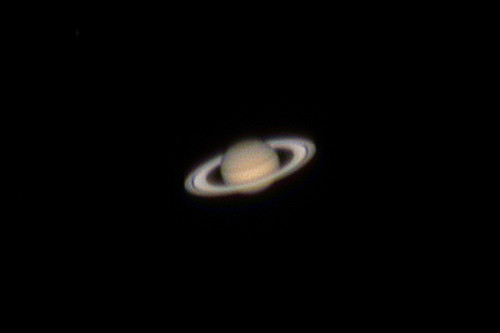
Saturn was a couple of days past opposition, with the rings still glowing brightly, and I was even able to grab a half-decent image (below):

Saturn

Titan and several moons were visible through the eyepiece, with Rhea, Dione and Tethys in a straight line just north of the planet.

I also had a quick look at NGC 7814 at 240x. Despite my eyes being nowhere near properly dark-adapted, I was still able to see Supernova 2021rhu. It was difficult to judge its brightness, but it seemed to have faded to somewhere around 13th magnitude.

Sunday, 22 August 2021

Rhubarb Supernova

16-17 July 2021, 23:45 – 01:15 (BST)


Seeing: Average

Transparency: Average/poor

Conditions: After a run of cloudy nights, a very mild, cloudless evening with a light breeze blowing from the north. (And a near first-quarter moon sinking in the west.) I spent a lot of time carefully aligning and calibrating the astrophotography rig, only to find out later (for reasons I haven’t yet figured out) that it had stopped tracking after a few minutes, leaving me with over an hour’s worth of star trails. Oddly, it started tracking again (or attempted to, given that the autoguider had long since lost its target star) on the last few frames. I suspect a loose or snagged cable is the culprit, but I haven’t been able to replicate the fault in daylight. (This is the experience I expected to have when I first attempted this type of astrophotography back in 2018, not three years in. Oh well…)

While that was in progress (or not), I revisited some summer favourites with the XT10 at 133x: M57, M56, Albireo and M27. The dumbbell’s central star was visible again (with averted vision), but not as easily as it was at 171x.

Then, with my eyes sufficiently dark-adapted, it was onto some special extragalactic targets: 

BL Lacertae, Active Galactic Nucleus / Blazar
133x. Not the most visually exciting object (it looks like a faint, inconspicuous star in a field full of stars), but at approximately 900 million light years this is the second-farthest thing I’ve seen (after quasar 3C 273). I had to consult the MSA (chart 1123) to track it down, and even then I had to make a rough sketch of the field stars to be sure I had seen it.

BL Lac usually fluctuates between magnitudes 14 and 17, which would normally put it out of range of my scope, but it’s been exhibiting a lot of activity over the last few months and is now brighter than it’s ever been, currently pushing 13th magnitude.

SN 2021rhu, Supernova in galaxy NGC 7814, Pegasus
At long last, a supernova bright enough for my scope, and in a place where I could see it. That said, I had to wait for Pegasus to clear the neighbour’s fence before I could get the XT10 on it, but even though it was still low in the sky, the supernova was immediately obvious at both 133x and 171x, shining relatively brightly against the faint haze of NGC 7814 at approximately magnitude 12.5. It appeared as an intense star-like point slightly east of the galaxy’s centre (I wasn’t able to see the galaxy’s dark lane). Quite an impressive sight considering it’s 40 million light years away (but bad news for anyone unfortunate enough to be within a few light-years of the explosion).

Apparently SN 2021rhu (with that name I can’t help but think of it as the “rhubarb supernova”) is a type 1a supernova. This is caused by a white dwarf accreting matter from a nearby companion star until electron degeneracy pressure can no longer support its mass – resulting in a rapid collapse, a runaway nuclear reaction and a spectacular explosion that rips apart the entire star.


Also: I was treated to three very bright passes of the ISS over the course of the evening. One pass was so bright I could see a halo around it.


I went out again the following night (17 July – 18 July) for another attempted imaging run which resulted in 8 minutes of perfect data followed by another hour or so of trailed images. [Insert expletives here.]

Fortunately I was able to salvage something from the session by sticking the camera on the XT10 and grabbing some data on Jupiter while a Ganymede shadow transit was in progress (below).

Ganymede Shadow Transit

Detail-wise, there wasn’t much to choose between the image and the eyepiece view (at 240x): the brown barges above the NEB showed up well, but I didn’t spot the string of white ovals in the southern hemisphere (which are just about visible in the full-size image).

I also had a look at Saturn as it emerged from behind the neighbour’s tree. Several moons were visible and lots of fine detail was briefly visible in the planet and the rings, although the seeing quickly deteriorated.

I also had another look at SN 2021rhu (at 240x). The supernova was still quite prominent despite my eyes not being properly dark-adapted. It’ll be interesting to see if it’s still visible in August once the moon has got out of the way.

Nature note
The mosquitoes were out in force on both nights; in all the years I’ve been doing astronomy I’ve never been bitten quite like that before.

Sunday, 15 August 2021

Clusters in Cygnus and Scutum

7-8 July 2021, 23:30 – 02:00 (BST)


Seeing: Average

Transparency: Average/poor

Conditions: A breezy night with patches of high cirrus passing overhead; quite cool for the time of year. England won a major football semi-final tonight for the first time in 50+ years, so there was lots of noise coming from the town centre: people singing and car horns blaring until well after 1 AM.

Light condensation building gradually over the course of the session – mostly on the atlas and the telescope tube; fortunately the optics remained unaffected up until the last few minutes.

NGC 7044, open cluster, Cygnus
133x. I’ve looked at a lot of Cygnus clusters recently, and most of them have been immediately obvious. However, at first all I could see here were two moderately bright stars embedded in a very small and very hazy knot of light. Averted vision showed another faint haze nearby, but it was unclear whether one or both of these belonged to the cluster. At 171x a few stars popped out with averted vision, and a third star joined the two brighter ones to form a triangle. Perhaps not the best object to start a session (I was expecting something brighter).

NGC 7027, planetary nebula, Cygnus
171x. Small but bright blue-green nebula with bi-lobed structure. Bright spot stood out on the western side – as noted on previous occasions.

NGC 7086, open cluster, Cygnus
133x. Rich, compact cluster (visible as a hazy patch in the finder). Stars arranged in a loose, ragged spiral. Orange star on the western side. Underlying haze of unresolved stars.

NGC 7063, open cluster, Cygnus
133x. Large, loose cluster of bright stars with a central asterism shaped a bit like a stick representation of a horse.

I then relocated to the constellation of Scutum and, after spending some time in the company of M11 (the Wild Duck Cluster), I revisited an open cluster and a globular cluster:

NGC 6664, open cluster, Scutum
133x. Large, loose and sparse collection of moderately bright stars, shaped a bit like a partially peeled banana. Slightly washed out by the glare from 4th magnitude Alpha Scuti to the west.

NGC 6712, globular cluster, Scutum
133x and 171x. Grainy round glow in a rich star field – seemed larger than I remember. Bright field star to east. Faint stars visible with averted vision; even more so at 171x, though the field is so rich it’s hard to tell which ones belong to the cluster and which belong to the Milky Way. The cluster itself appeared “lumpy” at this power, with a prominent knot of stars south of the core. I’ve been underwhelmed by this object in the past, but tonight it really came to life – the best view I’ve had to date.

I spent quite a lot of time looking at this cluster, and at one point a slow-moving MEO satellite crossed the field on a southerly trajectory, its brightness oscillating slightly as it rotated.

NGC 6934 (Caldwell 47), globular cluster, Delphinus
171x. Small, compact globular; more condensed than 6712, with a brighter core. Bright 9.5m star leading 2’ to the west. Grainy with averted vision, but harder to resolve than 6712. The most prominent members appeared to be south of the core, with another one just northeast of the core.

M27 (Dumbbell Nebula), planetary nebula, Vulpecula
171x (no filter). Large and boxy at this power; no obvious colour. Brightest field star on the western corner, with a couple more visible through the northern half of the nebula. The central illuminating star wasn’t immediately obvious against the nebulous background, but was visible with averted vision, popping in and out of view with the seeing. It's not particularly difficult, but you have to make a conscious effort to seek it out, which is probably why I haven’t seen it before. Sources seem to vary on the brightness of this star: some have it at 13th magnitude; others have it nearer 14th magnitude. Based on my observation, I would put it nearer 13 than 14.

I rounded off the session with a first look at Jupiter for the year, starting at 171x, before moving up to 240x and then 333x. (Saturn is still low and currently behind the neighbour’s fast-growing tree for most of the night, but Jupiter looks like it might just clear it.) All four Galilean moons were on view (one west, three east) and the Great Red Spot was on the meridian, looking a bit faded compared to the last time I saw it. By contrast the NEB had a very dark core and a distinct orange-brown hue. I was almost tempted to get the laptop and capture some videos, but the condensation started to interfere at this point. Bodes well for the next couple of months though.

Thursday, 28 January 2021

Falling Stars and Grazing Planets

A short update to round off the 2020 log. The weather during December was mostly unsuitable for observing, with a couple of notable exceptions.

The Geminid meteor shower put on a really fine display on the night of Saturday 12 December to Sunday 13 December, despite this being a good 24 hours before the shower peaked. (The actual night of the peak was clouded out.) I went outside a little before midnight and lasted about 90 minutes before the cold drove me back indoors, seeing at least 30 meteors (including one sporadic) during that time. I didn’t observe any fireballs, but I did notice a strange effect during the first half-hour whereby the meteors appeared to arrive in pairs. After a gap of two or three minutes, one would flash through Orion or Taurus, quickly followed by another one on almost the same path. Then another gap of two or three minutes before the next pair. My attempts to photograph the Geminids were less successful; they seemed to know exactly when I had the shutter open, and the one meteor I did “catch” in the act wasn’t bright enough to register on the sensor.


The day of the Great Conjunction between Jupiter and Saturn was also clouded out, but on the evening before closest approach (Sunday 20 December) there was a period between about 16:00 and 16:30 where the clouds cleared briefly in the southwest. Viewing conditions were pretty terrible, but I was able to see both planets (plus several moons and an interloper star) in the same field of view at several magnifications all the way up to 240x (i.e. within a third of a degree). Sadly both planets slipped behind a tree just as I was about to start an imaging run (using the ZWO ASI120MM at 1,000 mm), but I don’t think the results would have been that great anyway. Seeing the conjunction in the scope was good enough. (The image above is a quick consolation shot taken with the TV60, showing the relative size/brightness of the two planets.)


Nature note:
With the dusk gathering, and while I was scanning the gaps in the clouds with my binoculars, one of the local sparrowhawks floated over the garden, heading towards the local park (where I presume it has a roost).

Friday, 24 July 2020

Globular Clusters in Ophiuchus and Sagittarius

22 – 23 June 2020, 23:30 – 3:30


Conditions: Very mild, light wind with occasional gusts. No clouds and no condensation tonight.

Seeing: Good
Transparency: Quite good considering the time of year

Once again I set up two scopes in the garden: the XT10 with the 13mm Ethos (92x) and the TV60 with the 9mm Nagler (40x). The XT10 was balanced on my observing table, enabling it to point a little further south than usual (and also so I could observe while sitting down).

After warming up with views of M13, M57, M56 and Albireo, I turned my attention south to a selection of globular clusters.

M19, globular cluster, Ophiuchus
92x. Bright, condensed globular, about the same declination as Antares. Speckled appearance with averted vision. One star resolved north of the core, another one east of the core.

NGC 6284, globular cluster, Ophiuchus
92x. Small, condensed blur, a little north of M19. Swells in size with averted vision. Faint star east of core.

NGC 6293, globular cluster, Ophiuchus
92x. Another small, condensed blur. No resolution, but the core seemed particularly bright.

M62, globular cluster, Ophiuchus
92x. Large, condensed blur (one of the Messier globulars below -30 degrees). Bright core, a little grainy with averted vision.

NGC 6316, globular cluster, Ophiuchus
92x. Very faint round blur, east of M19 and M62, and about midway between them in terms of declination (-28 degrees). Condensed with averted vision. There were also a few stars superimposed over the top, surrounding the core; I assume these are foreground stars and not true cluster members.

M9, globular cluster, Ophiuchus
92x. Bright, asymmetric globular. Starts to resolve with averted vision, but really needs a darker sky to get the best out of it. Apparent dark patches southwest of core.

NGC 6342, globular cluster, Ophiuchus
92x. Faint, condensed blur, south of M9. Brighter core with averted vision. Faint star SW of core.

NGC 6356, globular cluster, Ophiuchus
92x. Bright, condensed globular, northwest of M9 and only a little smaller and fainter than its M-designated neighbour. No resolution, but some faint stars visible on the outskirts of the cluster.

M6, open cluster, Scorpius
92x (and skimming the neighbour's fence!). Better-framed at this magnification (than at 133x), but still a little too large for the fov. More stars visible, giving it an almost “chunky” appearance. On this occasion its overall outline reminded me a little of M24.

M7, open cluster, Scorpius: 40x (TV60 + 9mm Nagler)
A slightly better view tonight, reinforcing my initial impressions: a large, loose cluster with the dozen brightest stars arranged in a wavy x-shape.

NGC 6520, open cluster, Sagittarius
92x. I picked this up by accident while sweeping the area south of M8. A compact and very distinctive open cluster comprised of bright, colourful stars overlying a rich unresolved haze. Prominent orange star near the centre. This cluster stood out well despite its low altitude (-28 degrees declination).

M21, open cluster, Sagittarius
92x. Rich cluster with bright stars; not particularly condensed. Bright pair near centre.

M28, globular cluster, Sagittarius
92x. Bright, condensed globular. Grainy appearance. Hint of resolution with averted vision. Somewhat overshadowed by its illustrious neighbour…

M22, globular cluster, Sagittarius
92x. Very large “flattened” globular – spectacular in the Ethos. A few dozen stars resolved in direct vision; countless more with averted vision. Appeared to be a dark lane or rift on the western side. Tonight at least, it surpassed even M13 in visual splendour.

M24, star-cloud, Sagittarius
92x. Incredibly rich star-field. Even in the Ethos it covers several fields of view, but this is probably the best eyepiece for appreciating this region’s grandeur and sheer density of stars. I could easily spend an entire session here. The dark dust clouds which give M24 its distinctive sharp-edged appearance are conspicuous by their relative absence of stars. I know this region is actually a window into a deeper part of the galaxy, but the impression I get is of an iceberg of stars caught in the process of calving off from the Milky Way.

M18, open cluster, Sagittarius
92x. Bright little cluster; not particularly rich, but the brightest stars seem to form the shape of a pointy toadstool, or a partially opened umbrella.

M54, globular cluster, Sagittarius
92x. Small, round condensed blur. Prominent bright core, but not even a hint of resolution. Apparently gravitationally bound to the Sagittarius Dwarf Elliptical Galaxy (SagDEG).

M69, M70 and M55 (the only Messiers I haven’t yet observed) eluded me tonight. M69 and M70 are only a couple of degrees lower than M54, but that’s a lot of atmosphere to look through, making them too faint for the TV60. They also don't quite clear the fence as viewed from the XT10 - even with it balanced on a table. At -31 degrees, M55 should be viewable in the XT10, but – being further east than the other objects – the sky was too bright by the time it emerged from behind the tree. However, as a consolation, the conditions were just right for viewing the planets (with the 7mm DeLite).

Jupiter, 171x: Possibly my best view yet of the giant planet. Some sustained moments of excellent seeing revealed superfine detail, including festoons trailing from the notably turbulent NEB. Io’s shadow was visible as a perfect little dark spot on the NEB, and I was able to follow Io itself as it nudged across the darkened Jovian limb to begin its own transit. I did briefly add the 2.5x Powermate to increase the magnification to 428x, but the seeing wasn’t quite that good.

Saturn, 171x: Same detail as noted in the previous session, but holding steady for longer. The Cassini Division showed particularly well. Again, despite the brightening sky, Titan, Tethys, Dione and Rhea were clearly visible, along with a nearby faint star masquerading as a moon; I’d have to do a same-night comparison with the 5mm Nagler to be sure, but the DeLite does seem to control light-scatter better than any other eyepiece I’ve looked through.

Mars, 171x: First telescopic view of the red planet for this year. The seeing wasn’t quite as good here (it was still only just clearing the neighbour’s rooftop), but the gibbous phase was obvious along with some vague dark markings that showed a little better when I added the Baader Contrast Booster filter*. Disc still small at 11 arcseconds, but the best is yet to come (barring another dust storm like the one in 2018).

(* I bought the BCB years ago for the Vixen SP-102; I had no idea it was useful as a Mars filter until I read about it recently on Cloudy Nights.)

Sunday, 19 July 2020

The Southernmost Messier Object

14 June 2020, 00:30 – 03:30


Conditions: Mild, still (no wind), hazy and humid – heavy condensation. Cloud increasing over the course of the session.

Seeing: Average / poor
Transparency: Poor

I don’t normally observe in the two weeks either side of the summer solstice because the sky doesn’t get reasonably dark until gone midnight – and it doesn’t stay dark for very long. However, if I’m to do justice to the Scorpius/Sagittarius region I figured I should at least try to observe some of the brighter objects this month rather than tackle them all in a mad scramble in July or August. (And of course there’s no guarantee the skies will be clear then anyway.)

Also, encouraged by my glimpse of M7 last time out, I had the TV60 set up on the Super Polaris mount. However I hadn’t taken into consideration just how much the trees and plants can grow in barely a month, so I was contending with foliage as well as the neighbour’s fence. Fortunately, the TV60 is easier to move from side to side than the XT10.

After warming up with a look at M13 in both scopes (it appeared hazy and a little washed-out tonight, despite being nearly overhead), I switched to the main target for the evening.

M7, open cluster, Scorpius, 40x (TV60 + 9mm Nagler)
The scope was almost horizontal, but I was able to get just enough clearance over the neighbour’s fence to centre M7 in the field of view. The object itself appeared faint and washed out, but enough stars were visible to at least give a sense of a very large, splashy open cluster. The brightest stars seemed to form a distorted x-shape with a double star at the centre (although the atmospheric distortion and low magnification made it hard to split). There was also a haze of unresolved stars, plus an incomplete ring of brighter stars surrounding the central cluster. Even if M7 were high enough to be visible in the XT10, the TV60 would still be a better choice of scope to view it simply because of the larger field of view (2 degrees in the 9mm Nagler). By comparison, M6 – which is itself a fairly large cluster – appeared more traditionally condensed at the same magnification.

I also had the XT10 set up in the garden, but another thing I hadn’t taken into consideration was how bad the condensation would be tonight. I had planned to use the 13mm Ethos, but unfortunately the eye-lens misted over while I was looking at M7, so I swapped it out for the 9mm Nagler. The sky was getting hazier too, so I stuck to only the brightest objects. (The fainter stuff could wait for a better night.)

M21, open cluster, Sagittarius
133x. Loose, bright cluster, a little north of M20. Star pattern at centre in the shape of a teacup, or a backwards “3”.

M23, open cluster, Sagittarius
133x. Rich, large cluster. Uniformly bright stars filling the fov. Bright star to north. Concentration of fainter stars at western end of cluster.

M25, open cluster, Sagittarius
133x. Bright, large cluster, with a distinctive “D” shaped pattern of stars at the centre. Unlike M23, the stars come in a mixture of brightnesses.

With the condensation worsening and the sky already starting to brighten, it was almost time to pack up. However while taking the TV60 indoors I noticed that Jupiter and Saturn were starting to emerge from behind the tree, so I (carefully) moved the XT10 and changed the 9mm Nagler for the 7mm DeLite.

Jupiter, 171x: the seeing was variable but in the fleeting moments that it steadied, the DeLite gave a very sharp, comfortable view. All four Galilean moons were on view and I could see the Great Red Spot moving onto the disc, showing its familiar brick-red colour when the seeing allowed.

Saturn, 171x: Titan and three faint moons were visible, despite the brightening sky. Saturn was its usual exquisite self with the Cassini Division showing well in moments of good seeing, as well as the shadow of the planet on the rings, and the dusky equatorial band.

Saturday, 5 October 2019

The Moon and Jupiter

May - August 2019


A combination of cloud and short nights (at my latitude, the sky never gets out of astronomical twilight for a few weeks either side of the solstice) meant that I largely missed out on the summer deep-sky objects this year. (Although there was compensation in the form of a striking display of noctilucent clouds.) For future reference, I think I’ll have to put in a really late session in April or early May if I’m to stand a realistic chance of exploring Ophiuchus and northern Scorpius.

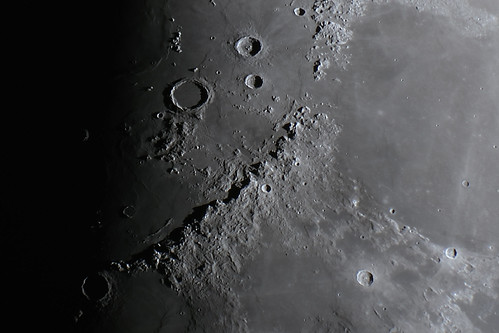
Lunar Apennines

On the few occasions I was able to get out in May the moon was dominating the sky, so I used the opportunity to get some images (like the one above), as well as putting a new Baader ND 0.9 filter to the test. The XT10 gathers a lot of light, so the filter certainly makes lunar observing a much more comfortable experience, particularly at lower magnifications. Purists may argue about the need for such a filter, but I’d rather not be swapping out Tele Vue eyepieces when I’m so dazzled by moonlight I can’t see what I’m doing. The Baader’s colour tone is pleasingly neutral and there were no reflections or other impairments that I could see.


10 August 2019, 20:50 BST

Jupiter is even lower in the sky this year (like Saturn, barely clearing the neighbour’s fence), but despite this I still managed to get some brief moments of good seeing – revealing the colour differences between the Great Red Spot, the darker equatorial belts, and the ongoing tan-coloured outbreak in the Equatorial Zone. All four Galilean moons were visible, with Europa gradually moving onto Jupiter’s disc as it began a transit. I was even able to use the 9mm Nagler + 2.5x Powermate combination to get a magnification of 333x, although as usual the seeing dropped off rapidly once Jupiter crossed the meridian.