Showing posts with label M57. Show all posts

Friday, 10 July 2020

Summer Clusters and Nebulae

18-19 May 2020, 23:45 – 2:30


Conditions: Breezy, relatively mild (first night I haven’t needed my winter coat). After a day dominated by high cirrus, the sky cleared suddenly, with just a few lingering vapour trails crossing the sky. Cloudy later on.

Seeing: Average - poor
Transparency: Poor - average

The nights are so short now that it doesn’t get reasonably dark until after 11pm, which makes for a lot of hanging around in the evening when (like tonight) the clear-sky forecast is ambiguous. With the sky near the northern horizon staying noticeably light, and vapour trails drifting overhead, the seeing and transparency varied considerably from minute to minute and from one part of the sky to another.

After warming up with M12 and M10 (both clusters looked a little hazy tonight), I tracked down another lesser-known globular in Ophiuchus:

NGC 6426, globular cluster, Ophiuchus
133x. Very faint hazy patch; a little condensed with averted vision. Unimpressive.

NGC 6572, planetary nebula, Ophiuchus
133x and 171x. Small, very bright oval disc; almost stellar at 133x. Stands out largely because of its strong green-blue colour. At 171x, the central star or core region (it was hard to tell exactly what I was seeing) overwhelms the surrounding nebulosity in direct vision. In averted vision the opposite is true: the outer nebulosity becomes the dominant feature.

NGC 6633, open cluster, Ophiuchus
133x. Follow-up from previous observation. Loose cluster of bright stars elongated roughly N-S. As noted previously, shows well in finder. Small “arrowhead” asterism of about 8 stars separated from main cluster on western (leading) side. Quite large, but a bit more “telescope-friendly” than the nearby IC clusters 4665 and 4756.

IC 4756, open cluster, Serpens
133x. Not as bright as IC 4665 and NGC 6633, but a very rich, very large cluster – best suited for smaller wide-field scopes.

NGC 6791, open cluster, Lyra
133x. Faint, extended haze. Starts to resolve with averted vision, giving at least a sense of its richness. Not much, if any, improvement on my previous observation, but I am slowly warming to this cluster.

M56, globular cluster, Lyra
133x. A little washed-out compared to previous observation. The triangular core was less apparent tonight, but I did notice a bright star leading the cluster and a long “x” shape of stellar arms.

M57, The Ring Nebula, Lyra
171x. Additional prep work for sketch (first draft below). The transparency must have been good in this part of the sky because I could just about detect a faint 14th magnitude star east of the ring (just beyond the brighter 13th magnitude star).


At 1:20 I was distracted by the unmistakable sight of the ISS passing high overhead.

After quick looks at M27, M4 and M80 I was irresistibly drawn to an old favourite:

M11, the Wild Duck Cluster, Scutum
133x. After all these years it still boggles me that I don’t have to travel any further than my back garden to see something as breathtakingly beautiful as this cluster. I have mixed feelings about the bucket list approach to life, but if you insist on such a checklist, seeing M11 through a telescope should probably be on it.

At around 2 AM the clouds returned with reinforcements, but after I’d taken the scope indoors – wouldn’t you know it – the sky suddenly cleared again from the south, and now it was remarkably free of haze. With only about half an hour of usable dark left, it wasn’t worth carrying it back out again, so all remaining observations were carried out with 7x50 binoculars and the naked eye (the most important instrument of all!).

M24, star-cloud, Sagittarius
I don’t recall ever seeing M24 with the naked eye before (the Milky Way in Sagittarius is always a little washed out from my location), but tonight it was visible as a hazy patch, a little smaller than the Scutum star-cloud further to the north. The binoculars revealed it to be sprinkled with stars, the brightest ones forming a distinctive almond shape.

This part of the sky (the steam rising from the spout of the Sagittarius teapot) is rich in bright clusters and nebulae, many of which showed up well in the binoculars (particularly M8, the Lagoon Nebula). Also visible in the binoculars were M12, M10, M11 and M27.

The binoculars resolved several more stars in M6 tonight, giving a much better view than 17 May. I also got my first glimpse of M7, which was just visible as a faint hazy patch very low in the south. I propped my elbow against a door-frame to steady the view and over time a few faint stars began to pop out. Averted vision also showed the cluster to be larger than was first apparent. From the same vantage point I could also see the bright stars Lambda Scorpii (Shaula), Upsilon Scorpii (Lesath) and G Scorpii through the binoculars (but not with the naked eye), all three of which culminate at less than 2 degrees above the horizon from my location. I don’t think I’ll be able to get the XT10 on M7, but it might be possible in the TV60.

Sunday, 20 October 2019

Three Summer Planetaries

25 August 2019, 22:00 – 23:00 BST

The main objective for the evening was photographing the Veil Nebula (West) using 3-minute subs. This is twice as long as anything I’ve attempted before, providing my first real test of the autoguiding set-up. After the inevitable faffing around with polar alignment etc., I got about an hour’s worth of data before my target crossed the meridian.

Conditions: A very mild, still evening (perhaps a little too mild, judging by the sensor temperatures). Once the imaging rig was up and running, I sat down with the XT10 to look at three familiar targets and one not-so-familiar.

M15, globular cluster, Pegasus
Viewed at 240x and 133x (the latter giving the best view on this occasion). Takes a little longer to “get your eye in” on this globular compared to M13, but very rewarding once you do. Nicely resolved, particularly with averted vision.

M27, The Dumbbell Nebula, Vulpecula
9mm Nagler + OIII filter. Very bright with this filter – the apple-core fills in to become a football. But hard to make out detail other than a sharp edge on one side.

NGC 6905, The Blue Flash Nebula, Delphinus
A new object for me; it helps that there’s a large arrow in the sky (the constellation Sagitta) pointing towards it. At 133x it was obvious as a medium to large-sized, round planetary nebula, though I can’t say there was anything particularly blue about it. Appeared to be some brightness variations across the disc, including a slightly darker core. Field star to the north and a fainter one to the east.

M57, The Ring Nebula, Lyra
Beautiful ethereal ring of light. So bright in the XT10 that I can’t really compare it to a smoke-ring anymore; it’s closer to the photographic representation (minus the colour of course). With the OIII filter it was brighter still, and seemed slightly more elongated compared to the unfiltered view.

Nature note
3 frogs in the pond … and 5 tadpoles!

Saturday, 16 March 2019

First night out with the new scope

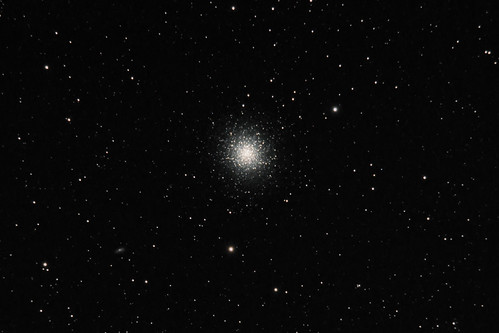
M13 Globular Cluster

18 – 19 May 2018, 22:30 – 02:00 BST


The sky was a little hazy and never completely dark, so for the most part I stuck to the bright showpiece objects. Best views came with the 9 mm Nagler – darker sky, better contrast. The scope took a good hour to cool down, but when it did the views were spectacular.

M13, great globular cluster in Hercules
In a word: wow! After switching from the 24 mm Panoptic to the 9 mm Nagler, pinpoint stars were resolved (in direct and averted vision) right across the face of the cluster, giving an impressive sense of scale and distance. After a while I could perceive chains of stars curving out from the centre. The first night was supposed to be a whistle-stop tour of some old favourites but I couldn’t tear myself away from this object. The longer I looked, the better the view got. I've viewed M13 many times with the 4-inch scope but now for the first time I could see it as a proper cluster of stars and not just a grainy snowball hovering on the threshold of resolution. (The photo above really doesn't do the spectacle justice.) At one point a satellite (space junk?) glided right across the middle of the cluster, followed a minute or two later by a second object travelling on the same path.

M57, Ring Nebula in Lyra
Very bright outer "donut", gauzy central region, brighter edge on one of the long sides. Faint star clearly seen adjacent to nebula.

M5, globular cluster in Serpens
Easier to find than I thought it would be. Smaller, more condensed than M13, but the XT10 resolved it well despite it being in a brighter part of the sky. Relatively bright star just off centre. It seemed (and I’ve thought this before with the Vixen SP-102) that although M13 is bigger and brighter overall, the brightest stars in M5 are brighter than the brightest ones in M13.

M81 and M82, pair of galaxies in Ursa Major
Not well-placed for observing now, but I couldn't resist looking at the Great Bear's famous galaxy pair. M81 showed a bright condensed core and not much else (I’ve no doubt the outer structure will be more evident on a better night). M82 was a surprisingly long streak of light (making me look forward to the likes of NGC 891, etc.) and the bisecting dark lane was clearly visible.

Despite its low altitude this year, Jupiter in the XT10 was as good as I’ve ever seen it. It was dazzlingly bright with the 9 mm Nagler, but the best view came with the 5 mm Nagler. Alt-Az tracking wasn’t any problem either, although it helped that it was near the meridian. Fleeting moments of good seeing revealed plenty of fine detail in and around the belts, with a noticeable “kink” in the NEB. The GRS was immediately obvious and – once my eye had adjusted to the brightness – its brick red hue stood out. All four Galilean moons were visible, but with no obvious signs of colour or resolution.

Veil Nebula, supernova remnant in Cygnus
I switched back to the 24 mm Panoptic for this one. As I anticipated, the sky wasn’t dark enough to see it with direct vision, but when I added the Ultrablock filter it immediately popped out. The Witch’s Broom (running through 52 Cyg) looked like a funnel cloud frozen in space, tapering to a sharp point. I had to sweep to find the other section, but again it popped out from the dark background, showing the distinct “chicken-bone” shape familiar from photographs, and a suggestion of a braided structure.

M27, Dumbbell Nebula in Vulpecula
Very bright with or without the Ultrablock. Appeared sharper on one side and ever so slightly bluer than M57. I need to spend more time on this object, but it's already clear that the XT10 is going to be an excellent scope for high-magnification viewing of planetary nebulae.

M71, globular cluster in Sagitta
Quick look, partly resolved. Loose for a globular.

NGC 6939, open cluster in Cepheus
Partially resolved, triangular shape. Appearance much the same as the photo I took recently.

Albireo, double star in Cygnus
One of the northern sky's showpiece doubles. Improved as it gained altitude; looked better at 50x, but perhaps the brightness was overwhelming the colours a little.

M51 and NGC 5195, Whirlpool Galaxy and companion in Canes Venatici
Again, not well placed, but both galaxies showed bright cores. A hint of spiral arm structure in M51, with a star superimposed over the face of the galaxy (definitely not a supernova).

Other impressions: lots of satellites/space junk seen passing through the field of view, often in pairs (According to Stellarium the brighter ones were from the GlobalStar family). The night included a very bright ISS passage - almost overhead - and visible most of the way down to the horizon.