Showing posts with label comet. Show all posts

Friday, 7 August 2020

Of Comets and Globular Clusters

12 July 2020, 00:00 – 2:00


Conditions: Mild with a very light wind. Some condensation (not forecast on clearoutside.com)

Seeing: Average
Transparency: Poor / average

Astronomy is not known for being a hectic pursuit, but this month it’s all been happening: the crowded star-fields of Sagittarius at their best (including my last three elusive Messier targets), Jupiter and Saturn at opposition, and – as if that wasn’t enough – a naked-eye comet that actually lived up to the hype. This was the second of three consecutive clear nights. Nights one and three were devoted exclusively to early-morning comet-chasing; on this night (11-12 July) I popped round to my local park to take some photos before returning home to catch up on some deep-sky observing.

Comet C/2020 F3 NEOWISE itself was too low and in the wrong part of the sky to get my telescope on, but 7x50 binoculars gave a really good view, clearly showing the bright star-like pseudo-nucleus and the long dust tail extending several degrees, gently curving up and away from the horizon. I wouldn’t rank it as a Great Comet like Hyakutake and Hale-Bopp, but it’s certainly the best one I’ve seen for many years.
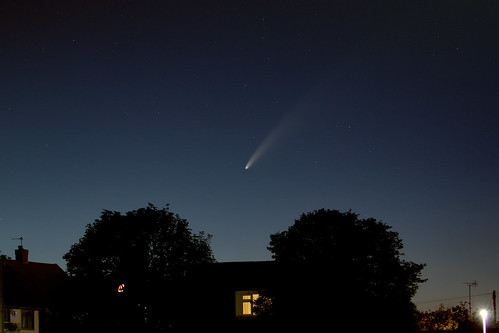
Comet C/2020 F3 (NEOWISE)

In a new strategy, I put bricks beneath the observing table to give the XT10 the little extra clearance it needed to reach below -32 degrees declination. The arrangement was more stable than it looked, but it’s not something I want to repeat too many times. All observations at 133x (9mm Nagler).

NGC 6624, globular cluster, Sagittarius
Fairly large condensed blur. Bright core with averted vision. Near Delta Sgr.

Given that I could clearly see NGC 6624 (at -30.3 degrees) you’d think I would have been able to see M69 and M70, but once again those two extra degrees of declination made all the difference. I may have glimpsed M69 as an extremely faint blur, but I need a follow-up observation to be sure.

M54, globular cluster, Sagittarius
Back up to -30 degrees again and this globular was no problem at all. Small, bright, condensed; as noted previously.

Bright ISS pass at 12:50.

M22, globular cluster, Sagittarius
Rich, large mass of stars – a little hazy tonight (its more typical appearance in UK skies, I think). Prominent rift on leading side, west of the core. Seemed quite loose at 133x.

I also tried (somewhat optimistically) for M55, but any chance of seeing it was hindered by the light from the rising last quarter moon. I spent the remainder of the session looking at Jupiter and Saturn, but poor seeing meant I only got fleeting glimpses of fine detail.

Tuesday, 4 February 2020

A Christmas Comet

25 December 2019, 19:00 – 21:00 GMT


Conditions: Cold evening (and getting colder), no wind. Slight haze affecting transparency. Condensation appearing after only a few minutes – by the end of the session the telescope was dripping wet and all exposed lenses were dewed over.

The session also served as the first test of a new Orion 9x50 RACI finderscope to go alongside the red-dot finder. It did a good job – until the condensation got to it.

After aligning the two finders (on Polaris), I began the session with a look at the Messier clusters in Auriga. All three showed up clearly in the finderscope, and looked particularly good in the Ethos 13mm, with M37 being the standout. M38’s neighbour NGC 1907 was partially resolved in the Ethos and more so in the 9mm Nagler. That extra 40x magnification does make a difference for pulling out faint stars.

M35 and NGC 2158, open clusters, Gemini
Again, M35 looked great in the Ethos, although I think M37 surpasses it (at least in the XT10). NGC 2158 started to show some resolution with averted vision, but not as good as 1907.

Comet C/2017 T2 (Panstarrs)
92x (Ethos). Small nebulous patch of about 9th or 10th magnitude high up on the Perseus/Camelopardalis border. Stellar nuclear region surrounded by a faint coma which swelled with averted vision. Suggestion of a faint tail fanning out to the south, but hard to be sure; the condensation was already starting to interfere. An improvement over the last comet I saw (ASASSN), but nothing to get too excited about. Still, at least I can say I made the effort to track it down.

M81, M82, galaxy pair, Ursa Major
The Ethos is large enough to show them in the same field of view, although both fall outside the central sharp zone. On individual examination both galaxies were bright and distinctive (shape-wise), but lacking detail on this occasion. Not really a night for galaxies.

NGC 2169, open cluster, Orion
The so-called Shopping Cart cluster or 37 cluster. A small but distinctive grouping of stars split into two halves. Comprising about 16 bright stars and a suggestion of fainter ones with averted vision. The Ethos resolved the brightest member of the cluster (in the eastern half) into a tight double: Struve 848, approximately 2.5” separation.

At this point the condensation had effectively taken both finders and the Ethos out of action. I struggled on with the 9mm Nagler for a while before eventually admitting defeat. The new finderscope proved its worth in the short time I was able to use it: it shows the same stars plotted in the Pocket Sky Atlas (and at the same orientation), which will make star-hopping much easier – particularly in galaxy season. I just need to make a dew-shield for it before I take the scope out again.

Thursday, 4 July 2019

Comet 46P/Wirtanen and M42

9 December 2018


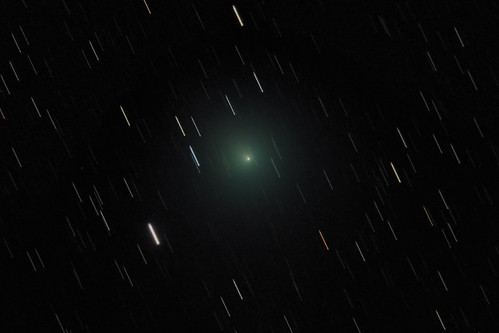
Comet 46P/Wirtanen

A night of imaging Comet Wirtanen and M42 with the TV60.

Conditions: surprisingly mild, and a good dark sky. Opportunities like this are few and far between at this time of year, so on this occasion I left the XT10 indoors to make sure I could give polar alignment, BackyardEOS etc. my full attention. Though I did have time to scan the Milky Way with the 7x50 binoculars once the imaging session was up and running.

Comet 46P/Wirtanen was faintly visible to the naked eye and appeared as a little fuzzball through binoculars, like a defocused globular cluster, or a diminished version of Comet Holmes during its famous outburst. Not the most exciting comet admittedly, but the first naked-eye one I’ve seen in quite a while.

I saw five meteors, four of which were Geminids. I also saw several winking and flaring objects east of Orion’s belt – presumably geostationary satellites (another one also photobombed a few of my M42 light frames).