Thursday, 11 July 2019

Winter Nebulae

28 January 2019, 19:15 – 21:15


The first clear, moon-free night in over a month. Cold, but not bitter. Light wind. Good transparency. Scope seemed to take longer to reach ambient temperature; best views were at 133x (9mm Nagler).

M45, Pleiades, Taurus
Viewing at 50x (24mm Panoptic); Merope nebula easier to see now I’ve got my bearings: visible as a misty patch fanning out from Merope to the south, framed by dark “lanes” on either side. The nebulosity in the Pleiades is much easier to see when you know which stars aren’t involved in it, such as the distinctive line of stars trailing from Alcyone.

NGC 2024, Flame Nebula in Orion
Tough to see because of the glare from Alnitak. Better contrast at 133x, but more condensed at 50x. IC 434 (the glow behind the Horsehead) was only suggested at best, but NGC 2023 clearly visible as a small patch of light surrounding a star, swelling with averted vision.

M78, reflection nebula in Orion
Twin stars immersed in a cloud, like headlights shining through fog. Some mottled structure apparent with averted vision, sharp cut-off on northern side – NGC 2071 visible on the other side of this dark gap: smaller and fainter than M78, no structure visible.
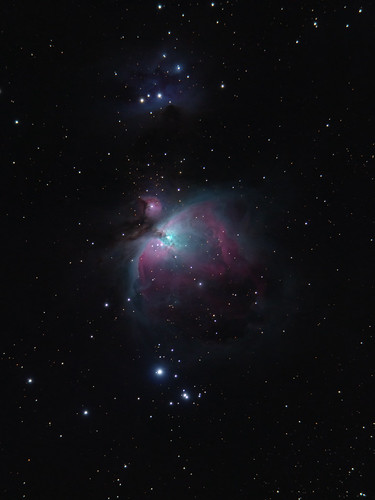

Orion Nebula (reprocessed)


M42, Great Nebula in Orion
Breathtaking spectacle; can appreciate it even more now I’ve photographed it (above). 133x gave the best view for contrast and detail even though it was too big for a single fov. Intricate detail seen with direct and averted vision, including nebulosity within the “fish-mouth” area. The dark lane between M42 and M43 contrasts nicely with the fainter nebulosity beyond the Huygens region, illustrating that the nebula is much more extensive than its initial bird-like appearance implies. Brighter arc seen on opposite side of cavity, corresponding with sculpted section seen in photos.

Trapezium stars E and (to a lesser extent) F were oddly easier to see at 133x than 240x (clearly not a night for high-power viewing).

The southern wing of the nebula was remarkable: long and irregular but with well defined edges, like a ribbon of light. The adjacent part of the nebula was not the same colour as the ribbon, but hard to say what exactly other than “not green”. Maybe the slightest hint of violet, but it was right on the limit of perception.

The Ultrablock significantly filled out the northern half of the nebula and made the Huygens region seem more boxy, sharper-edged, but otherwise not that much improvement (not a criticism of the filter; just that M42 is bright enough not to need it.)

M43, emission nebula in Orion
Comma-shaped haze surrounding single star. Dark lane visible with averted vision.

Also quick looks at NGC 1981 open cluster and the Running Man Nebula, the latter’s gauzy appearance clearly more akin to the Merope nebula than M42. Averted vision suggested a “bite” taken out of the southern edge.

NGC 2174-5, open cluster + emission nebula, Orion
Obvious and surprisingly large patch of light, somewhat elongated. Nebulosity seemed concentrated around central star, but no obvious cluster, at least not at low magnification.

NGC 2392, Eskimo Nebula, Gemini
Lovely winter planetary. Small, but immediately obvious fuzzy star at 50x. Nearby star helps confirm its nature. Central star visible at 133x. Averted vision showed two concentric rings of material. Seemed more blue-green than typical grey-green, but difference is subtle; certainly nowhere near as blue as the Snowball in Andromeda. Ultrablock filter improved contrast but not really required for such a bright nebula.

NGC 2264, Christmas Tree Cluster, Monoceros
Very pretty (and “right” way up for a change). Very bright blue star at “base” – seemed to be surrounded by haze, but hard to tell if it was genuine nebulosity. No obvious sign of the Cone Nebula, but while sweeping south I soon arrived at…

NGC 2261, Hubble’s Variable Nebula, Monoceros
Small and bright (but obvious even at 50x) fan-shaped nebula. 133x showed bright condensation at apex, but I think it would take a still higher power to show significant detail.

NGC 2237-9 (Rosette Nebula), surrounding open cluster NGC 2244 in Monoceros
Took a while to find – the lack of bright stars in Monoceros (not to mention the ever-present lure of Orion) make it a challenge to navigate via star-hopping. Appearance: Boxy cluster surrounded by large, diffuse nebula – too large for fov even at 50x. Brighter arc on northern side. Potential photographic target for TV60.

While sweeping across Monoceros I stumbled upon what I later identified as NGC 2301 – a distinctive rich cluster, well worth a return visit (if I can find it again).

Quick looks (cold, condensation and tiredness starting to play a part):

M97 (Owl Nebula), planetary nebula in Ursa Major
Large and faint (the opposite of the Eskimo). The Ultrablock dramatically improved the view. Hint of dark cavities (the owl's eyes).

M108, galaxy in Ursa Major
Faint sliver of light, with field star imposed over centre. Another potential photo target (pairing with Owl Nebula).

M81, M82, galaxies in Ursa Major
Not as impressive as previous observations – a sign it was time to pack up for the night.

Thursday, 4 July 2019

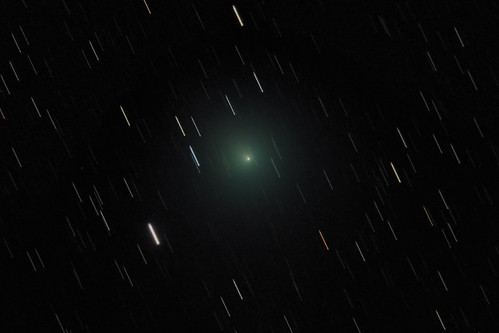
Comet 46P/Wirtanen and M42

9 December 2018


Comet 46P/Wirtanen

A night of imaging Comet Wirtanen and M42 with the TV60.

Conditions: surprisingly mild, and a good dark sky. Opportunities like this are few and far between at this time of year, so on this occasion I left the XT10 indoors to make sure I could give polar alignment, BackyardEOS etc. my full attention. Though I did have time to scan the Milky Way with the 7x50 binoculars once the imaging session was up and running.

Comet 46P/Wirtanen was faintly visible to the naked eye and appeared as a little fuzzball through binoculars, like a defocused globular cluster, or a diminished version of Comet Holmes during its famous outburst. Not the most exciting comet admittedly, but the first naked-eye one I’ve seen in quite a while.

I saw five meteors, four of which were Geminids. I also saw several winking and flaring objects east of Orion’s belt – presumably geostationary satellites (another one also photobombed a few of my M42 light frames).

Wednesday, 12 June 2019

Auriga and Beyond

30 November 2018, 20:30 – 22:30 GMT


Conditions: Good transparency - dark enough that the 24mm Panoptic wasn’t hindered by sky brightness. Clear at first, some bands of cloud later on. Cold, but not especially so for the time of year. Set up the XT10 on concrete for the first time rather than the lawn (so I could have a chance of seeing M42 rising) – despite this the scope seemed to cool down relatively quickly.

M37, Open Cluster in Auriga
Lovely rich cluster, roughly triangular – instantly recognisable. Dark lanes and chains of stars give it a symmetrical shape reminiscent of a crab or beetle (very much like O’Meara’s sketch in The Messier Objects). Best view probably at 50x.

M36, Open Cluster in Auriga
Smaller cluster than M37; individual member stars brighter but less numerous. Would be more highly regarded if it wasn’t outshone by its neighbours.

M38, Open Cluster in Auriga
Large, rich cluster; somewhat “straggly” compared to M37. NGC 1907 in same field of view at 50x: small, condensed cluster – some resolution with averted vision at 50x, giving it a “sparkling” appearance. More stars pop out at 133x

Located AE Aurigae in the eyepiece, but couldn’t discern the surrounding nebula with any degree of confidence. However I had more success with…

NGC 1931 (aka “The Fly”), Emission Nebula in Auriga
An obvious streak of nebulosity at all magnifications. Ultrablock filter improved the contrast – quite bright as nebulae go. Higher magnification revealed a tight triangle of stars at the centre.

M1 (Crab Nebula), Supernova Remnant in Taurus
Appeared as a “puff” of cloudy nebulosity. 133x (Nagler 9mm) + Ultrablock improved the contrast, but no detail to speak of other than a vaguely bi-lobed shape. One of those deepsky objects that can only really be appreciated when you think about what you're looking at.

NGC 1647, Open Cluster in Taurus
Large, sprawling cluster – needs a wider field to get the best view.

M77, Seyfert Galaxy in Cetus
Not the most prominent constellation, but this galaxy is helpfully within 2 fovs of Delta Ceti (a distinctly blue star). M77 itself appears as a very bright core embedded in a disc of nebulosity – immediately obvious even in this light-polluted part of the sky. A nearby 10th magnitude star helps with focus and averted vision. The galaxy holds brightness well at 240x, but I couldn’t see the recently discovered supernova. If it brightens by 1 or 2 magnitudes I might get lucky. (Postscript: it didn’t.)

Also: Mira (Omicron Ceti) was visible to the naked eye.

M35, Open Cluster in Gemini
Rich, large cluster; very distinctive chain of similarly bright stars forming an arc. Nearby cluster NGC 2158 was visible as a condensed patch of light – started to resolve (with averted vision) at 133x, but not as easily as 1907 in Auriga.

M42, Orion Nebula (and M43)
Had to peer between branches of neighbour’s tree to see it, but it was still spectacular despite the partial obstruction. Very bright, greenish core almost overwhelming the Trapezium at 50x, detailed structure apparent with direct vision. Long “wings”, one sweeping out towards NGC 1980. Ultrablock filter significantly increased the extent of the nebula, particularly on the northern side. Could easily spend a whole evening on this object.

Tuesday, 28 May 2019

A Crystal Ball in Taurus

2 November 2018, 19:45 – 21:45 GMT


Cold, very light wind, transparency improving over the course of the session.

Double Cluster, Perseus

Double Cluster, Perseus
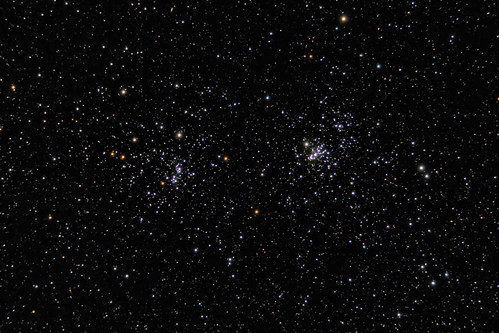
Viewed at 50x (24mm Panoptic). Comparing against recent photo (above). The lower magnification is better for framing the clusters – at the expense of some contrast – but the eyepiece view always beats the photographic representation. Red giant stars showing well.

Cr 466, open cluster in Cassiopeia 
Large and loose, would probably look better in a wide field refractor.

vdB 1, reflection nebula in Cassiopeia
First entry in O’Meara’s Secret Deep book. Despite its obscure designation it stood out reasonably well as an extended, if subtle, haze surrounding three stars. Not surprisingly the Ultrablock did nothing to improve the view (other than damping the glare from Beta Cas). Probably worth revisiting at higher magnification on a darker night.

M76, Planetary Nebula in Perseus
Prolonged averted vision (+ Ultrablock filter) seemed to reveal the faint “loop” extensions on either side of the main nebula (brighter on one side). Starting to wonder whether an O III filter might make a significant difference on this and similar nebulae.

NGC 1501, Planetary Nebula in Camelopardalis
133x + Ultrablock filter: green-grey disc which seemed to subtly change shape depending on which side of it I was looking. Otherwise, same details seen as on 9 October.

NGC 1514 (The Crystal Ball Nebula), Planetary Nebula in Taurus
The undoubted highlight of the session – a very pretty planetary nebula flanked by two nearby 8th magnitude stars (which help make the nebulosity obvious even at 50x). At 133x it appeared as a 9th magnitude star peering out from a cocoon of light. Obvious without the filter, but the Ultrablock really enhanced the view. The edges didn’t have a sharp cut-off (unlike other PN I’ve looked at recently), but the nebula had a certain indefinable quality about it that distinguished it as a Planetary Nebula rather than an Emission Nebula (like the difference between smoke and mist). It seems from my notes that I never tried for this with the 4-inch scope, but it doesn’t deserve its reputation as a difficult object. Having two similar-brightness stars in the same field-of-view really helps to “lock in” the averted vision.

Other notes: failed to find NGC 1275 (galaxy, Perseus), but did spot a lovely close double-star pair in the vicinity. Looked a little bit like a condensed facsimile of Eta Cas.

NGC 1342, open cluster in Perseus
133x. Fairly loose at this magnification. The “starfish” shape started to become apparent when I nudged the scope around, so would probably look better at 50x.

Also, a first look at M38 and NGC 1907, pair of open clusters in Auriga: very nice, well resolved at 133x. Two rich clusters presenting very different aspects – would definitely make a good imaging target for the TV60.

Condensation wasn’t so much of an issue this time, being noticeable only on the red dot finder.

Sunday, 26 May 2019

Cassiopeia – Camelopardalis

9 October 2018, 22:00 – 23:45 BST


Conditions: Transparency not great again, but still plenty of bright objects to look at.

NGC 281, nebula in Cassiopeia
Ultrablock filter helped a lot to improve the contrast at 50x (Panoptic 24mm). Central portion bright, contrasting against dark “maw”. Some mottled detail visible - dark lanes cutting through the nebula. Hard to determine overall size – nebula faded smoothly into background sky with no obvious cut-off.

Scanned the Cassiopeia/Perseus region for nebulae. Nothing popped out, but did sweep past some attractive open clusters, including Stock 23.

Gamma Arietis, double star in Aries
Pleasing blue-white pair of stars, equal brightness - like headlights.

NGC 1501, planetary nebula in Camelopardalis
Fairly bright medium-size PN, almost round. Slightly darker core revealed with averted vision, but not a “smoke-ring” like M57. Holds brightness at 240x (Nagler 5mm); appeared clumpy/mottled at higher magnification, seemed slightly brighter on north/south edges.

NGC 1502, open cluster in Camelopardalis
Viewed at 133x (Nagler 9mm); bright, rich cluster, pairs of stars running through middle. Triangular or wedge shape – like a racing yacht.