Showing posts with label perseus. Show all posts

Monday, 15 November 2021

Sightseeing in Cassiopeia and Perseus

8 October 2021, 20:45 – 22:45 (BST)


Seeing: Average
Transparency: Average

Conditions: A mild night with a light breeze. Patchy cloud at the start and end of the session.
With all the forecasts predicting clouds at some point, I wasn’t sure how much time I was going to get, so I kept the 13mm Ethos in the focuser for the entire session.

NGC 7789, open cluster, Cassiopeia
92x. Lovely, rich cluster – looks like a very loose globular in the Ethos. Orange star on the leading (west) side of the cluster.

NGC 457, open cluster, Cassiopeia
92x. The unmistakable Owl Cluster; this was always one of my favourites in the SP-102. Rich central spine of stars with several close doubles. Looks good in the Ethos.

NGC 436, open cluster, Cassiopeia
92x. Companion cluster to the Owl. About 15 members resolved in direct vision, with an underlying haze of unresolved stars.

Nature note: At approximately 21:20 I heard the first of several Redwings flying overhead. Winter is coming…

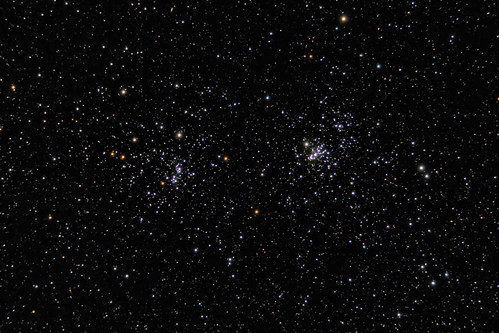
Double Cluster, Perseus
92x. What more can I say that I haven’t already said other than: wow! I don’t know if it’s the eyepiece design or something to do with the magnification I’m using, but star colours really seem to “pop” in the Ethos, particularly red giants and carbon stars.

NGC 957, open cluster, Perseus
92x. Elongated, almond-shaped cluster, with a mixture of bright stars and an underlying haze. Two bright stars at the east and west ends of the cluster. Not bad as clusters go, but its cause isn’t helped by its close proximity to the Double Cluster.

NGC 744, open cluster, Perseus
92x. Loose, vaguely bat-shaped cluster. (It also resembles – putting it less charitably – a concertina clothes horse.) Central diamond-shaped concentration of stars with a few close doubles. Bright star on the northern corner.

M76, “Little Dumbbell Nebula”, Perseus
92x. Seemed a little fainter at this magnification (possibly due to lower contrast). As noted previously, aligned NE-SW, with the SW lobe being the brighter of the two. The orange star noted last time out is due east. Field star west of the nebula, another one NW, and two more in a line farther out on the eastern side.

NGC 278, galaxy, Cassiopeia
92x. Small, round condensed fuzz southwest of a prominent blue field star. Bright core with averted vision; like an unresolved little globular cluster. A MEO satellite crawled through the field at around 22:15.

NGC 278 is certainly a lot easier to see than the two Andromeda satellite galaxies that also occupy this corner of Cassiopeia. Talking of which, NGC 185 was just visible as a faint featureless oval, but NGC 147 was a lot harder to see (as usual). After sweeping the area I thought I could detect a very faint glow south of a triangle of field stars – and by “very faint” I mean right on the threshold of visibility. I was going to take a breather and try again, but unfortunately the clouds returned at this point, bringing with them a thin layer of haze. When I went indoors I looked at a photo of NGC 147 in NSOG, and there it was south of a triangle of field stars, so I think maybe I did spot it at last. (But I’d like to see it again to be sure.)


I also went out the following night (9 October) from 21:00 to 22:15. I had planned to follow up on the observation of NGC 147, but it was quickly apparent that the transparency was too poor for viewing faint objects. The air temperature was also noticeably cooler, with condensation appearing on the scope from the outset. (The big eye lens of the Ethos doesn’t cope well with dew.)

So instead I switched to the back-up plan and spent an enjoyable hour observing Jupiter and its moons. The seeing was mostly poor with fleeting moments of clarity, so I didn’t go higher than 240x (5mm Nagler). However it was good enough for me to watch Europa emerging from Jupiter’s shadow at approximately 21:35, appearing first as a pinprick of light, then growing to full brightness in just a few minutes.

One brown barge was visible above the NEB, and the GRS was starting to rotate into view near the end of the session, but the seeing was deteriorating badly by this point. The metal tube of the scope was also dripping wet, so I packed up for the night.

Thursday, 16 January 2020

Perseus – Taurus Border

29 November 2019, 18:30 – 20:30 GMT


The first clear night in over a month(!), although there were some clouds passing over during the evening (moving from west to east to begin with; direction changing to north to south by the end).
A cold evening, temperature dropping steadily.

Transparency: average to poor
Seeing: very good, extremely steady once the scope had cooled down

Observations at 92x (Ethos 13mm) unless otherwise stated.

Zeta Persei, double? star, Perseus
Lovely multiple star system, labelled as Atik in the PSA (although other sources attribute this name to nearby Omicron Persei). Bright blue-white primary with close faint companion to the south and a fainter one further west. Two more stars of equal brightness further south (probably not physically associated with the main grouping).

Uranus
Distinct grey-green disc holding steady even at 333x (9mm Nagler + 2.5x Powermate). One moon suspected with averted vision to north; still present when I dropped down to 240x (5mm Nagler), although it was constantly flitting in and out of view, making it hard to be sure. A look at the S&T app later on confirmed there was a moon in that location and that I had most likely seen Titania.

NGC 1579, emission/reflection nebula, Perseus
Very faint, extended patch of light near field star. (Poor transparency made it tough to find, needed careful star-hopping to be sure I was looking in the right place.) Seemed mottled with averted vision. No improvement with OIII filter (if anything it made it even fainter).

NGC 1514, Crystal Ball Nebula, Taurus
Observation with the Ethos 13mm and Astronomik OIII filter. Delicate cocoon of light surrounding bright central star; quite large as planetary nebulae go. Flanked by two field stars. Seemed to have two or three dark bands cutting across the nebula. Somewhat faint without the filter. Not the best view I’ve had of it, but still a lovely sight.

By now the cloud cover was increasing overhead, so I spent the rest of the session looking for NGC 253 (the Silver Coin Galaxy) way down south in Sculptor. Unsurprisingly, that part of the sky was too bright for me to say I saw it with any degree of confidence. I think on an exceptional night (or an early morning in late August or September perhaps) I might be able to spot it, but any galaxy south of -15 degrees is always going to be a challenge from my location.

Tuesday, 28 May 2019

A Crystal Ball in Taurus

2 November 2018, 19:45 – 21:45 GMT


Cold, very light wind, transparency improving over the course of the session.

Double Cluster, Perseus

Double Cluster, Perseus
Viewed at 50x (24mm Panoptic). Comparing against recent photo (above). The lower magnification is better for framing the clusters – at the expense of some contrast – but the eyepiece view always beats the photographic representation. Red giant stars showing well.

Cr 466, open cluster in Cassiopeia 
Large and loose, would probably look better in a wide field refractor.

vdB 1, reflection nebula in Cassiopeia
First entry in O’Meara’s Secret Deep book. Despite its obscure designation it stood out reasonably well as an extended, if subtle, haze surrounding three stars. Not surprisingly the Ultrablock did nothing to improve the view (other than damping the glare from Beta Cas). Probably worth revisiting at higher magnification on a darker night.

M76, Planetary Nebula in Perseus
Prolonged averted vision (+ Ultrablock filter) seemed to reveal the faint “loop” extensions on either side of the main nebula (brighter on one side). Starting to wonder whether an O III filter might make a significant difference on this and similar nebulae.

NGC 1501, Planetary Nebula in Camelopardalis
133x + Ultrablock filter: green-grey disc which seemed to subtly change shape depending on which side of it I was looking. Otherwise, same details seen as on 9 October.

NGC 1514 (The Crystal Ball Nebula), Planetary Nebula in Taurus
The undoubted highlight of the session – a very pretty planetary nebula flanked by two nearby 8th magnitude stars (which help make the nebulosity obvious even at 50x). At 133x it appeared as a 9th magnitude star peering out from a cocoon of light. Obvious without the filter, but the Ultrablock really enhanced the view. The edges didn’t have a sharp cut-off (unlike other PN I’ve looked at recently), but the nebula had a certain indefinable quality about it that distinguished it as a Planetary Nebula rather than an Emission Nebula (like the difference between smoke and mist). It seems from my notes that I never tried for this with the 4-inch scope, but it doesn’t deserve its reputation as a difficult object. Having two similar-brightness stars in the same field-of-view really helps to “lock in” the averted vision.

Other notes: failed to find NGC 1275 (galaxy, Perseus), but did spot a lovely close double-star pair in the vicinity. Looked a little bit like a condensed facsimile of Eta Cas.

NGC 1342, open cluster in Perseus
133x. Fairly loose at this magnification. The “starfish” shape started to become apparent when I nudged the scope around, so would probably look better at 50x.

Also, a first look at M38 and NGC 1907, pair of open clusters in Auriga: very nice, well resolved at 133x. Two rich clusters presenting very different aspects – would definitely make a good imaging target for the TV60.

Condensation wasn’t so much of an issue this time, being noticeable only on the red dot finder.

Tuesday, 14 May 2019

Double Stars and Double Clusters

16 September 2018, 22:00 – 00:00 BST


First quarter moon adding to the light pollution in the south-west, but at least the seeing was good.

M15, globular cluster in Pegasus
Examined at all three available magnifications. The sky background was too bright to resolve stars at 50x; there was an improvement at 133x, but on this occasion the best view came at 240x – pleasing contrast, lots of faint stars resolved.

Veil Nebula, supernova remnant in Cygnus
Hindered a little bit by moonlight, but with the Ultrablock to filter most of it out, plenty of detail still visible. The nebula had a winding, braided structure. Brightness held up well at 133x with the two main arcs extending across several fields of view. Pickering’s Triangle suspected, but not confirmed – if so, it was right on the threshold of visibility.

A quick tour of the open clusters in northern Lacerta was a little disappointing. The sky was too bright to do justice to the 24mm Panoptic, and at 133x the field of view was too small to properly frame the clusters. For the most part, they just looked like sparse associations of bright stars.

A similar tour of the Cassiopeia clusters at 50x fared better due to the richer clusters and the darker background in that part of the sky. An intermediate magnification might help with some of these NGC clusters.

Eta Cassiopeiae, double star 
Looked very nice at 133x, with the secondary appearing to have an unusual purple hue.

Double Cluster in Perseus
The red giant stars stood out more at 133x, but the two clusters lose some of their impact at this magnification. However, higher magnifications might be useful for separating close pairs and picking out fainter cluster members at 240x.

The following observations were all carried out with the Ultrablock filter.

M76, planetary nebula in Perseus
Holds brightness very well all the way up to 240x. Bi-lobed, boxy shape, with the brighter lobe appearing almost rectangular. No colour apparent. Prolonged examination suggested one or two knots/condensations within the brighter lobe.

NGC 404 (Mirach’s Ghost), galaxy in Andromeda
Only a quick look, but this little galaxy showed up surprisingly well. It seemed the Ultrablock dimmed the glare from Mirach more than it dimmed 404, but I’ll have to try this again without the filter to verify.

NGC 604, emission nebula in M33, Triangulum Galaxy
Perhaps it stood out a little more through the filter, but the difference seemed marginal at best.

NGC 1491, emission nebula in Perseus
I actually meant to look for a different nebula, but this one stood out surprisingly well as an extended misty patch with a single reasonably bright star offset from the centre. Suggestion of mottled structure at higher magnification. Faded smoothly into the background sky, unlike some of the nebulae I’ve been looking at recently.

Thursday, 2 May 2019

A Nebula in another Galaxy

14 September 2018, 23:00 – 01:00 BST


Started by looking for Neptune but I couldn’t be sure I’d found it, even at higher magnification. Lack of bright stars nearby makes it difficult to star-hop with the EZ Finder.

M31, Andromeda Galaxy
Satellite galaxies M32 and M110 showed up well at 133x, but M31 still frustratingly bland apart from the dark lanes.

M33, galaxy in Triangulum
Viewed at 133x for a change and very quickly spotted the star-forming region NGC 604 as a small but obviously non-stellar patch of nebulosity close to a foreground star. I could still see it when I switched to 50x, though it’s easy to overlook at lower magnification. (Certainly much easier to pick out than the NGC 206 star-cloud in Andromeda.) With hindsight I probably could have seen it with the Vixen 102 if I’d known where to look, but now I can use it as a reference point to trace out the spiral arms. It's kind of mind-boggling to realise that I’m looking at a nebula in another galaxy. A reminder that higher magnifications are worth trying even on low surface brightness objects like M33.

NGC 891, edge-on galaxy in Andromeda
Still very challenging, but an improvement on my last attempt. Appeared as a very faint spindle of light, a little brighter on one side. Central dark dust lane seen fleetingly with averted vision as a narrow bar of empty space. I'm not familiar with using averted vision to see a dark or “absent” object (especially when I'm already using averted vision just to see the galaxy), so the effect was slightly disconcerting. It was as if the dark lane was right in front of my eyes the whole time, but for whatever reason I had to “allow” my brain to see it. Would I have noticed that level of detail if I hadn’t already seen so many photos of NGC 891? That's a tough question to answer, but I'd like to observe this galaxy again on a really dark, transparent night to put it beyond doubt.

Almach, double star in Andromeda
Very pretty at 133x – straw coloured primary, aquamarine secondary. Shows what an improvement steady atmosphere and properly-cooled mirror make not just to resolution, but colour perception too.

NGC 1023, galaxy in Perseus
Extended ellipse of light with a bright core, not unlike 7331 in Andromeda.

NGC 1245, open cluster in Perseus
Faint but rich sprinkling of stars, shaped like a large swift or a bow “aimed” at a brighter nearby star.

Double Cluster, Perseus
Hard to put into words how stunning this is through a telescope. Red giant stars showed up better with improved seeing and higher altitude. Exquisite resolution of bright and faint stars in the densest regions of the clusters.

Pleiades (M45), Taurus
Too large for field even at 50x. Definite mistiness around some stars – reflection nebula at last? Need to cross-check against photo, and inspect at higher magnification.


Sunday, 21 April 2019

Late Summer Clusters

6-7 August 2018, 23:00 – 01:00 BST


Tonight I set up the TV-60 and the Super Polaris for imaging M52 and NGC 457 (open clusters in Cassiopeia). While that was in progress I revisited some of last night’s targets and also sought out the following objects:

M2, globular cluster in Aquarius
Appeared as a circular fuzzball, possibly affected by haze and cloud. Some resolution with averted vision and one bright (foreground?) star offset from core. Easier to find than I expected, but needs revisiting under better conditions.

M92, globular cluster in Hercules
Every bit as impressive as M3 and M15, despite being on the “brighter” side of the sky tonight. Resolved nicely with a bright condensed core (albeit not as condensed as M15). It appeared to be a little elongated along one axis, almost oval–shaped.

NGC 129, open cluster in Cassiopeia
Loose arrangement of stars, but still obvious.

NGC 436, open cluster in Cassiopeia
Small cluster near NGC 457 (below the "feet" of the Owl Cluster). It was one of those clusters that hovered on the threshold of resolution in the 4-inch scope (which, in a way, made it more fascinating), but now with full resolution it seems a little disappointing – not as many stars as I was expecting.

M34, open cluster in Perseus
Large, bright and loose – more impressive than M39 in Cygnus, but I still think it looks better with a wider, more contrasty field.

Wednesday, 17 April 2019

Andromeda – Cassiopeia – Perseus

5-6 August 2018, 23:00 – 02:00 BST


As expected, I wasted a lot of time getting the SP/TV-60 combo polar-aligned and focused (but in my defence I hadn’t done it since May). I took a couple of test shots of the Veil Nebula but, realistically, exposures longer than about 90 seconds will need autoguiding – especially the further I get away from the pole. But on the plus side, I appear to have fixed the issue with the declination worm gear.

Anyway, I switched to a brighter object and shot 60 x 1 min exposures of M27, the Dumbbell Nebula. While that was in progress I pointed the XT10 at the following targets:

Saturn showed fleeting moments of good seeing, but again, not enough to justify shooting video clips. It’s noticeably lower in the sky now, so it’s unlikely it’ll look as good as it did on 25 June (at least for this year).

The Witch’s Broom segment of the Veil Nebula was faintly visible at 50x, brushing against 52 Cygni – the first time I’ve seen any part of the Veil without having to use the Ultrablock filter. Though I’m not sure I would have noticed it if I hadn’t already known it was there.

Double Cluster in Perseus
Spectacular as always. No significant increase in the number of stars I could see, but they were all that much brighter. The usual red giant stars were prominent – particularly the one halfway between the two clusters.

M31, Andromeda Galaxy
With the higher altitude I could get a sense of the galaxy extending beyond the dark dust lanes. The star cloud NGC 206 seemed to be visible with averted vision, but I’m still getting my bearings with Andromeda. The 24 mm Panoptic is better for getting more of M31 in the frame, but higher magnification might improve the contrast around its constituent parts.

M33, Triangulum Galaxy
Some tantalising structure starting to emerge, but needs to be higher in the sky. Again, higher magnification and a detailed finder chart might help with this one.

NGC 752, open cluster in Andromeda
Bright stars, but a large and very loose cluster. Better suited to the TV-60 or binoculars.

NGC 891, edge-on galaxy in Andromeda
Took a long time to find it, and even then it was extremely faint. I think I was expecting something smaller and brighter, but perhaps (although I couldn't see it) the light from the rising moon was already starting to interfere.

M76, Little Dumbbell Nebula in Perseus
Bright both with and without the filter. Double-lobed structure with one lobe clearly brighter than the other. Light greenish colour.

Then followed a quick tour of Cassiopeia to reacquaint myself with its many star clusters; not much to add on the notes from the old SP-102 log but now all the clusters are resolved to varying degrees (sometimes to their detriment, as the larger, looser clusters are hard to distinguish from the background Milky Way):
NGC 457, Owl Cluster: like meeting an old friend; one of the most distinctive clusters not in the Messier Catalogue
M103: very pretty little cluster
NGC 663, 659 and 654: 3+ clusters in the same patch of sky; potential astrophoto target
NGC 7789: very rich cluster
M52: also rich, but smaller than 7789; Bubble Nebula suspected, but not confirmed
Stock 2: large, sprawling cluster, more like a denser section of the Milky Way

NGC 281, Pacman Nebula (surrounding IC 1590 cluster) in Cassiopeia
Faintly visible without the Ultrablock filter, the addition of which increases its size as well revealing a trace of mottled detail. Very obvious dark bay eating into nebula. Sparse but tight grouping of stars at centre – more like a multiple star system than a cluster. Its size (about the same area as the moon) makes this another potential photo target for the TV-60.

Other Notes
Perseid meteors becoming more frequent.
NELM: Approximately 6 naked-eye stars counted in the square of Pegasus, indicating a limiting magnitude between 5.25 and 5.5 tonight.

Nature Note
One bat, a curlew (and some other bird – likely a wader) calling in the distance, and two frogs in the pond (one big, one little).