Showing posts with label mars. Show all posts

Sunday, 7 February 2021

Old Favourites in Gemini and Auriga

9 January 2021, 19:00 – 20:15


Conditions: Very cold; hazy cloud and a slight mistiness in the air. Windy earlier, but dropped off by the time I took the scope outside.

Seeing: Poor / average

Transparency: Poor (mostly)


And still the bad weather continues; this being the first clear(ish) moon-free night in nearly a month. With hindsight I’m glad I got so much observing done last winter, because this one's looking more and more like a write-off.


Mars: 240x. Rather small now. The variable seeing made it hard to pick out detail, but there appeared to be a bright spot or cloud close to the SPC.

While in the area I took a quick look at Gamma Arietis (the headlight double) and also stumbled upon a similarly-spaced double in the same constellation. Possible Pi or Epsilon Arietis (most likely the former).

NGC 1514, Crystal Ball Nebula, Taurus
171x + OIII filter. Large (especially at this magnification), but quite faint tonight – even with the filter. Irregular outline with averted vision, but internal structure hard to see. Central star like a dim light shining through candyfloss. Also viewed at 92x (Ethos 13mm) without a filter; the nebulosity was still visible, but if it weren’t for the two halo-less stars flanking it, it could easily have been mistaken for the effects of condensation on the mirrors.

NGC 2392, Eskimo Nebula, Gemini
171x + OIII filter, and 92x (no filter). Bright, condensed, approximately half the size of NGC 1514. If 1514 was like candyfloss then this was like a scrunched-up swab of cotton wool. The shell structure I’ve seen on previous occasions was smeared out by bad seeing. Central star easier to see at 92x without the filter.

M35 and NGC 2158, open clusters, Gemini
Glorious view at 92x. NGC 2158 fairly obvious as an extended misty patch SW of M35 – seemed larger than I remember. A few stars resolved with averted vision, mostly on the outskirts.

M36, open cluster, Auriga
92x. Pretty cluster, bright stars arranged in pairs, but somewhat overshadowed by M37.

M37, open cluster, Auriga
92x. Spectacular view in the Ethos, easily the highlight of an otherwise indifferent night. Superbly rich in stars – arguably the best winter cluster (if you count the Double Cluster as an autumn object). The orange-red star at centre seemed particularly prominent tonight.

M42, Great Nebula, Orion
92x. Partially obstructed by neighbour’s tree, so just a quick look to make sure I get my annual fix. The Trapezium stars seemed to be showing slightly different colours (mostly likely due to combination of poor seeing and diffraction).


As tempting as it was to wait for Orion to clear the neighbour’s tree, the cold was really starting to bite at this point, so I called it a night.

Sunday, 17 January 2021

A Gap in the Clouds

8 December 2020, 17:30 – 19:00


Conditions: Cold, clear, still (for once). Sky crawling with satellites. Very damp and muddy from recent rain. Smell of smoke in the air.

Seeing: All over the place – mostly poor but occasionally excellent

Transparency: Average / poor


The run of bad weather continues; the strong winds blow in a new batch of clouds almost as soon as the old ones have cleared, giving me barely enough time to observe with binoculars, let alone a telescope. Tonight’s 90-minute window felt like a luxury by comparison.


NGC 189, open cluster, Cassiopeia
133x. A pick-up from a previous session. (This is the first entry in O’Meara’s Hidden Treasures, but it’s not plotted in either the PSA or SA 2000.) Faint spray of stars in the rough shape of a Christmas star (appropriate for the time of year), though if you include the straight chain of stars trailing to the west it start to look more like a magic wand. Smaller than the nearby cluster NGC 225; would probably look better in a darker sky.

NGC 7293, Helix Nebula, Aquarius
50x + OIII filter. Very faint and ghostly tonight, even with the filter. Double-ring structure just about visible with some effort. Not a patch on last year’s viewings. It was at this point I had to concede that the low surface brightness objects on my target list (NGC 253, NGC 246, etc.) would have to wait for another night.

Mars: At 240x (plus the BCB filter) Mars was small and distinctly gibbous, but Syrtis Major was clearly visible. Increasing the magnification to 333x (same filter) made it easier to define the somewhat ragged outline of Syrtis Major, but the diminished SPC was hard to see. Looked as if there was a bright cloud extending from the Hellas region to the morning limb.


I also attempted (very optimistically) to track down IC 289 (a PN in Cassiopeia) and NGC 1275 (a galaxy in Perseus which has eluded me on several occasions) but the transparency wasn’t improving – if anything it was getting worse. Even M77 (one of the brighter Messier galaxies) was disappointingly faint. With the clouds gathering and the condensation increasing, I rounded off the session by popping the Ethos in the focuser and taking a quick look at – what else? – the magnificent Double Cluster.

Nature Note:
A fox casually trotting through the garden during the daytime, causing some anxiety among the local gulls.

Saturday, 26 December 2020

Mars and the Moon

28 November 2020, 19:00 – 20:00


Conditions: Quite cold (as you’d expect for the time of the year). Light film of condensation on the telescope.

Seeing: Good / excellent

Transparency: N/A


My run of good luck with the weather had to come to an end eventually, and so it proved with the months of October and November being pretty much a wash-out as far as deep-sky observing was concerned. The few windows of clear sky I did get were devoted to observing and imaging Mars, and fortunately I able to get just enough data to assemble a crude albedo map.

Tonight however was all about observing, with the seeing remaining unusually steady for once.


Mars: Good views at all magnifications from 171x up to 428x. Gibbous phase starting to become more obvious now. SPC tiny, but still bright. The albedo features were of much lower contrast than previous viewings, even with the Baader CB filter in place; but I was looking at the Tharsis / Solis Lacus region – the site of a recent major dust storm. There was a large – and prominent – bright yellowish haze near the limb (over Argyre?), plus a less obvious fainter haze further north.


The Moon: Nearly full, very bright. Viewed at 171x and 428x (with the Baader ND filter). As usual, the amount of detail on view was almost overwhelming, particularly at the higher magnification, but a few observations worthy of mention include:

At least three Plato craterlets “twinkling” in and out of view when the seeing allowed.

Mons Rümker region near the terminator, just a few days before the Chang’e 5 mission landed to collect samples.

Rimae Sirsalis showing particularly well (at 428x it looked more like a canyon than a rille).

Mare Humboldtianum visible close to the northern limb (the best view I’ve had of this elusive libration feature).


Nature note:
Tonight's soundtrack: The gentle “tseep” of winter thrushes passing overhead, and the not so gentle clattering of a fox jumping over the fence into the garden. Its eyes lit up when I shone the torch at it, but it didn’t leave until I cleared my throat.

Thursday, 5 November 2020

Nebulae in Cepheus and Cassiopeia

20 – 21 September 2020, 21:45 – 01:00


Conditions: Chilly, breezy. Light condensation appearing as the temperature dropped.

Seeing: Good
Transparency: Poor

With Mars now larger than the magic 20-arcsecond threshold, deep-sky observing (and indeed deep-sky astrophotography) will be playing second fiddle to the red planet for the next couple of months. (The autumn constellations will be back next year; Mars won’t be this good again until 2030-something.) That said, the nights are getting longer, so I was able to get a couple of hours of observing before Mars took centre stage.

I started with a short wander around Cygnus at 133x, during which I stumbled across 27 Cyg – a close double in a dark nebula (B146). The transparency in this part of the sky was very poor (the Crescent Nebula was disappointing – even with the filter it was barely visible ), so I relocated to Cepheus.


NGC 7538, emission nebula, Cepheus
133x + OIII filter. Initial impression was of an amorphous patch of light, like a puff of smoke, surrounding a pair of 11th magnitude stars. Averted vision showed some detail in the form of mottling, including what looked like a dark lane or rift on the eastern side of the nebula. Not a showpiece object by any means, but not bad given the middling conditions. Switching up to 171x plus the Ultrablock filter gave much the same view, but larger and fainter – although the two central stars were easier to see. The nebula was just barely visible without the filters.

IC 1470, emission nebula, Cepheus
133x + OIII filter. I never know quite what to expect when tracking down obscure IC-designated nebulae. Sometimes they’re surprisingly bright; other times they’re all but invisible. However this object was fairly easy to spot as a quite small, fuzzy round patch of light. The core appeared stellar with averted vision. Increasing the magnification to 171x (no filter) showed a star embedded in a wide, fan-shaped nebula, a bit like a comet. (It reminded me of Hubble’s Variable Nebula, NGC 2261.) The Ultrablock filter offered a little improvement: the central star became harder to see, while the nebula itself seemed more triangular and harder-edged.

A quick look at the eye-catching clusters NGC 7510 and Mrk 50 (see last year's notes on these) and then onto another nebula.

NGC 7635, Bubble Nebula (Caldwell 11), Cassiopeia
171x + Ultrablock gave the best view, though it wasn’t nearly as good as my previous look at this object (perhaps the Ethos plus the OIII filter would be a better combination). Bright star associated with a nebula of indistinct shape; with averted vision it looked a little bit like one half of a Yin-Yang symbol.

NGC 40, “Bow-Tie Nebula” (Caldwell 2), planetary nebula, Cepheus
171x + Ultrablock filter. While reading up on this nebula (after my observation on 16 September), I found some reports claiming it responds better to narrowband filters than OIII. Now I’ve tried both I do think the Ultrablock filter gives a slightly better view than the OIII, but this nebula is bright enough that it doesn’t really need it. The two arcs were a little easier to see (with averted vision), but of course it helps when you already know where they are.


Mars: The combination of the 9mm Nagler and the 2.5x Powermate (giving a magnification of 333x) seemed to hit the sweet spot tonight, giving me my finest view yet. The SPC was a brilliant little oval and the Sinus Meridiani (home of the Mars Opportunity rover) and Sinus Sabaeus regions were showing particularly well. I could also see a blue haze over the north polar region and brighter patches along the morning limb. I swapped the eyepiece for a camera and captured some videos, resulting in the image below:


Tuesday, 13 October 2020

Planetary Nebulae in Cygnus (again) and Cepheus

15 – 16 September 2020, 21:30 – 00:30


Conditions: Much the same as the previous night, but warmer(!) with heavier condensation.

Seeing: Average
Transparency: Poor

I warmed up with a look at globular clusters M15 and M2 with the 7mm DeLite (171x). As noted before, M15 has a significantly condensed core compared to the looser M2, but overall the brightest stars in M15 were brighter than those in M2, making it (M15) a little easier to resolve. M2 had one prominent star (noted on previous occasions) residing in a dark void just east of the core.

Then it was back to Cygnus to catch up on a few planetary nebulae I missed last night.


NGC 7026, planetary nebula, Cygnus
171x. Located just north of 63 Cyg (and easy to overlook on a star chart – which is why I missed it last night despite being in that area) – almost in the same field at 171x. The nebula itself appeared as a little ellipse of green-grey light immediately west of a bright star. Possible lobed structure with averted vision, but even at 171x it was so small it was hard to be sure.


I then spent an inordinate amount of time looking for PK 80-6.1, the so-called “Egg Nebula”. (I should know better than to go after PK-designated planetaries, but I figured that an object worthy of a nickname is probably worth tracking down … probably.) Eventually I did stumble upon a star-like point surrounded by a faint haze – looking more like a tiny galaxy than a PN. With averted vision it seemed doubled. By the time I’d put the OIII filter in, it had left the field and I couldn’t find it again (or if I did, I didn’t notice it). Not sure about this one.


NGC 40, “Bow-Tie Nebula” (Caldwell 2), planetary nebula, Cepheus
171x. Surprisingly faint in OIII, but when I removed the filter I could see a bright central star embedded in a round shell of nebulosity. Averted vision suggested an asymmetry in the form of brighter arcs in the SE and NW sides of the shell. Faint star due west of the nebula.

I failed to spot NGC 7139 in central Cepheus, but I had better luck with the next target:

NGC 7354, planetary nebula, Cepheus
171x. Faint oval disc; brighter with averted vision. A little brighter still with the addition of the OIII filter, plus a suggestion of “clumpiness” with averted vision. Plotted in SA 2000 but not the PSA.


I spent the remainder of the session looking at Mars before a combination of condensation and tiredness forced me back inside. It looked much the same as it had the previous night, although Solis Lacus was rotated a little closer to the limb.

Sunday, 4 October 2020

Planetary Nebulae in Cygnus

13 – 14 September 2020, 22:30 – 01:30


Conditions: Humid, hazy, no wind. Heavy condensation from about 23:15 onwards, particularly on the star atlas.

Seeing: Average
Transparency: Poor

Experience has taught me there’s no point trying for faint stuff like galaxies when the sky is like this, so I devoted the session to planetary nebulae … at least until Mars rose into view. But before that I warmed up with a quick look at Albireo at 133x. Not much I can add to previous superlatives, other than to say that the 9x50 finder does split this double, although you can’t really make out the colours of the two stars.


NGC 6884, planetary nebula, Cygnus
133x and 171x. Tiny blue-grey disc, almost stellar. Only really stood out with averted vision.

NGC 6826, “The Blinking Planetary”, Cygnus
171x. Slightly oval, bright green-grey disc. Seemed slightly brighter on eastern side. Central star showing clearly.

NGC 7008, “Foetus Nebula”, planetary nebula, Cygnus
171x. This one’s been on my target list for a while, but it was almost directly overhead when I looked for it, which made getting the scope on it somewhat tricky. Large (for a PN) kidney bean-shaped nebula associated with a pair of bright stars. Quite a distinctive shape compared to all the various “discs and doughnuts” I’m used to seeing when I look at planetary nebulae. Use of averted vision revealed three bright spots in the larger portion of the nebula. I’m not sure if one of these was the illuminating star as it’s hard to tell where the centre is. The nebula appeared much brighter when the OIII filter was added; in particular the larger lobe was enhanced to the point where it overwhelmed the aforementioned bright spots. There also appeared to be two dark lanes cutting into the nebula at right angles, giving it a segmented appearance. An unusual object worthy of its nickname.

NGC 7048, planetary nebula, Cygnus
171x + OIII filter. Amorphous patch of light, adjacent to a 10th magnitude star. (Not a small nebula, but needs the higher magnification to separate it from the star.) The shape becomes better defined with averted vision: oval with a possible lobed structure.

NGC 7027, planetary nebula, Cygnus
171x + OIII filter. Small, very bright nebula. Shape-wise, it seemed slightly “squared off”, with two bright components of unequal size separated by a narrow dark lane (just visible with averted vision). One very bright spot on the western lobe – not sure if this was the illuminating star (offset from the centre) or just a prominent condensation. There also appeared to be a hazy outer halo surrounding the nebula, but this may have been caused by condensation. The nebula appeared much the same without the filter, but boosting the magnification to 428x with the 2.5x Powermate emphasised the boxy shape and the clumpy structure – particularly in the larger lobe. This object really does benefit from as much magnification that you can reasonably throw at it.

While at 428x I couldn’t pass up the opportunity to revisit an old favourite in Andromeda:

NGC 7662, “Blue Snowball”, planetary nebula, Andromeda
7mm DeLite + 2.5x Powermate. Impressively large at 428x! Still bright at this magnification, but the colour was more subdued – a pale greenish-blue. Darker centre with averted vision; no sign of the central star. Faint star due east. The nebula seemed slightly brighter on the eastern side, with a possible faint halo extending NE-SW, though again, this may have been a side effect of the condensation.


The rest of the session (00:15 – 01:30) was devoted to observing and imaging this autumn’s star attraction, Mars. Even under favourable conditions it’s a challenging planet to view, but I’m finding that with practice I’m seeing a little more detail each time out. As noted before, the Baader Contrast Booster filter really helps with this. The bright South Polar Cap is still the most striking feature, despite its diminishing size. The dichotomy between the darker southern and lighter northern hemispheres was also fairly easy to see, and eventually I was able to make out an isolated dark spot – Solis Lacus – near the centre of the disc (as often happens in astronomical viewing, it was so obvious once I’d noticed it that I wondered why I hadn’t seen it straight away). This is the first feature on Mars, other than the polar caps and Syrtis Major, that I’ve been able to positively identify. In fleeting moments of good seeing I glimpsed subtle colour variations across the surface, including a bluish haze on the northern limb. As yet I’m not seeing anything at 428x that I haven’t seen at 171x; still waiting for that elusive window of perfect seeing!


Nature note:
Plenty of frogs on the move. I have to be very careful where I’m treading.

Wednesday, 23 September 2020

Exploring Lacerta and Pegasus

21 – 22 August 2020, 21:45 – 01:30


Conditions: Strong, frequent gusts of wind. More cloud than the forecast predicted, particularly early on.

Seeing: Good
Transparency: Average

Given the windy conditions (and the prospect of clouds forcing a premature conclusion) I stuck to one eyepiece (13mm Ethos, 92x) for almost the entire session. As it turned out I got more telescope time than expected, but with another moon cycle already underway and more stormy weather forecast, it’ll probably be the last session for a while.

After beginning with a look at the always-beautiful Albireo, I crossed the border into the constellation of Vulpecula.

NGC 6802, open cluster, Vulpecula
Moderately large hazy patch on the eastern end of Cr 399 (Coathanger cluster/asterism). A handful of stars resolved with averted vision, the brightest pair being near the centre; otherwise grainy. Nice to finally get a decent look at this cluster. The “Coathanger” of course looked better in the finder than it did in the eyepiece.

NGC 6882/6885 (Caldwell 37), open cluster, Vulpecula
Loose, large group of medium-bright and faint stars surrounding a bright blue-white star (20 Vulpeculae). The identification of this cluster (or clusters) is a thorny issue which I’m staying well clear of, other than to say this is a rich star-field, so it’s hard to tell where the boundaries of this cluster (or clusters) are.

NGC 7686, open cluster, Andromeda
Small group of faint stars surrounding a bright orange-yellow star. Again, sits in quite a rich star-field, so an easy cluster to overlook if you’re just sweeping through the area.

NGC 7296, open cluster, Lacerta
Compact little cluster in a rich section of the Milky Way. The stars form an outline vaguely resembling (to my eyes at least) a water lily flower on a lily pad.

NGC 7243 (Caldwell 16), open cluster, Lacerta
Large, rich cluster; on first glance vaguely triangular in shape. Over time it started to take on the outline of a rocket in flight, with a wide pair of bright stars near the base (the engines) and a closer double near the centre.

NGC 7209, open cluster, Lacerta
Large cluster of similarly bright stars. Quite rich but also loose and sprawling, not condensed. The stars seem to be arranged in a meandering trail, like a snake or a winding river.

While I was in the area I hopped over the border into Cygnus to look for the Cocoon Nebula, but couldn’t see anything obvious. At this point (23:00) the wind was getting really gusty, so I redeployed the telescope counterweight to hold down my star chart. Next stop, Pegasus.

NGC 7331 (Caldwell 30), galaxy, Pegasus
Quick look at an old favourite. Appeared as a bright streak of light at 92x.

NGC 7217, galaxy, Pegasus
Bright round galaxy, south of Pi Peg in western Pegasus. Brighter towards the centre, particularly with averted vision.

NGC 7662 (Caldwell 22), Blue Snowball Nebula, planetary nebula, Andromeda
Couldn’t resist a quick look at this one - another old favourite. Exquisite little blue-grey disc with a slightly darker centre. Definitely one to revisit with the DeLite on a less windy night.

I drew a blank on NGC 7640 (galaxy in Andromeda, south of the Blue Snowball), but I had more luck with the next three galaxies.

NGC 7457, galaxy, Pegasus
Small, faint round galaxy, north of Beta Peg (Scheat). Brighter core with averted vision.

NGC 7332, galaxy, Pegasus
Small streak of light (edge-on galaxy?) west of Lambda Peg, aligned roughly north-south. Bright, star-like nucleus with averted vision. Field star off the southern tip.

NGC 7177, galaxy, Pegasus
Small round galaxy in western Pegasus; somewhat faint. Brighter extended core with averted vision (not star-like).

I also looked for galaxy NGC 7448 near the bright blue-white star Alpha Peg (Markab), but again, failed to see this one.

NGC 7479 (Caldwell 44), galaxy, Pegasus
Faint streak of light, bar-like core with averted vision. Field stars either end of long axis. I remember seeing this one before; it has faint spiral arms which should be just about visible in my scope on a better night.

NGC 7814 (Caldwell 43), galaxy, Pegasus
Bright oval haze, a little brighter towards the centre with averted vision.

NGC 7619 & 7626, galaxies, Pegasus
Pair of small round galaxies in same fov, close to the Pegasus/Pisces border. The western one (7619) was a little brighter and larger; 7626 is 7’ to the east. Both galaxies showed star-like cores with averted vision. I didn’t know it at the time, but these are the brightest two members of the Pegasus I Galaxy Cluster, some 250 million light years away.

After drawing a blank on NGC 7741 (galaxy in the square of Pegasus), I relocated to Aquarius.

M72, globular cluster, Aquarius
A little condensed, grainy with averted vision. With time some faint stars became visible on the outskirts of the cluster, including two stars south of the core. Two bright field stars east of the cluster.

NGC 7009 (Caldwell 55), Saturn Nebula, Aquarius
Bright, pale aquamarine ellipse. Quite elongated for a planetary nebula.

At this point (1:30) I was almost ready to pack up for the night, but there was one last target rising from the east which demanded my attention (and a higher magnification).

Mars, 171x (7mm DeLite): The red planet is starting to look very impressive now. Still in its gibbous phase, but the SPC was very bright, and appeared to be surrounded by a dark hood. Syrtis Major was prominent and showed hints of finer detail, including a dark feature that appeared to divide as it extended towards the bright limb of the planet. The Baader Contrast filter didn’t show me anything that wasn’t visible in the unfiltered view, but it made it easier to see, and provided a warmer, more aesthetically pleasing image. Despite the wind and the fact it was still only just clearing the fence, this was definitely the best view I’ve had of Mars to date.

Nature note:
More frogs (at least 11); more bloody mosquitoes.

Friday, 24 July 2020

Globular Clusters in Ophiuchus and Sagittarius

22 – 23 June 2020, 23:30 – 3:30


Conditions: Very mild, light wind with occasional gusts. No clouds and no condensation tonight.

Seeing: Good
Transparency: Quite good considering the time of year

Once again I set up two scopes in the garden: the XT10 with the 13mm Ethos (92x) and the TV60 with the 9mm Nagler (40x). The XT10 was balanced on my observing table, enabling it to point a little further south than usual (and also so I could observe while sitting down).

After warming up with views of M13, M57, M56 and Albireo, I turned my attention south to a selection of globular clusters.

M19, globular cluster, Ophiuchus
92x. Bright, condensed globular, about the same declination as Antares. Speckled appearance with averted vision. One star resolved north of the core, another one east of the core.

NGC 6284, globular cluster, Ophiuchus
92x. Small, condensed blur, a little north of M19. Swells in size with averted vision. Faint star east of core.

NGC 6293, globular cluster, Ophiuchus
92x. Another small, condensed blur. No resolution, but the core seemed particularly bright.

M62, globular cluster, Ophiuchus
92x. Large, condensed blur (one of the Messier globulars below -30 degrees). Bright core, a little grainy with averted vision.

NGC 6316, globular cluster, Ophiuchus
92x. Very faint round blur, east of M19 and M62, and about midway between them in terms of declination (-28 degrees). Condensed with averted vision. There were also a few stars superimposed over the top, surrounding the core; I assume these are foreground stars and not true cluster members.

M9, globular cluster, Ophiuchus
92x. Bright, asymmetric globular. Starts to resolve with averted vision, but really needs a darker sky to get the best out of it. Apparent dark patches southwest of core.

NGC 6342, globular cluster, Ophiuchus
92x. Faint, condensed blur, south of M9. Brighter core with averted vision. Faint star SW of core.

NGC 6356, globular cluster, Ophiuchus
92x. Bright, condensed globular, northwest of M9 and only a little smaller and fainter than its M-designated neighbour. No resolution, but some faint stars visible on the outskirts of the cluster.

M6, open cluster, Scorpius
92x (and skimming the neighbour's fence!). Better-framed at this magnification (than at 133x), but still a little too large for the fov. More stars visible, giving it an almost “chunky” appearance. On this occasion its overall outline reminded me a little of M24.

M7, open cluster, Scorpius: 40x (TV60 + 9mm Nagler)
A slightly better view tonight, reinforcing my initial impressions: a large, loose cluster with the dozen brightest stars arranged in a wavy x-shape.

NGC 6520, open cluster, Sagittarius
92x. I picked this up by accident while sweeping the area south of M8. A compact and very distinctive open cluster comprised of bright, colourful stars overlying a rich unresolved haze. Prominent orange star near the centre. This cluster stood out well despite its low altitude (-28 degrees declination).

M21, open cluster, Sagittarius
92x. Rich cluster with bright stars; not particularly condensed. Bright pair near centre.

M28, globular cluster, Sagittarius
92x. Bright, condensed globular. Grainy appearance. Hint of resolution with averted vision. Somewhat overshadowed by its illustrious neighbour…

M22, globular cluster, Sagittarius
92x. Very large “flattened” globular – spectacular in the Ethos. A few dozen stars resolved in direct vision; countless more with averted vision. Appeared to be a dark lane or rift on the western side. Tonight at least, it surpassed even M13 in visual splendour.

M24, star-cloud, Sagittarius
92x. Incredibly rich star-field. Even in the Ethos it covers several fields of view, but this is probably the best eyepiece for appreciating this region’s grandeur and sheer density of stars. I could easily spend an entire session here. The dark dust clouds which give M24 its distinctive sharp-edged appearance are conspicuous by their relative absence of stars. I know this region is actually a window into a deeper part of the galaxy, but the impression I get is of an iceberg of stars caught in the process of calving off from the Milky Way.

M18, open cluster, Sagittarius
92x. Bright little cluster; not particularly rich, but the brightest stars seem to form the shape of a pointy toadstool, or a partially opened umbrella.

M54, globular cluster, Sagittarius
92x. Small, round condensed blur. Prominent bright core, but not even a hint of resolution. Apparently gravitationally bound to the Sagittarius Dwarf Elliptical Galaxy (SagDEG).

M69, M70 and M55 (the only Messiers I haven’t yet observed) eluded me tonight. M69 and M70 are only a couple of degrees lower than M54, but that’s a lot of atmosphere to look through, making them too faint for the TV60. They also don't quite clear the fence as viewed from the XT10 - even with it balanced on a table. At -31 degrees, M55 should be viewable in the XT10, but – being further east than the other objects – the sky was too bright by the time it emerged from behind the tree. However, as a consolation, the conditions were just right for viewing the planets (with the 7mm DeLite).

Jupiter, 171x: Possibly my best view yet of the giant planet. Some sustained moments of excellent seeing revealed superfine detail, including festoons trailing from the notably turbulent NEB. Io’s shadow was visible as a perfect little dark spot on the NEB, and I was able to follow Io itself as it nudged across the darkened Jovian limb to begin its own transit. I did briefly add the 2.5x Powermate to increase the magnification to 428x, but the seeing wasn’t quite that good.

Saturn, 171x: Same detail as noted in the previous session, but holding steady for longer. The Cassini Division showed particularly well. Again, despite the brightening sky, Titan, Tethys, Dione and Rhea were clearly visible, along with a nearby faint star masquerading as a moon; I’d have to do a same-night comparison with the 5mm Nagler to be sure, but the DeLite does seem to control light-scatter better than any other eyepiece I’ve looked through.

Mars, 171x: First telescopic view of the red planet for this year. The seeing wasn’t quite as good here (it was still only just clearing the neighbour’s rooftop), but the gibbous phase was obvious along with some vague dark markings that showed a little better when I added the Baader Contrast Booster filter*. Disc still small at 11 arcseconds, but the best is yet to come (barring another dust storm like the one in 2018).

(* I bought the BCB years ago for the Vixen SP-102; I had no idea it was useful as a Mars filter until I read about it recently on Cloudy Nights.)

Tuesday, 23 April 2019

Three More Clusters

31 August 2018, 22:00 – 23:00 BST

Just time to get in an hour of observing before the moonlight interferes.

Mars
240x (Nagler 5mm). Dust slowly clearing, hint of dark markings, polar cap very bright – like a sliver of fluorescent light.

NGC 6940, open cluster in Vulpecula
Best views at 50x (24mm Panoptic): an impressive sprinkling of stars with what looked like a central ribbon of brighter stars defining the long axis. Overall its shape vaguely resembled a tadpole or a deflating balloon on a string.

NGC 7063, open cluster in Cygnus
Loose, sparse gathering of bright stars – better suited to a wide-field refractor.

M15, globular cluster in Pegasus
The faintest stars were washed out by light from the rising moon, but it still looked impressive, particularly with averted vision.

Monday, 8 April 2019

Planetary Nebulae in Aquila

2 August 2018, 22:00 – 00:00 BST


Transparency improving week by week, but the seeing seems to be going the other way. Saturn only showed well for fleeting moments, not enough to justify attaching the camera and the laptop. From about 23:00 onwards the entire Sagittarius “teapot” asterism was visible, with Epsilon Sagittarii (Kaus Australis) being the most southerly star I could see at -34 deg 23’ declination. (Apparent mag. +1.85).

The ISS also made one of its regular appearances.

All observations at 133x (Nagler 9mm) unless otherwise stated.

M17 (Omega/Swan Nebula), nebula in Sagittarius
Very bright both with and without the Ultrablock (although the filter really helps improve the contrast in this light-polluted part of the sky). An extended bar of nebulosity with the brightest part forming the characteristic “2” or swan shape around a conspicuous dark patch. The main bar takes on an impressively mottled structure with the filter in place.

M22, globular cluster in Sagittarius
A large, sprawling ball of stars. Surprisingly well resolved despite its very low altitude and the murky light pollution.

Intrigued by all the planetary nebulae symbols marked on the PSA chart for Aquila, I decided to take a closer look...

NGC 6751, PN in Aquila
Small, featureless disc of light.

NGC 6781, PN in Aquila
Large, low surface-brightness nebula. Responded well to the Ultrablock filter. Not perfectly round; suggestion of an asymmetric dark core.

NGC 6804, PN in Aquila
Medium sized planetary nebula. Faint field stars in and around disc – could trick a casual observer into thinking they were looking at a partially resolved star cluster.

Also looked without success for NCG 6741 and 6803 – though I discovered later it was probably due to their very small apparent size. I did however notice a couple of conspicuously bright aquamarine “stars” through the Ultrablock filter, so it’s possible I did see them without realising it.

M71, globular cluster in Sagitta
Not completely resolved (unlike the comparably rich M11), confirming its status as a globular cluster, albeit a very loose one. Roughly triangular in shape, with chains of stars forming two swept-back “wings”.

Mars
Current altitude (approx. 12 degrees) is so low I was literally looking at it through my neighbours’ fence, so the image was severely hampered by diffraction as well as poor seeing. Suggestion of polar brightening, but no significant detail seen.


Nature Note
Saw one big frog in the pond, but no froglets. The heavy rain on Friday night seems to have been the cue for a mass exodus. In recent evenings I’ve also seen a couple of bats hunting low over the garden.


Wednesday, 27 March 2019

Summer Clusters and Nebulae

14 -15 July 2018, 23:00 – 02:00 BST


A very clear night, if not completely dark; good enough to see 5th magnitude stars after dark-eye adaption, and the Scutum star-cloud with averted vision (although the latter seems to be more affected by light pollution than ever).

Saturn looked very impressive when I first pointed the telescope at it, with the usual moons in attendance and the Cassini Division visible most of the way around, but the seeing deteriorated rapidly as it passed the meridian. (Possibly due to warm air rising off the pond and the surrounding concrete.)

M39, open cluster in Cygnus
A sparse cluster of bright stars, spilling outside the edge of field of view even at 50x. Too loose and large for a big reflector; I wasn’t even sure I was looking at a cluster at first.

NGC 7062, open cluster in Cygnus
A grainy, fuzzy patch of nebulosity at 50x; starts to resolve at 133x. Faint stars.

NGC 6910, open cluster in Cygnus
A grouping of bright stars arranged in a kind of flattened Y-shape. Not rich, but well-framed at 50x. Quite pretty; would probably have greater appeal if it didn’t already reside in such a rich section of the Milky Way.

M29, open cluster in Cygnus
Boxy, like a mini version of the Pleiades. The extra aperture doesn't really add anything to this cluster that I hadn't already seen through the 4-inch.

NGC 7000, North America Nebula in Cygnus
Scanned region with Ultrablock, but too large for fov. Could tell that some areas were brighter than others but hard to distinguish nebulosity from the sheer number of background stars.

NGC 6888, Crescent Nebula in Cygnus
I spent a lot of time looking for this with the 4-inch and never convinced myself of seeing it, but I found it right away with the XT10 (Panoptic 24 mm + Ultrablock). Appeared as an elongated semi-circle of stars connected by bright streaks of nebulosity. Closer examination showed a faint haze filling the interior of the crescent, giving the impression of a baby wrapped in swaddling clothes, with a darker region where the face would be.

I left the Pan 24 and the Ultrablock in place and moved down to 52 Cygni and the Veil Nebula, supernova remnant in Cygnus: now high overhead and even more vivid than the previous sighting. The Witch’s Broom still looked like a frozen funnel cloud, a twisted spike of nebulosity extending beyond 2 fovs. The Eastern Veil showed more detail; both halves are very clearly “structured” nebulae, in that they have clearly defined edges as opposed to the more typical cloudy nebulae which just fade gently into the background sky.

M57, Ring Nebula in Lyra
Studied at 240x, with and without the Ultrablock filter. Holds its brightness well at high magnification in the XT10. Otherwise as per previous description. Slight green-grey colour.

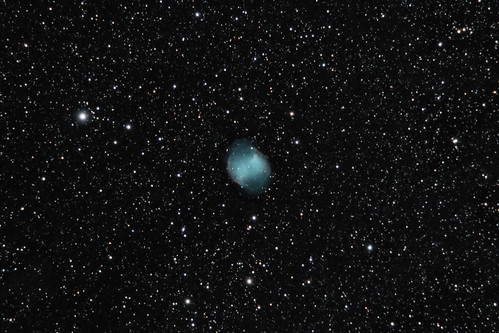
M27, The Dumbbell Nebula

M27, Dumbbell Nebula in Vulpecula
The "apple-core" took on a more boxy appearance at 240x. Distinct, sharp cut-off in brightness on one edge, and strong hints of structure within the nebula – most prominent being the diagonal bar commonly seen in photos like the one above.

M11, Wild Duck Cluster in Scutum
Not much I can add to the previous report. Just a fantastic cluster to look at in the XT10.

NGC 6712, globular cluster in Scutum
Stumbled upon this while sweeping south of M11. Fuzzy, circular blur at 50x, but starts to betray its true nature at higher magnification. Reminded me of M13 as seen in the smaller scope.

M15, globular cluster in Pegasus
Well resolved, very condensed core – more so than other globulars I’ve looked at. Definitely worth revisiting when it's higher in the sky. Nearby field stars really help frame this object at both 50x and 133x, giving it a 3D appearance.

NGC 7006, globular cluster in Delphinus
Small, circular blur. Relatively easy to see in the XT10, but no stars resolved.

NGC 7331, spiral galaxy in Pegasus
This galaxy displays a bright core nestled in a fainter disc, very much a mini M31. Suggestion of asymmetry on one side. Couldn’t see the companion galaxies (the “tadpoles”) on this occasion, but I think they should be visible on a darker night with higher magnification. (Ditto for Stephan’s Quintet.)

NGC 7662 (Blue Snowball), PN in Andromeda
I find it hard to distinguish between blue and green in low light, but this definitely has a bluish turquoise hue compared to, say, the grey-green of M57. Appeared circular at 133x, with a hint of a darker core.

Almach (Gamma Andromedae), double star
Lovely pairing of a pale yellow primary and a sky-blue secondary. (Looking back at the notes I made with the 4-inch, I've previously described the colours as straw and aquamarine.)

Tiredness was really starting to creep in at this point (and dew was forming), so subsequent observations fall into the “just one more object” category.

M52, open cluster in Cassiopeia
Rich cluster, worth revisiting in the autumn.

M31, Andromeda Galaxy
Showing a frustrating lack of detail despite its brightness. Obviously, higher altitude and darker skies should improve things, but perhaps higher magnification might increase the contrast at the expense of the “big picture”.

M33, Triangulum Galaxy
Large circular blur devoid of any real detail, but at least it was obvious (unlike in the 4-inch) despite being fairly low in the sky. Averted vision showed a distinct, almost star-like condensation at the nucleus – not something I recall seeing before.

Finished off with a first look at Mars through the XT10. As big as I’ve ever seen it (and ever likely to see it), but rendered featureless by the global dust-storm. Hint of a brightening at the poles, but low altitude causing a lot of colour dispersion. Even to the naked eye it looks pale yellow rather than its usual amber hue.