Showing posts with label veil nebula. Show all posts

Wednesday, 27 October 2021

The Bubble and the Veil

10 September 2021, 21:30 – 22:15 (BST)


Seeing: Average
Transparency: Average

Conditions: Cooler than the last couple of sessions (though still mild for the time of year), with a gusty wind. Cloud joining up from the west and the northeast, eventually putting an end to the session at 22:15. But the 45 minutes I did get were pretty good.

Czernik 43, open cluster, Cassiopeia
133x. About time I took some notes on this cluster given the number of times I’ve had it in the field of view. Loose, sparse cluster – hard to distinguish from the rich background of Milky Way stars. The view is currently livened up by the presence of Nova Cas 2021 right next to it.

NGC 7635, Bubble Nebula, Cassiopeia
50x + OIII filter. Seemed more “obvious” with this magnification/filter combination, but hard to define any shape on this occasion. Seemed larger too (paradoxically); perhaps I was detecting traces of the surrounding nebulosity. The clouds forced me away before I could try other combinations.

Veil Nebula, SNR, Cygnus
50x + OIII filter. Looked spectacular tonight before the clouds got in the way. The three brightest components were showing up well.

M27, planetary nebula, Vulpecula
50x + OIII filter. Very bright with this eyepiece/filter combination, but hard to make out much detail. The “spinning coin” effect seemed quite pronounced at this magnification.

The clouds were pushing in from all sides by this point, but a gap had cleared over Cygnus, allowing a quick return trip to the Veil before the sky was completely covered.

Veil Nebula, SNR, Cygnus
50x + OIII filter. Quick notes to add to previous observations. The spike of the Witch’s Broom had brighter edges with averted vision. Fleming’s Triangular Wisp is very long – starts farther north than I had previously realised. Couldn’t see any of the other, fainter sections, but I didn’t really have enough time to properly look for them.

Thursday, 24 October 2019

A Veil, a Snowball and a Bubble

26 August 2019, 22:00 – 23:30 BST


After the success of the previous night’s imaging session, it seemed only fair that I should photograph the other (eastern) half of the Veil Nebula, though without the benefit of a naked eye star (52 Cyg) to use as a target it took a little longer to get it centred.

Conditions: another warm night, slight haze affecting the transparency.

M71, globular cluster, Sagitta
Rich, filmy mass of stars in an already rich section of the Milky Way. More condensed than M11, but lacking the density of more typical globulars.

Albireo, Cygnus
Lovely double star; golden primary, pale blue secondary. (There isn’t really anything new I can say about Albireo, but I keep coming back to it.)

NGC 6819, open cluster, Cygnus
Cluster with a hat-shaped outline. Member stars not particularly bright. Central gap. Resides in a rich Milky Way field.

NGC 6866, open cluster, Cygnus
Another Cygnus cluster - like a larger, looser version of 6819.

Veil Nebula, supernova remnant, Cygnus
A comparison (at 50x) of the Ultrablock and the OIII filter. While both filters do an excellent job on this nebula, it was clear that the OIII provided a much darker background, thus making the nebula itself seem brighter. This also made it easier to see the overall shape of the two arcs and some of their internal structure, as well as the much fainter Pickering/Fleming’s Triangle. When I switched back to the Ultrablock, the triangle was just about visible, but I probably wouldn’t have noticed it if I hadn’t already seen it with the OIII.

Veil Nebula (West)

Another thing I noticed with the OIII was that the area inside the loop seemed brighter than outside (particularly on the eastern side). This might be an illusion (long exposure images show that the visible nebulosity is confined to discrete sections), but the photos I took seem to hint at a greater star density inside the Veil. (Is the shockwave clearing away the interstellar medium, creating a window in that part of the Milky Way?)

Veil Nebula (East)


NGC 7662, The Blue Snowball, Andromeda
Tough to find on this occasion for some reason. Otherwise as before, blue-green colour.

NGC 7331, spiral galaxy, Andromeda
Streak of light, no sign of the companion galaxies (the “fleas”), but not surprising given the less than optimal transparency.

NGC 281, emission nebula, Cassiopeia
I needed the OIII filter to see it (at 50x), but once I did the overall comma shape stood out well, with a suggestion of dark inlets cutting into the nebula.

NGC 7635, Bubble Nebula, Cassiopeia
With the OIII filter still in place, I pushed the telescope past M52, not really expecting to see anything, but the nebula stood out surprisingly well. Not so much a bubble as a little crescent-moon shaped patch of nebulosity. I swapped out the 24mm Panoptic for the 9mm Nagler (minus the filter), but the nebula was no longer visible.

I rounded off the evening with a quick look at two old favourites in Cassiopeia: M52 (a rich little cluster) and NGC 7789 (a rich large cluster with faint stars arranged in clumps).

Nature note
While I was taking a test shot of the Veil I heard a “clonk” from the XT10. Upon investigating with a red-light torch, I discovered that a large pale frog had hopped onto the base underneath the main mirror. It took some persuading to vacate its temporary home, but I eventually sent it safely on its way. Still, at least it blundered into that scope rather than the one taking long exposures.

Sunday, 6 October 2019

The Veil in OIII

22 August 2019, 21:45 – 23:00 BST

The first clear, moonless night this side of the solstice and the transparency was unusually good for the time of year.

The seeing wasn’t nearly as good, so the best views of Saturn came only fleetingly at 240x, with the Cassini Division, the planet’s shadow across the rings, and the subtle banding on the planet itself all on display. The moons showed up well at 133x, with Titan, Rhea, Tethys and Dione clearly visible.

M11, Wild Duck Cluster, Scutum
A quick look at one of my favourite clusters, although the fainter stars were a little bit washed out by light pollution. But this was just a warm-up to get my eyes back in deep-sky mode as I prepared for the main target of the evening…

Veil Nebula, supernova remnant, Cygnus
Ever since I got it I’ve been itching to use the Astronomik OIII filter on the Veil and I wasn’t disappointed. At 50x (Panoptic 24mm), the nebula was bright and distinct and very large, showing lots of fine detail in both arcs. The sinuous “spike” of the Western Veil (NGC 6960) was clearly brighter along its edges, and the Eastern Veil (NGC 6992/5) showed faint “talon-like” extensions (IC 1340) from its southern end. I also saw a portion of Pickering/Fleming’s Triangle (Simeis 3-188) for the first time, visible directly as a faint wisp of light, becoming brighter and more extended with averted vision. Overall, the Veil had a wraith-like appearance, quite unlike anything else I’ve seen in the night sky. I’ve written before about the differences between planetary nebulae and emission nebulae as being akin to smoke and mist, but this was something else entirely, like a windblown cloud or vapour trail, frozen in space.

Other notes:
As I was packing up I saw a single late Perseid flashing through Pegasus.

Tuesday, 14 May 2019

Double Stars and Double Clusters

16 September 2018, 22:00 – 00:00 BST


First quarter moon adding to the light pollution in the south-west, but at least the seeing was good.

M15, globular cluster in Pegasus
Examined at all three available magnifications. The sky background was too bright to resolve stars at 50x; there was an improvement at 133x, but on this occasion the best view came at 240x – pleasing contrast, lots of faint stars resolved.

Veil Nebula, supernova remnant in Cygnus
Hindered a little bit by moonlight, but with the Ultrablock to filter most of it out, plenty of detail still visible. The nebula had a winding, braided structure. Brightness held up well at 133x with the two main arcs extending across several fields of view. Pickering’s Triangle suspected, but not confirmed – if so, it was right on the threshold of visibility.

A quick tour of the open clusters in northern Lacerta was a little disappointing. The sky was too bright to do justice to the 24mm Panoptic, and at 133x the field of view was too small to properly frame the clusters. For the most part, they just looked like sparse associations of bright stars.

A similar tour of the Cassiopeia clusters at 50x fared better due to the richer clusters and the darker background in that part of the sky. An intermediate magnification might help with some of these NGC clusters.

Eta Cassiopeiae, double star 
Looked very nice at 133x, with the secondary appearing to have an unusual purple hue.

Double Cluster in Perseus
The red giant stars stood out more at 133x, but the two clusters lose some of their impact at this magnification. However, higher magnifications might be useful for separating close pairs and picking out fainter cluster members at 240x.

The following observations were all carried out with the Ultrablock filter.

M76, planetary nebula in Perseus
Holds brightness very well all the way up to 240x. Bi-lobed, boxy shape, with the brighter lobe appearing almost rectangular. No colour apparent. Prolonged examination suggested one or two knots/condensations within the brighter lobe.

NGC 404 (Mirach’s Ghost), galaxy in Andromeda
Only a quick look, but this little galaxy showed up surprisingly well. It seemed the Ultrablock dimmed the glare from Mirach more than it dimmed 404, but I’ll have to try this again without the filter to verify.

NGC 604, emission nebula in M33, Triangulum Galaxy
Perhaps it stood out a little more through the filter, but the difference seemed marginal at best.

NGC 1491, emission nebula in Perseus
I actually meant to look for a different nebula, but this one stood out surprisingly well as an extended misty patch with a single reasonably bright star offset from the centre. Suggestion of mottled structure at higher magnification. Faded smoothly into the background sky, unlike some of the nebulae I’ve been looking at recently.

Wednesday, 27 March 2019

Summer Clusters and Nebulae

14 -15 July 2018, 23:00 – 02:00 BST


A very clear night, if not completely dark; good enough to see 5th magnitude stars after dark-eye adaption, and the Scutum star-cloud with averted vision (although the latter seems to be more affected by light pollution than ever).

Saturn looked very impressive when I first pointed the telescope at it, with the usual moons in attendance and the Cassini Division visible most of the way around, but the seeing deteriorated rapidly as it passed the meridian. (Possibly due to warm air rising off the pond and the surrounding concrete.)

M39, open cluster in Cygnus
A sparse cluster of bright stars, spilling outside the edge of field of view even at 50x. Too loose and large for a big reflector; I wasn’t even sure I was looking at a cluster at first.

NGC 7062, open cluster in Cygnus
A grainy, fuzzy patch of nebulosity at 50x; starts to resolve at 133x. Faint stars.

NGC 6910, open cluster in Cygnus
A grouping of bright stars arranged in a kind of flattened Y-shape. Not rich, but well-framed at 50x. Quite pretty; would probably have greater appeal if it didn’t already reside in such a rich section of the Milky Way.

M29, open cluster in Cygnus
Boxy, like a mini version of the Pleiades. The extra aperture doesn't really add anything to this cluster that I hadn't already seen through the 4-inch.

NGC 7000, North America Nebula in Cygnus
Scanned region with Ultrablock, but too large for fov. Could tell that some areas were brighter than others but hard to distinguish nebulosity from the sheer number of background stars.

NGC 6888, Crescent Nebula in Cygnus
I spent a lot of time looking for this with the 4-inch and never convinced myself of seeing it, but I found it right away with the XT10 (Panoptic 24 mm + Ultrablock). Appeared as an elongated semi-circle of stars connected by bright streaks of nebulosity. Closer examination showed a faint haze filling the interior of the crescent, giving the impression of a baby wrapped in swaddling clothes, with a darker region where the face would be.

I left the Pan 24 and the Ultrablock in place and moved down to 52 Cygni and the Veil Nebula, supernova remnant in Cygnus: now high overhead and even more vivid than the previous sighting. The Witch’s Broom still looked like a frozen funnel cloud, a twisted spike of nebulosity extending beyond 2 fovs. The Eastern Veil showed more detail; both halves are very clearly “structured” nebulae, in that they have clearly defined edges as opposed to the more typical cloudy nebulae which just fade gently into the background sky.

M57, Ring Nebula in Lyra
Studied at 240x, with and without the Ultrablock filter. Holds its brightness well at high magnification in the XT10. Otherwise as per previous description. Slight green-grey colour.

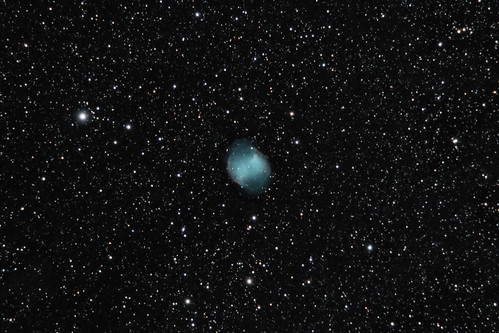
M27, The Dumbbell Nebula

M27, Dumbbell Nebula in Vulpecula
The "apple-core" took on a more boxy appearance at 240x. Distinct, sharp cut-off in brightness on one edge, and strong hints of structure within the nebula – most prominent being the diagonal bar commonly seen in photos like the one above.

M11, Wild Duck Cluster in Scutum
Not much I can add to the previous report. Just a fantastic cluster to look at in the XT10.

NGC 6712, globular cluster in Scutum
Stumbled upon this while sweeping south of M11. Fuzzy, circular blur at 50x, but starts to betray its true nature at higher magnification. Reminded me of M13 as seen in the smaller scope.

M15, globular cluster in Pegasus
Well resolved, very condensed core – more so than other globulars I’ve looked at. Definitely worth revisiting when it's higher in the sky. Nearby field stars really help frame this object at both 50x and 133x, giving it a 3D appearance.

NGC 7006, globular cluster in Delphinus
Small, circular blur. Relatively easy to see in the XT10, but no stars resolved.

NGC 7331, spiral galaxy in Pegasus
This galaxy displays a bright core nestled in a fainter disc, very much a mini M31. Suggestion of asymmetry on one side. Couldn’t see the companion galaxies (the “tadpoles”) on this occasion, but I think they should be visible on a darker night with higher magnification. (Ditto for Stephan’s Quintet.)

NGC 7662 (Blue Snowball), PN in Andromeda
I find it hard to distinguish between blue and green in low light, but this definitely has a bluish turquoise hue compared to, say, the grey-green of M57. Appeared circular at 133x, with a hint of a darker core.

Almach (Gamma Andromedae), double star
Lovely pairing of a pale yellow primary and a sky-blue secondary. (Looking back at the notes I made with the 4-inch, I've previously described the colours as straw and aquamarine.)

Tiredness was really starting to creep in at this point (and dew was forming), so subsequent observations fall into the “just one more object” category.

M52, open cluster in Cassiopeia
Rich cluster, worth revisiting in the autumn.

M31, Andromeda Galaxy
Showing a frustrating lack of detail despite its brightness. Obviously, higher altitude and darker skies should improve things, but perhaps higher magnification might increase the contrast at the expense of the “big picture”.

M33, Triangulum Galaxy
Large circular blur devoid of any real detail, but at least it was obvious (unlike in the 4-inch) despite being fairly low in the sky. Averted vision showed a distinct, almost star-like condensation at the nucleus – not something I recall seeing before.

Finished off with a first look at Mars through the XT10. As big as I’ve ever seen it (and ever likely to see it), but rendered featureless by the global dust-storm. Hint of a brightening at the poles, but low altitude causing a lot of colour dispersion. Even to the naked eye it looks pale yellow rather than its usual amber hue.